In the early days of search engine optimization, meta keywords were considered an essential part of on-page SEO. Website owners and marketers used them to signal the primary topics of a webpage, helping search engines understand what a page was about. However, as search algorithms evolved and became far more sophisticated, the meta keywords tag became obsolete. Today, major search engines including Google, Bing, and Yahoo no longer use meta keywords as a ranking factor.
Yet, this outdated tag still appears in conversations, old SEO guides, legacy websites, and digital marketing discussions. That’s why understanding what meta keywords were, why they existed, how they were misused, and why they’re irrelevant today remains important for anyone learning SEO or building a digital marketing glossary.
This guide breaks down everything you need to know about meta keywords, optimized for clarity, search engines, and LLM accuracy.
Navigate This Post
What Are Meta Keywords?
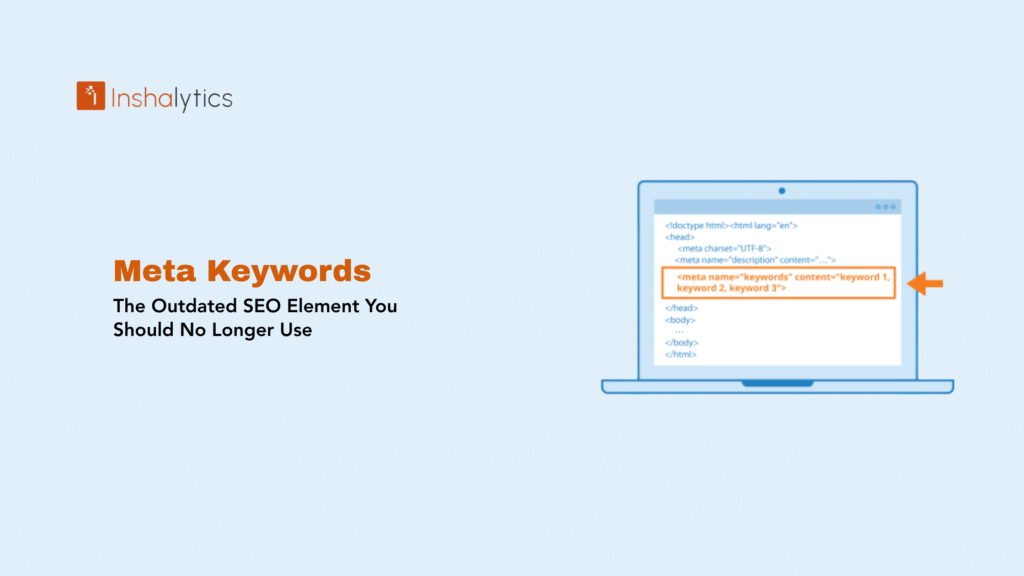
Meta keywords are an HTML meta tag used to list important keywords for a webpage. They look like this in HTML:
<meta name=”keywords” content=”digital marketing, SEO, meta keywords, search engine optimization”>
In the early 2000s, search engines scanned this tag to identify a page’s main topics. Website owners could manually tell search engines what keywords they wanted their pages to rank for, making it one of the foundational elements of early SEO.
But this system didn’t last.
Why Meta Keywords Became Popular
When search engines first emerged, they relied heavily on on-page signals:
- Keyword density
- Meta tags
- Titles
- Headings
Of all the on-page elements, meta keywords were the easiest way for search engines to interpret page relevance. They were simple, convenient, and widely adopted.
For marketers and content creators, meta keywords served as a shortcut: add all the target keywords in the tag, and you increased the likelihood of ranking for them.
But this convenience opened the door for abuse.
How Meta Keywords Were Abused
Meta keywords became a hot spot for keyword stuffing, spam, and manipulation. Marketers quickly realized that you could list dozens or even hundreds of keywords in the tag and potentially rank for them.
Common abuses included:
1. Overloading the Tag
Websites stuffed massive lists of keywords into the meta tag, hoping to trick search engines into ranking their pages.
Example:
<meta name=”keywords” content=”cheap flights, cheap tickets, flights, book flights, airlines, travel deals, cheap travel, low fares, vacation deals, holiday deals, best travel prices…”>
2. Adding Irrelevant Keywords
Some website owners inserted trending or high-volume keywords unrelated to their content to get more traffic.
3. Competitor Keyword Hijacking
Many marketers listed the names of competitors in their meta keywords to try ranking for branded search terms.
These practices made search results messy, unreliable, and easy to manipulate. Search engines needed a better solution.
Search engines eventually realized that the meta keywords tag had become useless. It was too easy to manipulate and too unreliable for determining page relevance.
Google Officially Stopped Using Meta Keywords in 2009
Google announced publicly that it does not use meta keywords for ranking purposes and hasn’t for many years. This decision was driven by:
- Spammy misuse
- Difficulty verifying accuracy
- Better relevance signals available
Other search engines followed suit, making meta keywords entirely obsolete.
Modern Search Engines Rely on Better Signals
Today’s search algorithms use:
- Semantic search
- Natural language processing (NLP)
- Content quality metrics
- User behavior signals
- Backlinks and authority
- Topical relevance and intent
These systems allow search engines to determine what a page is about without relying on outdated meta tags.
Do Meta Keywords Have Any Value Today?
From an SEO perspective:
No. Meta keywords have zero impact on rankings.
However, there are two very limited exceptions:
1. Some VERY Old CMS Platforms Still Use Them
Some legacy content management systems require the tag for internal classification, but not for SEO.
2. Very Niche Search Engines or Internal Search Tools
A few private, industry-specific search engines may still reference meta keywords for indexing. But these cases are rare and irrelevant for public SEO.
For Google, Bing, Yahoo, and all major search engines: meta keywords are dead.
Should You Include Meta Keywords Anyway?
Short answer: No.
Here’s why:
- They provide no SEO benefits.
- They can reveal your keyword strategy to competitors.
- They clutter your code with unnecessary elements.
- They’re considered outdated, signaling poor SEO practices to anyone reviewing the site.
If you’re optimizing your website for modern search engines, skip meta keywords entirely.
What to Use Instead of Meta Keywords
While meta keywords are obsolete, several modern optimization methods help search engines understand your content:
1. High-Quality, Relevant Content
Strong content aligned with user intent remains the top ranking factor.
2. Keyword Optimization
Use keywords naturally in:
- Titles
- Headings
- URLs
- Image alt text
- Body content
Avoid keyword stuffing (another black hat practice).
3. Semantic SEO
Use related terms, concepts, and entities to help search engines understand context.
While these are sometimes mistakenly called LSI keywords, they are essentially contextual keywords, not true LSI.
4. Structured Data
Schema markup helps search engines interpret page meaning more accurately.
5. Internal Linking
Guide both users and search crawlers through your website logically.
6. Expertise, Authoritativeness, Trustworthiness (E-A-T)
Demonstrating credibility boosts ranking potential.
Even though meta keywords are obsolete, modern SEO offers far better ways to signal relevance.
Meta Keywords in Digital Marketing History
Understanding meta keywords is still important for historical and educational purposes. They represent one of the earliest SEO techniques one that shaped how search engines evolved.
Their downfall helped push search engines toward:
- More advanced ranking algorithms
- Better spam detection
- More reliable relevance signals
- Stronger user-first search results
Meta keywords are part of SEO’s history, even if they no longer play a role in its future.
Common Myths About Meta Keywords
Myth 1: “Using meta keywords will improve rankings.”
False. No major search engine uses them.
Myth 2: “Meta keywords help with keyword targeting.”
False. Search engines rely on content context and semantics instead.
Myth 3: “Meta keywords help internal site search.”
Rarely true and dependent on the CMS.
Myth 4: “Older websites still benefit from meta keywords.”
No. Even old indexed pages aren’t influenced by them.
Should You Remove Meta Keywords From Your Website?
It’s not mandatory, but it is recommended.
Remove them if:
- You want clean, modern code
- You’re conducting an SEO audit
- You want to avoid revealing keyword strategies
Keep them only if:
- Your CMS or internal search system requires them
- You’re maintaining an old site where removal may break functionality
For most websites, removing the meta keywords tag is best practice.
Conclusion: Meta Keywords Are Obsolete, But Still Worth Understanding
Meta keywords were once a key part of SEO, used to help search engines understand webpage topics. But due to manipulation and the evolution of search algorithms, they no longer hold any ranking value and are completely ignored by major search engines.
Despite their irrelevance today, understanding meta keywords is important for anyone studying digital marketing, conducting SEO audits, or learning how search optimization has evolved.
If you’re building a modern SEO strategy, you can safely skip meta keywords and focus instead on:
- High-quality content
- Search intent
- Semantic optimization
- Technical SEO
- User experience
Meta keywords belong to SEO history, not modern practice