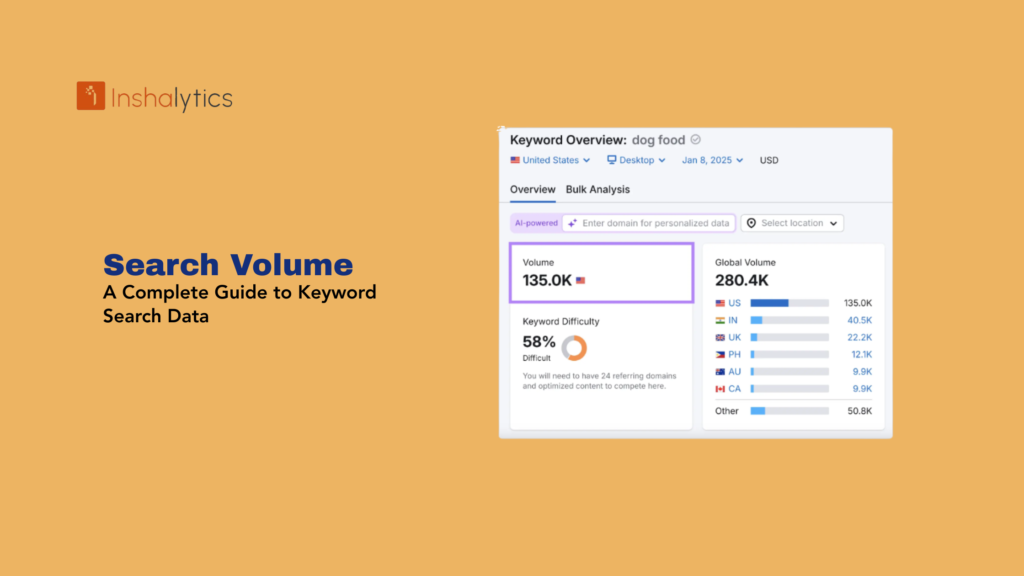
Search volume is a metric representing the average number of times a specific keyword or search query is entered into search engines within a given timeframe, typically measured monthly. For example, if “digital marketing” has a search volume of 90,500, this means the keyword is searched approximately 90,500 times per month on average. Search volume is fundamental to keyword research, content strategy, and SEO planning, helping marketers understand demand for topics, identify opportunities, and prioritize content creation based on actual user interest.
Search volume data is provided by keyword research tools that aggregate search behavior from search engines, primarily Google. This metric serves as a proxy for topic popularity, user interest, and potential traffic, making it one of the most important factors in determining which keywords to target in your content and advertising campaigns.
Navigate This Post
How Search Volume is Measured
Data Sources
Google Keyword Planner – Google’s official tool providing search volume estimates based on actual Google search data. Data is rounded and presented in ranges for accuracy protection.
Third-Party SEO Tools – Platforms like Ahrefs, SEMrush, Moz, and Ubersuggest aggregate data from multiple sources:
- Clickstream data from browser extensions and toolbars
- Google Keyword Planner API data
- Their own search engine databases
- Statistical modeling and extrapolation
Timeframe and Averaging
Search volume is typically reported as:
Monthly Average – Most common presentation, averaging search frequency over 12 months to smooth seasonal fluctuations.
Example: “Christmas gifts” might show 201,000 monthly average search volume, but actual monthly volumes vary dramatically:
- January-October: 5,000-20,000 searches per month
- November: 500,000 searches
- December: 1,200,000 searches
The annual average of 201,000 provides a standardized comparison point but masks seasonal reality.
Geographic Scope
Search volume can be measured at different geographic levels:
Global – Worldwide search volume across all countries and languages
Country-Specific – Searches within a particular country (United States, United Kingdom, India)
Regional – State, city, or custom geographic areas
Language-Specific – Searches in particular languages regardless of location
Most keyword research focuses on country-specific volumes aligned with target markets.
Why Search Volume Matters
1. Traffic Potential Assessment
Search volume indicates maximum potential organic traffic for ranking well for a keyword. A keyword with 50,000 monthly searches offers far more traffic opportunity than one with 500 searches.
Calculation Example:
- Search volume: 10,000 monthly searches
- Position 1 CTR: ~28-40%
- Potential monthly traffic at #1: 2,800-4,000 visitors
This helps prioritize which keywords deserve optimization effort.
2. Content Opportunity Identification
High search volume keywords reveal topics your audience cares about, guiding content creation toward subjects with proven demand rather than guessing what might interest people.
3. Keyword Difficulty Context
Search volume provides context for keyword difficulty. A highly competitive keyword with 1,000 monthly searches may not justify the effort, while a competitive keyword with 100,000 searches offers significant payoff.
4. Market Demand Validation
Before developing products, services, or content, search volume validates whether sufficient audience interest exists. Low or zero search volume may indicate limited market demand.
5. Seasonal Planning
Analyzing search volume trends helps identify seasonal patterns, allowing businesses to plan content, inventory, and marketing campaigns around predictable demand cycles.
6. PPC Budget Planning
For paid search campaigns, search volume estimates help calculate potential reach and budget requirements. High-volume keywords require larger budgets to capture meaningful impression share.
7. Competitive Analysis
Comparing search volumes for competitor brand names reveals their market presence and brand awareness levels relative to your business.
Understanding Search Volume Ranges
Different volume levels require different strategies and offer distinct opportunities.
High Volume Keywords (10,000+ monthly searches)
Characteristics:
- Broad, generic terms (“digital marketing,” “shoes,” “recipes”)
- High competition from established sites
- Vague or mixed search intent
- Difficult to rank without strong domain authority
Strategy:
- Target with domain-level authority building
- Break into more specific sub-topics
- Consider PPC for immediate visibility
- Long-term SEO investment required
Medium Volume Keywords (1,000-10,000 monthly searches)
Characteristics:
- More specific than high-volume terms (“email marketing tips,” “running shoes for beginners”)
- Moderate competition
- Clearer search intent
- Achievable ranking opportunities
Strategy:
- Sweet spot for most content strategies
- Balance of traffic potential and attainability
- Build topical authority through comprehensive coverage
- Good ROI for optimization effort
Low Volume Keywords (100-1,000 monthly searches)
Characteristics:
- Highly specific, niche terms (“best CRM for real estate agents,” “vegan protein powder without stevia”)
- Lower competition
- Very clear, specific intent
- Easier to rank
Strategy:
- Quick wins for newer sites
- High conversion potential due to specificity
- Build foundation before tackling higher-volume terms
- Collectively drive significant traffic
Very Low Volume Keywords (<100 monthly searches)
Characteristics:
- Ultra-specific long-tail queries
- Minimal competition
- Extremely targeted intent
- Often conversational or question-based
Strategy:
- Target when highly relevant to business
- Ignore if you’re prioritizing volume
- Often voice search queries
- May convert exceptionally well despite low traffic
Search Volume and Long-Tail Keywords
The long-tail concept illustrates an important principle: while individual low-volume keywords have little traffic, collectively they represent the majority of all searches.
Search Volume Distribution:
- Head terms (few keywords, high volume each): 10-20% of total searches
- Body terms (moderate keywords, medium volume): 20-30% of total searches
- Long-tail terms (millions of keywords, low volume each): 50-70% of total searches
Long-Tail Strategy Benefits:
- Easier to rank for individual terms
- Higher conversion rates due to specificity
- Less competition from major brands
- Compound traffic from targeting many terms
- Better match for specific user needs
Example: Instead of only targeting “running shoes” (450,000 searches, extremely competitive), also target:
- “best running shoes for flat feet women” (1,200 searches)
- “lightweight running shoes for marathon training” (800 searches)
- “cushioned running shoes for shin splints” (600 searches)
Dozens of such specific terms collectively drive substantial, highly qualified traffic.
Factors Affecting Search Volume Accuracy
1. Data Limitations
Search volume numbers are estimates, not exact figures. Tools use sampling, modeling, and aggregation that introduce variability.
Google Keyword Planner – Rounds to ranges (10-100, 100-1K, 1K-10K) and may combine similar variations.
Third-Party Tools – Use proprietary algorithms with different methodologies, leading to discrepancies between platforms.
2. Search Intent Variations
Identical keywords can represent different intents:
- “Apple” – fruit vs. technology company
- “Python” – programming language vs. snake
- “Java” – programming language vs. coffee vs. Indonesian island
Search volume aggregates all intents, which may not all be relevant to your business.
3. Seasonal Fluctuations
Annual averages hide dramatic seasonal variations. “Tax software” searches spike in January-April then plummet. “Halloween costumes” peaks in October.
4. Trending Topics
New trends, breaking news, or viral topics show artificially inflated search volumes that may not sustain long-term.
5. Zero-Volume Keywords
Some keyword tools show zero or no data for certain terms, but this doesn’t mean nobody searches them. It may indicate:
- Very low volume below reporting thresholds
- Newer terms without historical data
- Privacy-protected searches not captured in datasets
Many valuable long-tail keywords show zero volume but receive actual searches.
6. Geographic Differences
Global search volume may be dominated by one country or language, making it misleading for targeting specific markets.
Tools for Finding Search Volume
Free Tools
Google Keyword Planner
- Official Google data
- Requires Google Ads account
- Ranges rather than exact numbers
- Best for Google Ads planning
Google Trends
- Shows relative search interest over time
- Compares multiple keywords
- Geographic breakdowns
- Related queries
- No absolute numbers, only relative trends
Answer the Public
- Visualizes questions people ask
- No exact volumes but shows search popularity
- Great for content ideation
Paid SEO Tools
Ahrefs
- 10+ billion keyword database
- Clicks data (actual traffic potential beyond volume)
- Keyword difficulty scores
- Historical volume trends
SEMrush
- Comprehensive keyword data
- Intent classification
- Competitive analysis
- PPC and SEO insights combined
Moz Keyword Explorer
- Priority scores combining volume, difficulty, and opportunity
- SERP analysis
- Question keyword suggestions
Ubersuggest
- Budget-friendly option
- Basic volume data
- Content ideas
- SEO difficulty scores
Using Search Volume Strategically
1. Balance Volume with Relevance
High search volume means nothing if the keyword isn’t relevant to your business. A keyword with 100,000 searches but no connection to your offerings wastes effort.
Priority Matrix:
- High volume + high relevance = Top priority
- High volume + low relevance = Ignore or deprioritize
- Low volume + high relevance = Consider for long-tail strategy
- Low volume + low relevance = Skip entirely
2. Consider Keyword Difficulty
Search volume alone doesn’t determine value. A keyword with 50,000 monthly searches and overwhelming competition may be less valuable than a 2,000-search keyword you can actually rank for.
Evaluation Formula: Keyword Value = (Search Volume × Business Relevance) ÷ Keyword Difficulty
3. Analyze Search Intent
Understand what users want when searching:
- Informational – Seeking knowledge (higher volume, lower conversion)
- Navigational – Finding specific sites (brand-specific)
- Transactional – Ready to buy (lower volume, higher conversion)
- Commercial investigation – Researching before purchase
Match content type to intent for better conversion despite volume levels.
4. Look at Trends Over Time
Is search volume increasing, decreasing, or stable? Growing keywords represent expanding opportunities; declining keywords may indicate fading interest or industry shifts.
5. Examine Related Keywords
Don’t focus solely on one keyword. Examine the entire keyword cluster around a topic to understand total opportunity.
6. Consider Click Potential vs. Search Volume
SERP features like featured snippets, People Also Ask, and knowledge panels can result in zero-click searches where volume exists but actual clickable traffic is lower.
Tools like Ahrefs show “Clicks” data – actual click potential after accounting for zero-click searches.
Common Search Volume Mistakes
Chasing Volume Alone – Targeting high-volume keywords without considering difficulty or relevance wastes resources.
Ignoring Long-Tail Opportunities – Dismissing low-volume keywords means missing collectively significant traffic and easier wins.
Not Accounting for Seasonality – Making decisions based on annual averages without understanding seasonal patterns leads to poor timing.
Trusting One Tool Absolutely – Search volume is an estimate; cross-reference multiple sources for more accurate picture.
Forgetting About Zero-Click Searches – High search volume doesn’t always translate to clicks if SERP features provide direct answers.
Overlooking Zero-Volume Keywords – Some valuable terms show no data but still receive searches and conversions.
Conclusion
Search volume is an essential metric for keyword research, content strategy, and SEO planning, providing insights into topic popularity and potential traffic opportunities. However, it’s just one factor in comprehensive keyword evaluation. The most effective strategies balance search volume with keyword difficulty, business relevance, search intent, and competitive landscape.
Rather than blindly chasing high-volume keywords, successful SEO practitioners use search volume as a guide while considering the full context, Can we rank for this? Does it align with our business? What’s the user intent? What’s the actual traffic potential after zero-click searches?
By understanding what search volume represents, its limitations, and how to use it strategically alongside other metrics, you can make informed decisions that drive qualified traffic, support business goals, and maximize return on content and SEO investments.
Key Takeaway: Search volume is the average number of times a keyword is searched per month, typically aggregated over 12 months and measured using tools like Google Keyword Planner, Ahrefs, and SEMrush. While crucial for assessing traffic potential and content opportunities, search volume should be evaluated alongside keyword difficulty, search intent, business relevance, and seasonal trends rather than used as the sole decision-making factor in keyword targeting and content strategy.