Every HVAC contractor knows the shoulder season dread. April and October roll around, the weather turns mild, and your phone goes quiet. Your techs have time on their hands. Your dispatch board thins out. Your revenue dips while your payroll stays flat.
You saw it coming. You see it coming every single year. And yet it still catches you off guard.
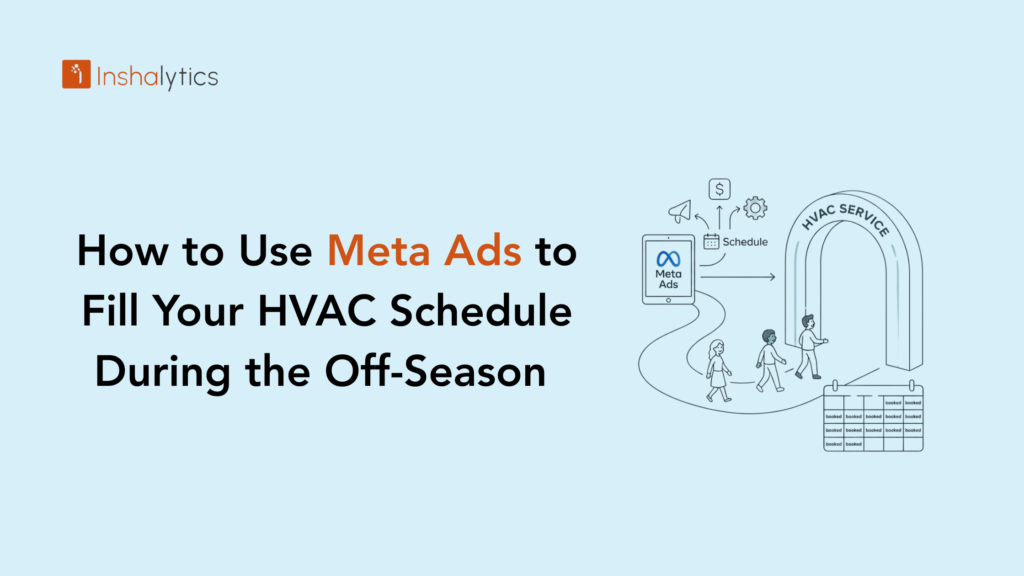
Here’s the hard truth most HVAC contractors refuse to accept: the off-season isn’t inevitable. It’s a demand-generation problem, not a demand problem. Homeowners still have aging systems, dirty ducts, and comfort concerns during shoulder seasons, but they just aren’t searching Google for emergency repairs because nothing’s broken yet. Meta ads are the most effective channel for reaching them before they need you.
This playbook walks through exactly how to build Meta campaigns that fill your spring and fall schedules, the offers that convert, and the campaign structure that turns scrolling homeowners into booked appointments.
The Off-Season Problem Every HVAC Contractor Sees Coming (and Still Gets Caught By)
Most HVAC contractors respond to the shoulder season by cutting marketing spend. That’s exactly the wrong move, and it’s why your competitor who keeps marketing ends up eating your lunch when peak season returns.
Why Spring and Fall Feel Like a Ghost Town
Spring and fall feel slow because Google search volume for emergency services drops dramatically. Homeowners aren’t panicking about their AC or furnace when the weather’s 70 degrees. They’re also not actively shopping for maintenance because nothing’s prompting them to think about it. The result: your highest-intent lead source (search) dries up while latent demand still exists.
What Your Competitors Do Wrong (and Why It’s Your Opportunity)
Most HVAC contractors respond to the shoulder season by pulling back on ad spend. Google Ads budgets get slashed. SEO efforts stall. Marketing goes silent until summer saves them. This is exactly the wrong move, and it creates a massive opportunity for any contractor willing to keep marketing when competitors go quiet.
Meta ad inventory gets cheaper during shoulder seasons because big advertisers aren’t competing for attention. You pay less per impression, less per click, and less per lead than you would during peak.
The Revenue Math of a Full vs. Empty Shoulder Season
A six-truck HVAC company with techs producing $800/day each is missing $4,800 of daily revenue when the schedule’s empty. Over a six-week shoulder slump, that’s $200,000+ of unrealized revenue. Even a modest Meta ad investment of $3,000 over that window can generate enough maintenance, tune-up, and replacement leads to close most of that gap.
Why Meta Ads Are the Right Channel for HVAC Off-Season Demand Generation
Meta ads are uniquely suited for the shoulder season because they create demand rather than capture it.
Google Captures Demand Meta Creates It
During peak season, Google search volume spikes with homeowners actively searching for emergency repairs. Google Ads captures that demand beautifully. During shoulder seasons, that search volume drops because nothing’s broken. Meta ads create the demand Google can’t capture, planting the seed of “I should probably get my AC checked before summer” in a homeowner who wasn’t thinking about it.
Lower Ad Costs During Shoulder Season
Meta ad inventory prices fluctuate with overall advertiser demand. During e-commerce-heavy seasons (Q4, Black Friday), inventory gets expensive. During HVAC shoulder seasons (spring and fall), inventory is cheaper because most competition is elsewhere. You get more impressions and clicks for the same budget during the exact window you need them most.
Homeowners Aren’t Searching Yet, But They’re Still Scrolling
Homeowners scroll through Instagram and Facebook year-round. The shoulder season doesn’t slow their social media usage; it just changes what grabs their attention. A well-crafted maintenance reminder or seasonal offer can stop the scroll and produce a lead before the homeowner ever Googles anything.
How Do You Keep HVAC Leads Coming During the Slow Season?
To keep HVAC leads coming during the slow season, shift your marketing focus from emergency services to prevention-oriented offers like maintenance plans, seasonal tune-ups, and indoor air quality upgrades. Pair these with financing promotions for system replacements to capture homeowners considering planned upgrades. Meta ads are the most cost-effective channel for reaching these prospects during shoulder seasons.
Shift the Conversation From Emergencies to Prevention
When nothing’s broken, homeowners aren’t buying repairs. They are open to preventive maintenance that keeps their system running, tune-ups that lower summer bills, and inspections that avoid surprise failures. Reframe your marketing from “fix your broken HVAC” to “keep your HVAC from breaking.” Preventive messaging feels helpful rather than salesy, which is exactly what converts on Meta.
Promote Maintenance Plans and Pre-Season Tune-Ups
Maintenance plans are the gift that keeps giving recurring revenue that stabilizes shoulder season cash flow. A well-marketed maintenance plan campaign during spring recruits customers who stay on your rolls for years. Frame the offer around peace of mind and cost savings rather than “service calls.”
Pre-season tune-ups convert homeowners who know they should service their system but keep putting it off. A time-bound offer (“$79 AC tune-up, book by April 30”) creates urgency that breaks the procrastination.
Sell Indoor Air Quality Upgrades Year-Round
Indoor air quality products, such as UV lights, advanced filtration, and whole-home humidifiers, have no seasonal dependence. Homeowners care about air quality in spring just as much as in summer. IAQ offers work exceptionally well on Meta because the platform is uniquely suited to education, showing the problem (dirty coil, moldy duct) before selling the solution.
The HVAC Off-Season Campaign Structure That Actually Works
A proper Meta campaign structure pulls homeowners through a funnel rather than pitching cold audiences.
Cold-Audience Awareness Ads (Build the Funnel)
Cold-audience campaigns target homeowners who’ve never heard of your company. Educational content works best here, with videos explaining common HVAC problems, maintenance tips, and seasonal prep checklists. The goal isn’t immediate conversion. It’s building awareness and filling your retargeting pool with engaged prospects.
Budget: 40% of your shoulder season Meta spend expectation: Low immediate conversions, high audience building.
Mid-Funnel Lead Gen Ads (Capture Intent)
Mid-funnel campaigns target homeowners who’ve engaged with your content or visited your website. These audiences are warmer and respond to direct offers. Meta Lead Ads work beautifully here. Pre-filled forms reduce friction and boost conversion rates.
Budget: 35% of your shoulder season Meta spend expectation: Direct lead generation with reasonable cost-per-lead.
Retargeting Ads (Close the Loop)
Retargeting ads follow up with people who visited your website but didn’t convert, engaged with your ads but didn’t submit a form, or previously interacted with your content. Retargeting delivers the lowest cost-per-lead in most HVAC Meta accounts because these audiences are pre-qualified.
Budget: 25% of your shoulder season Meta spend. Expectation: Highest conversion rates and lowest CPL.
Off-Season Offers That Generate Bookings on Meta
Your offer matters more than your creative. A great offer with mediocre creative outperforms a perfect ad with a generic “free estimate.”
Early-Bird AC Tune-Up Specials (Published 60–90 Days Early)
“Beat the summer rush, book your AC tune-up by April 15 for $79 (regular $129).” Early-bird offers with specific pricing and deadlines convert significantly better than vague “save on tune-ups” messaging. Publish these campaigns 60–90 days before your peak summer demand to pre-book spring schedules.
Furnace Pre-Heating-Season Inspections
“Furnace inspection and tune-up, $89 book by September 30.” Same framework, different season. Fall campaigns should pre-book heating season appointments before the first cold snap creates a scheduling crunch. Homeowners who procrastinate through October become your emergency calls in November. Capture them in August and September instead.
Financing and Seasonal Payment Plans for System Replacements
“0% APR financing for 60 months on new system replacement offer ends March 31.” Financing offers convert homeowners who need new systems but have been putting them off due to sticker shock. Shoulder season financing campaigns smooth replacement revenue across the year instead of concentrating it in summer panic replacements.
Maintenance Agreement Promotions With Real Savings Math
“Join our Comfort Club: two tune-ups per year, 15% off repairs, priority scheduling, $18/month.” Maintenance agreements are the highest-lifetime-value customers in your business. Shoulder season campaigns targeting agreement sign-ups produce recurring revenue that insulates you from future shoulder seasons.
Creative and Ad Copy That Stops the Scroll in Off-Season
Shoulder season creative has to earn attention in a way that peak season creative doesn’t. Homeowners scrolling in March aren’t primed to think about HVAC; your creative has to make them care.
Raw, In-the-Field Technician Videos
A 30-second video of your lead technician explaining a common problem, “Your AC probably sounds a little different this year, and here’s why…” outperforms polished corporate content every time. Authenticity wins on Meta. Homeowners trust a technician with a real truck and real tools over a studio-produced ad.
Before-and-After Dirty Coil and Filter Content
Visual contrast stops scrolls. Photos or short videos showing a disgusting evaporator coil, a clogged air filter, or a corroded component before and after cleaning create immediate visceral reactions. Pair the visual with the health or cost implication (“This coil was inside a home breathing on the family for 8 years”), and you’ve got a scroll-stopper.
Local Landmark and Community Content That Builds Trust
Film your team at recognizable local locations, the courthouse, the local Little League field, and the downtown diner. Community-rooted content builds trust that generic “licensed and insured” messaging doesn’t. When homeowners see you’re genuinely local, the “let a stranger in my home” hesitation drops significantly.
How to Budget Meta Ads for the HVAC Off-Season
Budget planning for shoulder season Meta campaigns requires different math than peak season.
Starting Budget: $500–$1,500/month for Demand Generation
For HVAC companies new to Meta, a shoulder season starting budget of $500–$1,500/month covers one or two campaigns with enough volume to generate meaningful data. Expect 15–40 leads per month at this budget, depending on your offer strength and market.
Scaling Up: When to Push Toward $3,000–$5,000/month
Once you’ve identified a winning offer and creative combination, scale the budget to $3,000–$5,000/month across cold, warm, and retargeting audiences. At this budget, you’re filling enough of your shoulder season pipeline to make the investment obviously worth it.
Why Pulling Back in Shoulder Season Is Exactly the Wrong Move
Most HVAC contractors cut ad spend during the shoulder season to “preserve cash.” This is the biggest budget mistake in the industry. Cheaper inventory, less competition, and the opportunity to capture market share while competitors disappear make shoulder season the single most cost-efficient window to invest in marketing. Social media marketing during the off-season has outsized ROI.
How Inshalytics Keeps HVAC Schedules Full Year-Round With Integrated Meta Strategy
Shoulder season planning is the difference between HVAC companies that smooth revenue across the year and those that white-knuckle through spring and fall every single year.
Our 4-Season Meta Ad Framework
Every Inshalytics HVAC Meta strategy is built on a four-season framework: Spring pre-AC campaigns in February and March, summer retargeting and upsell campaigns, fall pre-furnace campaigns in August and September, and winter retention and maintenance plan campaigns. Campaigns launch 60–90 days before demand to give the algorithm time to optimize.
Connecting Meta Leads to Your CRM and Dispatch System
Meta leads cool faster than Google leads. Fast follow-up is critical. We integrate lead forms directly with your CRM, dispatch software, and automated text responses so new leads trigger action within 60 seconds of form submission. No leads sit in an inbox overnight.
Real Client Examples: Off-Season Revenue Recoveries
[CASE STUDY/TESTIMONIAL PLACEHOLDER] Our HVAC clients typically recover 40–70% of their shoulder season revenue gap through Meta-driven maintenance, tune-up, and replacement campaigns. The math: $3,000 in Meta ad spend producing $35,000+ in shoulder season bookings.
Build Your Off-Season Meta Ad Calendar Today
The worst time to start shoulder season marketing is the middle of the shoulder season. Planning is the entire ballgame.
The 60-Day Pre-Season Launch Window
Your spring campaigns should be live by late January. Your fall campaigns should be live by early August. The 60-day pre-season launch window gives Meta’s algorithm time to optimize, builds your retargeting audience before demand peaks, and gets offers in front of homeowners before they’re thinking about HVAC at all.
What to Prepare Before You Spend a Dollar
Before launching, you need:
- A specific, time-bound offer with clear pricing and deadlines
- Landing pages dedicated to each offer with phone prominence
- Call tracking installed and tested
- A response system that triggers within five minutes of lead submission
- Meta Pixel is installed on your website for retargeting
Without these foundations, you’re wasting budget on leads you can’t convert.
The shoulder season isn’t an unavoidable slump. It’s a demand-generation problem with a proven solution. HVAC companies that keep marketing when competitors disappear capture market share, fill their schedules, and smooth revenue across the year. Meta ads are the most cost-effective channel for executing that strategy when done with the right offers, structure, and follow-up systems. If you want a custom shoulder season Meta plan built for your specific market and services, Inshalytics runs HVAC Meta campaigns designed to keep your dispatch board full year-round. Book a consultation, and let’s map out your next 90 days before the slow season catches you again.