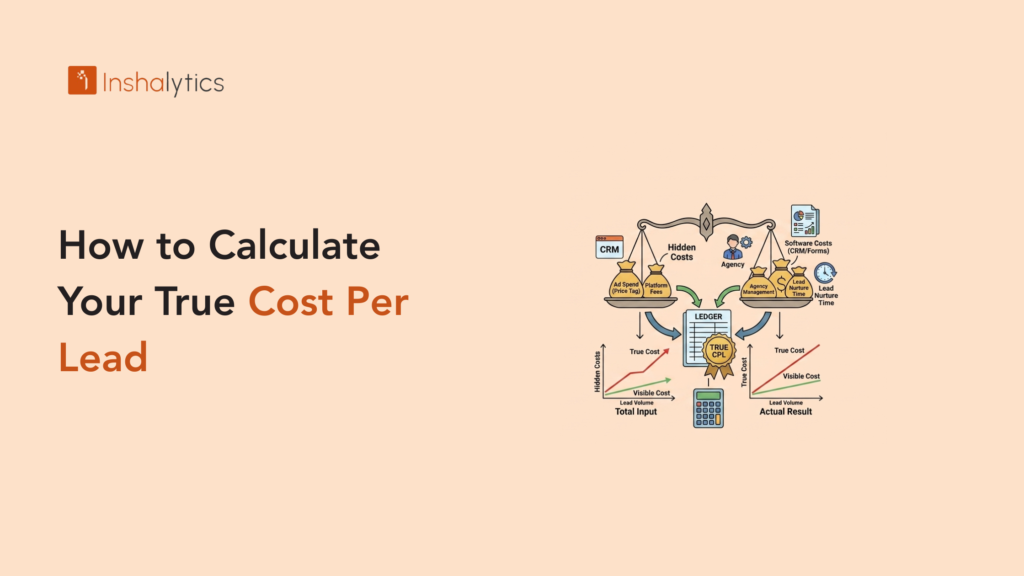
The platform charges you $35 for a lead. That is the number on the invoice. That is not what the lead actually cost you. By the time you factor in the phone call you made, the callback attempt when they did not answer, the drive across town, the estimate you wrote, the follow-up you sent, and the 30 minutes you spent waiting to hear back from someone who was already three quotes deep before they contacted you, that $35 lead cost you significantly more. The true cost per lead for handyman businesses is almost always higher than the sticker price, and for businesses relying heavily on shared lead platforms, it is often high enough to quietly destroy margins. This guide gives you the formula to calculate what a lead actually costs you, and what that number should be telling you about your marketing decisions.
Why the Sticker Price Is Not Your Real Cost Per Lead
Most handyman business owners track what they spend on leads. Few track what they spend to process leads. That gap between the invoice total and the actual cost is where margin disappears without anyone noticing.
What Gets Left Out of Most Lead Cost Calculations
The platform fee or ad spend is only the direct acquisition cost. Your true cost per lead also includes your time (or your office staff time) to call, text, follow up, and re-attempt contact on leads that do not answer. It includes vehicle and fuel costs for estimates driven on leads that do not convert. It includes the opportunity cost of the paying jobs you could have been doing instead of chasing a prospect who was never serious. And it includes any tools, software subscriptions, or CRM costs that exist specifically to manage your lead pipeline. None of these appear on the platform invoice. All of them are real costs of acquiring a booked job.
The Difference Between Cost Per Lead and Cost Per Booked Job
Cost per lead tells you what you paid for the inquiry. Cost per booked job tells you what you paid to win actual work. These two numbers diverge dramatically depending on your close rate. A $40 shared lead with a 10% close rate costs $400 per booked job. A $70 exclusive lead with a 40% close rate costs $175 per booked job. The platform charging more per lead is delivering work at less than half the cost per job. Tracking only cost per lead and ignoring close rate is one of the most common and most expensive analytical mistakes in handyman marketing. The full handyman lead generation guide covers how these metrics connect to a sustainable acquisition system.
How Shared vs. Exclusive Lead Models Change the Math
Shared leads from platforms like Angi and Thumbtack are sold to three to five contractors simultaneously. Your close rate on a shared lead is structurally limited because you are competing with four other operators calling the same homeowner within the same window. Industry data for handyman shared leads puts close rates at 8% to 15%. Exclusive leads (from Google Ads, your GBP, your website, or LSA) go to you and only you. The homeowner chose to contact your business specifically. Close rates on exclusive inbound leads run 30% to 50%. The price per lead may be higher, but the cost per booked job is usually significantly lower. The detailed math on this is covered in the shared versus exclusive lead comparison.
The True Cost Per Lead Formula (Full Version)
The following formula captures all components of your actual lead cost and should be calculated monthly for each active lead source.
Step 1: Add Up All Hard Costs
Hard costs include everything you spend money on directly related to lead acquisition: platform subscription or per-lead fees, Google Ads or Meta Ads spend, agency management fees, call tracking software, CRM subscription costs, and any tools or software used primarily for lead management. Add these up for the month by source. If you use a $79 per month CRM and it is used primarily to manage leads from two sources, split the cost proportionally between them. Hard costs are the floor of your true cost per lead calculation.
Step 2: Calculate Your Time Cost
Your time has a dollar value. Most handyman business owners set this at their effective hourly rate (what they charge customers divided by hours worked) or at a minimum of $50 to $75 per hour. Track how many hours per month you or your team spends on lead-related tasks: answering calls from leads, attempting callbacks, texting leads who did not answer, writing and sending estimates, following up on sent estimates, and disputing invalid leads with platforms. Multiply those hours by your hourly rate. For a solo handyman spending 12 hours per month on lead processing at an effective rate of $65 per hour, that is $780 in time cost before a single platform fee. This number shocks most handyman business owners who have never calculated it.
Step 3: Calculate Your Drive Cost
Estimate-related driving is a direct cost of your lead acquisition process. For every lead that results in a site visit for a free estimate, calculate the round-trip mileage and apply the IRS standard mileage rate (67 cents per mile in 2025) or your actual per-mile vehicle cost. If you drive 25 miles round trip for 8 estimates per month and only 3 of those convert to jobs, you have driven 125 miles for estimates that produced no revenue. At $0.67 per mile, that is $83.75 in drive cost on non-converting estimate trips. Add this to your platform fees and time cost.
Step 4: The True CPL Formula
True CPL = (Platform or Ad Spend + Agency Fees + Software Costs + Time Cost + Drive Cost on Non-Converting Estimates) divided by Total Leads from That Source. Once you have this number by source, calculate your cost per booked job by dividing true CPL by your close rate for that source: Cost Per Booked Job = True CPL divided by Close Rate. If your true CPL from Thumbtack is $68 and your close rate on Thumbtack leads is 12%, your cost per booked job is $566.67. Compare that against your average job revenue and your target margin to determine whether the channel is profitable at all.
Benchmark: What Should Your True CPL Be for a Handyman Business?
There is no single correct number because average job value determines what is acceptable. The formula for your maximum justifiable true CPL is: (Average Job Revenue multiplied by Target Profit Margin) multiplied by Close Rate. This gives you the maximum you can spend per lead and still hit your profit target.
Calculating Your Maximum Justifiable CPL
If your average handyman job generates $450 in revenue and you target a 30% profit margin, you need $135 in gross profit per job. If your close rate is 25%, your maximum true CPL to still hit 30% margin is $135 multiplied by 0.25, which equals $33.75. If your current true CPL from any source exceeds $33.75, that source is either destroying your margin or requiring you to undercut on price to win jobs where you cannot afford to. Run this calculation for every active lead source monthly. The result tells you immediately which sources are sustainable and which are eroding your business.
What Good Numbers Look Like in Practice (2026 Benchmarks)
For handyman businesses in 2026, benchmark true CPL ranges by source are approximately as follows. Google LSA exclusive leads from a verified profile with 50 or more reviews: $35 to $65 per lead with close rates of 35% to 50%, producing a cost per booked job of $70 to $185. Google organic search through a well-optimised GBP and website: $20 to $45 per lead (accounting for SEO investment cost spread across volume) with close rates of 35% to 45%, producing a cost per booked job of $44 to $128. Shared platform leads (Angi, Thumbtack): sticker price of $15 to $50 per lead but with close rates of 8% to 15%, producing a cost per booked job of $100 to $625 when true costs are included. The impact of lead marketplaces on handyman profit margins covers the full financial analysis of why shared platforms consistently underperform owned-channel leads on a per-booked-job basis.
How Average Job Size Changes the Acceptable CPL Range
A handyman business focused on small repairs ($150 to $300 average job) has very little room for high CPL because the gross profit per job is thin. A business that has repositioned toward larger projects (deck repairs, bathroom renovations, multi-trade jobs averaging $800 to $2,000) can absorb a higher CPL and still hit margin targets. This is one of the strongest arguments for niching into higher-ticket services: it creates more room in your cost-per-lead budget to invest in higher-quality, exclusive lead sources that generate better customers. The lead quality vs. quantity guide covers how job type affects the whole acquisition economics calculation.
How to Track True CPL by Source Without Complicated Software
You do not need expensive analytics software to track true CPL. A simple monthly spreadsheet with the right columns is enough to generate the insights that inform your marketing budget decisions.
The Monthly Lead Cost Tracking Sheet
Set up a spreadsheet with one row per lead source and these columns:
• Source: Platform name or channel (Thumbtack, Google Ads, GBP Organic, LSA, Referral, etc.)
• Hard cost ($): All direct spend on that source this month
• Time cost ($): Hours spent processing leads from that source multiplied by your hourly rate
• Drive cost ($): Non-converting estimate mileage cost from that source
• Total true cost ($): Sum of the three above
• Leads received (#): Total inbound inquiries from that source
• True CPL ($): Total true cost divided by leads received
• Jobs booked (#): Leads that converted to a booked and attended job
• Close rate (%): Jobs booked divided by leads received
• Cost per booked job ($): True CPL divided by close rate
Update this sheet at the end of every month. After three months, patterns emerge clearly. Combine this with your lead source tracking setup to make sure every lead is correctly attributed to its source.
The Most Common Calculation Mistakes to Avoid
The three errors that distort true CPL calculations most frequently are: (1) not accounting for time cost at all, which makes high-labour lead sources like shared platforms look artificially cheap; (2) calculating close rate on leads contacted rather than leads received, which inflates your close rate by excluding leads you never reached; and (3) measuring cost per lead monthly rather than on a rolling 90-day basis, which smooths out the seasonal spikes that can make a source look better in some months than it actually is on average.
What Your True CPL Tells You About Your Lead Sources
Once you have true CPL and cost per booked job calculated by source, the marketing budget conversation becomes straightforward. The math tells you what to do.
When to Cut a Lead Source
Cut a lead source when its cost per booked job exceeds your maximum justifiable CPL (calculated earlier in this guide) after at least 90 days of data and after verifying that your follow-up process is consistent across all sources. Do not cut a source based on 30-day data during a slow season or before you have confirmed your contact rate on that source is above 80% (meaning you are successfully reaching at least 80% of the leads you receive). A slow source may have a contact problem, not a quality problem. Fix the contact process before cutting the budget.
When to Scale a Lead Source
Scale a lead source when its cost per booked job is at or below your maximum justifiable CPL and your volume from that source is lower than your capacity to handle. If organic search via your GBP is delivering booked jobs at $85 each and you could handle ten more jobs per month, the correct move is to invest in the GBP optimisation and local SEO work that increases organic lead volume from that channel. Scaling a profitable source is the highest-leverage marketing investment available.
When to Fix Instead of Cut or Scale
Some sources have a high cost per booked job, not because the lead quality is poor but because the follow-up process is broken. If your contact rate on any source is below 70% (you are not reaching 30% of leads), your cost per booked job is inflated by non-answers, not by bad leads. Fixing your follow-up response time and implementing a CRM-based follow-up sequence before cutting the source is the correct diagnostic sequence. A source that looks expensive because of follow-up failure may look excellent once the process is fixed.
How Inshalytics Builds Lead Sources With Transparent Cost Per Booked Job
Most handyman marketing agencies report on leads generated and cost per lead. Inshalytics reports on cost per booked job because that is the metric that connects marketing investment to actual revenue. Every engagement we run for handyman clients starts with setting up the tracking infrastructure that makes true CPL calculation possible: call tracking by source, CRM referral source tagging, and a monthly report that shows cost per booked job by channel.
We build the owned-channel lead infrastructure (GBP, local SEO, LSA, converting website) that consistently delivers exclusive leads at the lowest cost per booked job available in your market. The full alternatives to paid lead platforms guide covers how each owned channel compares in terms of cost trajectory and lead quality.
Ready to know your real cost per booked job by channel? Talk to Inshalytics about setting up lead source tracking that gives you the data to make correct marketing budget decisions every month.