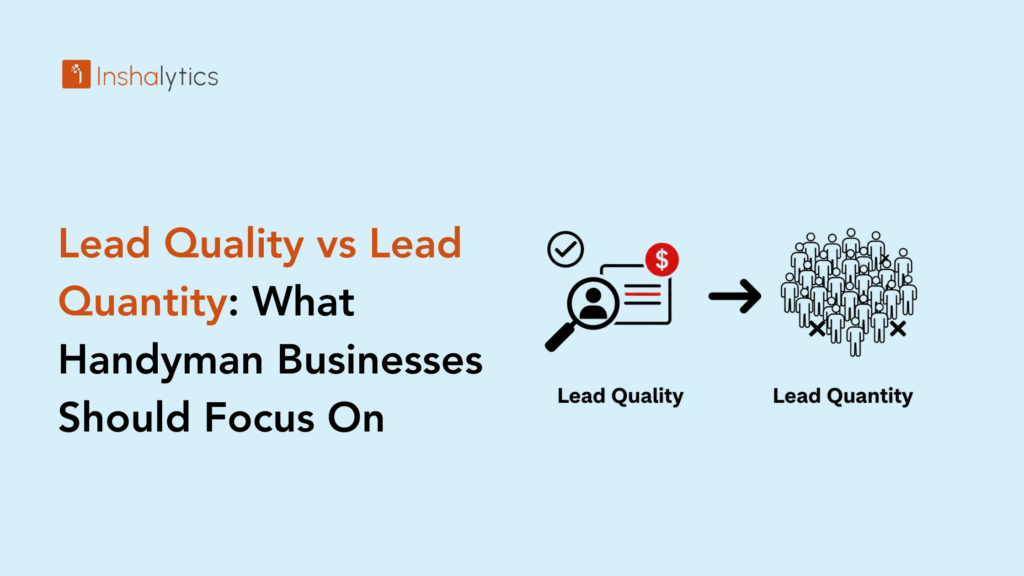
More leads sounds like the obvious answer. If ten leads produce two jobs, then a hundred leads should produce twenty, right? For handyman businesses that have chased volume, the reality usually looks different. More leads means more time answering the phone, more estimates that go nowhere, more miles driven to quotes that never convert, and a marketing budget that grows without a proportional increase in revenue.
The lead quality vs. lead quantity debate is not abstract. It has direct consequences for how much you earn, how many hours you work, and whether your business actually grows. This article breaks down what quality means for handyman leads, when quantity is the right approach, and how to build a pipeline that delivers quality leads without the frustration of quantity.
The Lead Volume Trap That Wastes Handyman Marketing Budgets
The appeal of lead volume is understandable. Platforms like Angi, HomeAdvisor, and Thumbtack sell the promise of a steady stream of phone calls and quote requests. More activity in the pipeline feels like growth. In practice, volume without quality is a budget leak disguised as progress.
Why More Leads Doesn’t Mean More Revenue?
Consider the math. A handyman business paying $45 per shared lead on a platform with a 12 percent close rate is spending $375 to close one job. If that job pays $400, the margin after lead costs is almost nothing before accounting for drive time, materials, or overhead. Scaling that model by buying more leads does not solve the problem. It amplifies it. Quality leads, exclusive, inbound, high-intent contacts who found your business and reached out specifically to you, close at rates of 35 to 50 percent. The same $375 budget applied to building the infrastructure that generates those leads (SEO, Google Business Profile, reviews) produces dramatically different economics over time.
The Hidden Costs of Chasing Quantity: Time, Fuel, and Mental Energy
Every lead you pursue costs time, regardless of whether it converts. A no-show estimate costs you 90 minutes of driving and waiting. A price-shopper who requests quotes from four competitors costs you 30 minutes on the phone explaining your value. A homeowner who “just wants a ballpark” costs you the opportunity of a real conversation with a client who is ready to book.
Multiply those interactions across a pipeline built on shared, low-quality leads, and the invisible cost becomes significant. The burnout that many solo handymen experience is rarely about the physical work; it is about the ratio of time spent chasing leads to time spent actually doing jobs.
How Shared Lead Platforms Sell Volume While Destroying Margins
Shared lead platforms are built for volume. Their business model depends on selling the same lead to multiple contractors simultaneously. Every time they sell a lead, they get paid regardless of who wins the job or whether anyone does. You are not buying a customer. You are buying entry into a speed-based competition where whoever calls first tends to win, and everyone else loses money.
The structural incentive of these platforms is to maximize the number of leads sold, not the quality of those leads. Understanding that incentive is the first step toward spending your marketing budget more productively. Our SEO services are built specifically to generate inbound leads that belong exclusively to your business, the opposite of the shared lead model.
What Makes a Handyman Lead “High Quality” in the First Place?
A high-quality handyman lead is one where the prospect has a specific, genuine need, has a budget aligned with your rates, is located within your service area, and has reached out to you specifically rather than to multiple competitors simultaneously.
That definition sounds simple, but it has significant implications for where your leads come from and how they behave when they contact you.
The Four Traits of a Lead Worth Pursuing
A lead worth your time typically has four characteristics:
- Specificity: They can describe what they need, not just “a few things fixed.”
- Readiness: They want the work done within a defined timeframe, not “eventually.”
- Location: They are within your service area and know roughly what travel costs are
- Budget alignment: They have either asked about your rates and not immediately balked, or they found you through a channel that pre-qualifies intent (organic search, referral)
Leads that lack two or more of these traits tend to waste more time than they produce revenue.
Ready-to-Hire vs. Just-Browsing: How to Tell the Difference Quickly
The fastest qualifier is specificity. “I have a cabinet door that won’t close and a bathroom exhaust fan that’s stopped working. Can you come on Thursday?” is a question. “I have some stuff that needs fixing around the house” is a browse. Training yourself to identify this distinction on the first contact and declining to invest significant time in vague requests protects your schedule without requiring an elaborate screening process.
How Job Value, Location, and Scope Define Lead Quality for Handymen
Not all good leads are equally valuable. A lead for a single light fixture installation and a lead for a full day of punch-list items at a property manager’s rental unit both qualify under the criteria above, but the latter is worth several times more. As you build your marketing strategy, target the channels and messaging that attract the job types with the highest value-to-time ratio in your market.
Is Lead Quantity Ever the Right Strategy for a Handyman Business?
Volume is not always wrong. There are specific situations where prioritizing quantity makes more sense than obsessing over quality, and recognizing those situations prevents the mistake of under-investing when growth demands scale.
When Volume Makes Sense: New Businesses, New Markets, and Off-Season Gaps
A brand-new handyman business with no referral base, no review history, and no organic search presence needs volume to survive while it builds. In this phase, a lead marketplace provides immediate market access. The economy is poor, but the alternative, waiting six months for SEO to generate leads, is not viable for someone who needs income now.
Similarly, when entering a new service area or filling schedule gaps during slow seasons, short-term volume purchasing can prevent costly downtime. The key distinction is treating it as a bridge, not a destination.
The Problem With Scaling Volume Without Improving Your Systems First
Scaling lead volume before your business has the systems to handle it creates a different kind of problem. If your response time is slow, your conversion rate is low, or your estimates are not persuasive, more leads simply amplify those failures. Volume scaling works only when the infrastructure to convert leads into booked jobs is already functioning well.
How to Use Lead Quantity as a Short-Term Bridge, Not a Long-Term Foundation
The businesses that use lead marketplaces successfully treat them as temporary scaffolding necessary during early growth, to be removed as owned lead generation takes over. Set a clear threshold: “When my organic leads cover X percent of my monthly capacity, I reduce marketplace spend by Y percent.” That intentional transition from rented leads to owned traffic is what separates businesses that scale profitably from those that stay trapped in the volume game.
The Math That Proves Quality Wins Over Quantity for Handyman Businesses
Numbers make this argument better than any general claim. The economics of quality vs. quantity are straightforward when you do them honestly.
Comparing Customer Acquisition Cost Across Shared Leads vs. Organic SEO
Industry benchmarks for 2025 and 2026 put the customer acquisition cost on Angi at approximately $2,500 when accounting for close rates, wasted leads, and platform fees. According to 2025–2026 industry benchmarks, SEO delivers the same customer for $290 to $310. Even in the early months when SEO is building, the trajectory points decisively toward owned lead generation as the more profitable long-term channel.
Close Rate Reality: 10–15% on Shared Leads vs. 35–50% on Exclusive Inbound
The close rate gap between shared and exclusive leads is not marginal. It is decisive. At a 12 percent close rate, you need 8 leads to close 1 job. At a 40 percent close rate, you need 3 leads to close the same job. The revenue per marketing dollar spent on exclusive inbound leads is dramatically higher, and the time per booked job is dramatically lower.
How One High-Quality Client Can Outperform Ten Low-Quality Leads in Lifetime Value
A single property manager who discovers your business through organic search and hires you for recurring work at six to eight properties is worth more revenue over two years than ten one-time handyman leads from a shared platform. Client lifetime value, the total revenue a client generates over their relationship with your business, is almost always higher for clients who found you through quality channels.
How Inshalytics Builds Marketing Systems That Attract Quality Leads
Every handyman marketing strategy we build at Inshalytics is designed around lead quality, not lead quantity. The goal is not to fill your phone with calls; it is to fill your calendar with profitable jobs.
Why Our SEO-First Approach Generates Exclusive, High-Intent Traffic?
Search engine optimization generates inbound leads for homeowners who found your business by searching for exactly what you offer, in your exact service area, and chose to contact you specifically. These leads are exclusive by nature. No other contractor received the same notification the moment that the homeowner typed “handyman near me” and clicked your result.
How We Help Handyman Businesses Stop Competing on Price for Every Job
Competing on price is a symptom of competing for the wrong leads. When your business appears organically in search results for specific, high-intent queries,” licensed handyman for kitchen repairs in [City],” “bathroom grab bar installation near me, “the homeowners who click and call are already aligned with your positioning. Price is a less central variable in those conversations because the client sought you out, not the other way around.
The Content and Visibility Strategy That Filters Out the Wrong Clients
Content marketing targeted at the right client personas does dual duty: it attracts the homeowners who value quality and reliability, and it naturally does not attract those who are purely price-shopping. A blog post on “Why Proper Drywall Repair Matters Before You Paint” does not reach clients who want the cheapest possible patch job. It reaches clients who care about the result.Stop paying for leads you will never close. Contact our team and let’s build a pipeline that delivers the quality your business deserves.