You’ve asked five different agencies what lead generation costs for a handyman business. You got five different answers, three of them vague, and every single pricing page ends the same way: “Contact us for a custom quote.”
That opacity is intentional. Most agencies hide pricing because pricing is a competitive advantage and because there’s no standard answer that applies to every market, every budget, and every service mix. But for handyman businesses evaluating whether to invest in professional lead generation, that lack of transparency makes budgeting feel like guesswork.
This guide pulls back the curtain. Here’s what handyman lead generation services actually cost in 2026, broken down by pricing model, by channel, and by what you should realistically expect to get for each dollar.
Why Handyman Marketing Pricing Is So Hard to Find Online
The first thing to understand is why pricing varies so much. It’s not entirely evasion it’s that the inputs are genuinely different for every business.
The Intentional Opacity of Agency Pricing Pages
Agencies price services based on market competition, client size, service scope, and how desperate you seem when you reach out. Publishing a flat rate removes their ability to size deals to clients. That’s why most pricing pages show ranges so wide they’re nearly useless, or direct you to a sales call before revealing any number.
The antidote is to walk into every agency conversation knowing the benchmarks. If you know that Google Ads management for a handyman business typically runs 15–20% of ad spend with a minimum fee, you’re not starting from zero.
Why Generic Lead Gen Pricing Doesn’t Apply to Home Services
The pricing guides that dominate search results are built for B2B lead generation where leads cost $150–$500 each because a single deal is worth $50,000. Handyman economics are completely different. Your average job might be $200–$600. Your lifetime customer value is built on repeat work over years, not on a single contract.
This matters because agencies that serve B2B clients and dabble in home services will often apply pricing structures that don’t fit. A $5,000/month retainer makes sense if a single new client is worth $25,000. It’s harder to justify if your average ticket is $350 and you need 15 new jobs per month to make it work.
The Number You Actually Need: Cost Per Booked Job, Not Cost Per Lead
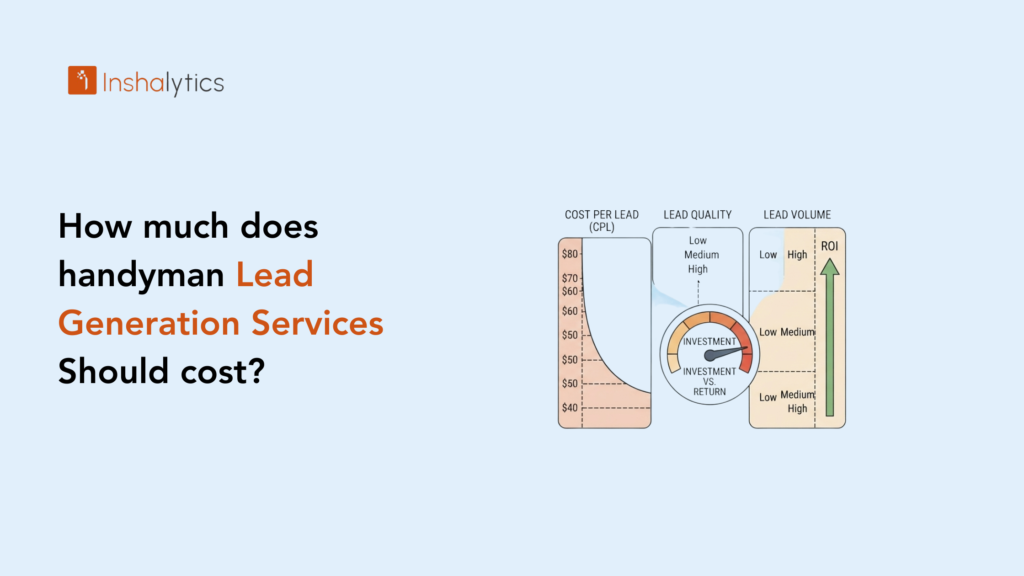
Cost per lead is the wrong metric. A handyman buying shared leads from a marketplace at $25 each with a 10% close rate is spending $250 per booked job. A handyman running a well-optimized Google Ads campaign at $60 per lead with a 30% close rate is spending $200 per booked job, and those leads are exclusive.
Before evaluating any pricing, know your true cost per lead formula and your close rate by channel. Every conversation about lead generation cost starts there.
The Four Pricing Models You’ll Encounter When Hiring for Handyman Lead Gen
Agencies structure their fees in four main ways. Each has a different risk profile and fits different business stages.
Monthly Retainer: What You Get and What You Don’t
The monthly retainer is the most common pricing model. You pay a fixed fee each month in exchange for ongoing work: campaign management, SEO, content creation, reporting, or some combination. Retainers for handyman businesses typically range from $1,000 to $4,000 per month depending on the scope, not including ad spend.
The advantage is predictability. The disadvantage is that you pay regardless of results, which means accountability mechanisms (clear KPIs, monthly performance reviews, exit clauses) need to be built into the agreement before you sign. An agency that resists defining what “success” looks like at 90 days is an agency that plans to collect fees without being held to outcomes.
Pay-Per-Lead: The Appeal and the Quality Trap
Pay-per-lead sounds ideal in theory. You only pay when someone actually contacts you. In practice, the model has a structural flaw: when agencies get paid per lead regardless of whether that lead converts, they have an incentive to prioritize volume over qualification.
For handyman businesses, pay-per-lead from a platform like Angi or Thumbtack means paying $20–$70 per lead that is simultaneously sent to three to five other contractors. The economics of shared leads almost always favor building your own channels over time, even if the upfront investment is higher.
Pay-per-lead makes sense as a bridge-filling pipeline while your own channels build, but it should never be your primary acquisition strategy long-term.
Hybrid Models: When Shared Risk Produces Better Results
A hybrid model combines a lower base retainer with performance-based bonuses tied to lead volume, cost per lead, or booked job metrics. The base retainer covers the agency’s operating costs. The performance bonus gives them skin in the game.
For handyman businesses, the hybrid model often produces the best outcomes because it aligns incentives. Your agency earns more when you earn more. Look for hybrid arrangements where the bonus is tied to booked jobs, not just leads delivered; that distinction tells you whether the agency understands your actual business goal.
Per-Channel Management Fees: How the Math Actually Works
Some agencies price by channel rather than by scope. They charge a management fee for Google Ads, a separate fee for SEO, and another for social advertising. This structure is transparent but can get expensive fast when you add channels.
Standard management fee structures for home services:
- Google Ads: 15–20% of monthly ad spend, with a minimum fee of $500–$800/month
- LSA management: Flat $300–$600/month (lower because the platform is simpler)
- SEO retainer: $800–$2,500/month for local handyman SEO
- Facebook/Meta Ads: 15–20% of ad spend, minimum $400–$600/month
These are management fees only; ad spend is separate and additional.
What Handyman Lead Generation Should Actually Cost by Channel
With the pricing models understood, here are the realistic cost ranges by channel for a handyman business in 2026.
Google Ads and LSA Management: Real Fee Ranges for Handyman Campaigns
Google Local Services Ads (LSA) are typically the best first paid channel for handyman businesses. You pay per qualified lead, not per click, and the “Google Verified” badge builds immediate credibility. LSA leads for handyman businesses in most markets cost $20–$45 per lead, and they’re exclusive.
For a well-managed LSA program, expect to pay $300–$600/month in agency management fees plus your actual lead costs. See how local services ads work for handyman businesses before evaluating agencies; knowing the platform makes it easier to ask the right questions.
Google Search Ads require more management complexity: keyword selection, negative keyword lists, landing page optimization, and bid management. Expect $500–$1,000/month in management fees plus $1,000–$3,000/month in ad spend for a handyman business targeting a single metro area.
Local SEO for Handymen: What Monthly Retainers Cover and What They Don’t
Local SEO is the channel that generates leads at zero cost per click once rankings are established. The investment is in building the asset and that takes time.
A legitimate local SEO retainer for a handyman business covers: Google Business Profile optimization and management, citation building and NAP consistency, on-page optimization for service and location pages, and content creation targeting local handyman keywords. Monthly retainers for this scope typically run $800–$2,000 for a single-city handyman operation.
Be cautious of SEO services priced below $500/month. At that price point, you’re likely getting automated citation submissions and no real strategy. The local SEO work that actually moves handyman rankings requires consistent human effort, not automation.
Facebook Ads Management: Fees, Ad Spend, and Realistic CPL for Handyman
Facebook advertising for handyman businesses plays a fundamentally different role than Google it reaches homeowners who aren’t actively searching yet, positioning your business before the need becomes urgent. It works best for larger-ticket services like deck building, garage organization, or smart home installation.
Facebook Ads management for handyman businesses typically runs $400–$800/month in agency fees, plus $500–$2,000/month in ad spend. Cost per lead on Facebook for handyman services runs $20–$50, but close rates are lower than Google because the leads are less urgent. The comparison between Facebook and Google Ads for handyman services is worth reading before allocating budget across both channels.
Cost Per Lead Benchmarks: What Good Looks Like Across Each Channel
Here’s what qualified, exclusive cost-per-lead looks like across channels for a handyman business:
- Google LSA: $20–$45 per lead (high intent, exclusive)
- Google Search Ads: $35–$65 per lead (high intent, exclusive)
- Local SEO (organic): $5–$20 per lead once ranking (lowest long-term CPL)
- Facebook Ads: $20–$50 per lead (lower intent, exclusive)
- Shared lead platforms (Angi, Thumbtack): $15–$60 per lead (lower intent, shared with competitors)
The organic lead is cheapest long-term but requires the most upfront investment to build. The shared platform lead is cheapest day-one but costs the most in close-rate inefficiency over time.
Hidden Costs That Blow Handyman Marketing Budgets
The number on the proposal is never the full number. These are the hidden costs that catch handyman businesses by surprise.
Setup Fees, Onboarding Costs, and First-Month Surprises
Many agencies charge one-time setup fees that don’t appear prominently in the initial proposal. Account setup, campaign configuration, landing page creation, and CRM integration can add $500–$2,000 to your first month’s investment before you’ve received a single lead.
Ask explicitly: “What is my total cost in month one, including all setup and onboarding fees?” Reputable agencies will give you a clean number. Agencies that reveal these costs piecemeal after you’ve committed are telling you something important about how they operate.
Minimum Spend Requirements and Lock-In Contract Risks
Some agency contracts include minimum monthly spend commitments that persist regardless of performance. Read the fine print before signing. A 12-month minimum at $2,500/month is a $30,000 commitment before you’ve verified the agency delivers.
Look for contracts with 30–60 day exit clauses and defined performance benchmarks. Any agency confident in their work should have no problem building accountability into the agreement. Why handyman marketing agencies fail is a question worth understanding before you sign anything.
What Happens to Your Assets If You Leave the Agency
This is the question most handyman business owners forget to ask: who owns the website, the Google Ads account, the SEO work, and the content if you leave?
Some agencies build everything inside their own accounts and retain ownership on exit. If you walk away, you lose the campaign history, the SEO authority that was built in your domain, and sometimes the website itself. Make data ownership explicit in the contract. Everything built for your business should be owned by your business.
How to Evaluate Whether Agency Pricing Is Actually Worth It for Handymen
The ROI question is the only one that matters. Here’s how to run the math before committing.
Running the ROI Math: What a Booked Job Needs to Cost
Work backward from your economics. If your average job is $350, your close rate on qualified leads is 25%, and your profit margin is 40%, you can afford roughly $35 per lead before lead generation starts eating into profit.
Now compare that against what agencies are quoting. If an agency is charging $1,500/month in management fees plus $1,500/month in ad spend, they need to generate at least 85 leads per month at a 25% close rate roughly 21 booked jobs to produce a 2:1 return on the total investment. That’s a high bar for a solo or small-crew handyman operation.
The math improves significantly when your average ticket is higher and your close rate on inbound leads is stronger. This is exactly why reducing your dependency on shared leads and building owned channels increases ROI over time your close rate goes up as lead quality improves.
Questions to Ask Any Agency Before Signing
Walk into every agency conversation with these questions. The answers reveal more than any proposal document:
- “What does success look like at 90 days in booked jobs, not impressions?”
- “Can you show me attribution reporting from a current handyman client?”
- “Who owns my ad accounts, website, and domain if I leave?”
- “What is my all-in cost in month one, including setup?”
- “What’s your contract structure and exit clause?”
An agency that answers all five confidently and specifically is worth a deeper conversation. An agency that deflects, generalizes, or defers any of these to “we’ll cover that after you sign” is not.
The Difference Between Buying Leads and Building a Lead System
Buying leads is a transaction. You pay, you receive contacts, you work them, you pay again. If you stop paying, the leads stop. There’s no compounding value, no asset being built, no foundation for future growth.
Building a lead system through owned SEO, a well-optimized Google Business Profile, and campaigns that build brand recognition in your market creates something that grows in value over time. Your cost per lead from organic channels drops every month as rankings improve. Your brand recognition means homeowners call you specifically rather than selecting from a list of five contractors.
That distinction is the core of how Inshalytics approaches handyman lead generation differently from platforms that sell contacts.
How Inshalytics Prices Handyman Lead Generation Programs
At Inshalytics, we build lead generation systems for handyman businesses that are designed to be owned, not rented. Our programs combine local SEO, Google Ads, LSA management, and conversion optimization into an integrated system where every channel feeds the same funnel and where the assets we build belong to you.
What Our Programs Include and What You Pay
Every Inshalytics handyman program starts with a full audit of your current online presence: GBP completeness, existing rankings, citation consistency, competitor visibility, and current lead sources. That audit drives the strategy; we don’t apply a template.
Pricing is built on your market, your service area, and your business size. We don’t hide it behind a call; we quote transparently and separate management fees from ad spend so you always know exactly where your money goes.
Why We Separate Management Fees from Ad Spend
Conflating management fees and ad spend is the most common way handyman businesses get overcharged. An agency that bills you $3,000/month “for marketing” without specifying how much goes to Google has no incentive to spend your ad budget efficiently; their fee is the same either way.
We invoice management fees and ad spend separately on every program. You see exactly what you’re paying us to manage and exactly what you’re paying Google or Meta to run your ads. That separation is the minimum standard for accountability in any marketing engagement.
Ready to see what a program built for your market and your business looks like? Get in touch with Inshalytics; we’ll give you a real number, not a form submission.
Handyman lead generation services cost anywhere from $800 to $5,000+ per month depending on scope, channels, and market. The right investment depends entirely on your job economics, your current close rate, and whether you’re building an asset or renting access.
Know the benchmarks before you negotiate. Ask the right questions before you sign. And measure every dollar against cost per booked job not cost per lead, not impressions, and not sessions. That’s the number that tells you whether the investment is working.