Before spending a dollar on HVAC ads, it’s worth answering one question honestly: is this market actually winnable at the budget available, or is it about to become an expensive lesson in how competitive local HVAC advertising has gotten? Search “AC repair near me” in a saturated metro and the answer is usually staring right back, five Local Services Ads deep and a map pack that hasn’t changed hands in years.
This guide covers how to read a market’s real competitiveness before committing spend, when paid ads still make sense despite heavy competition, and when SEO is the smarter first move instead. The goal isn’t to avoid competitive markets entirely. It’s to walk in with realistic expectations about what it will take to win.
What Does “Too Competitive” Actually Look Like?
A market is too competitive for a given budget when the cost to compete for visibility, through either ads or organic rankings, outpaces what the business can realistically spend and still turn a profit on the jobs it books. That’s a budget question as much as a market question, and it starts with actually looking at what’s currently occupying the search results rather than guessing.
Counting Local Services Ads and Map Pack Density
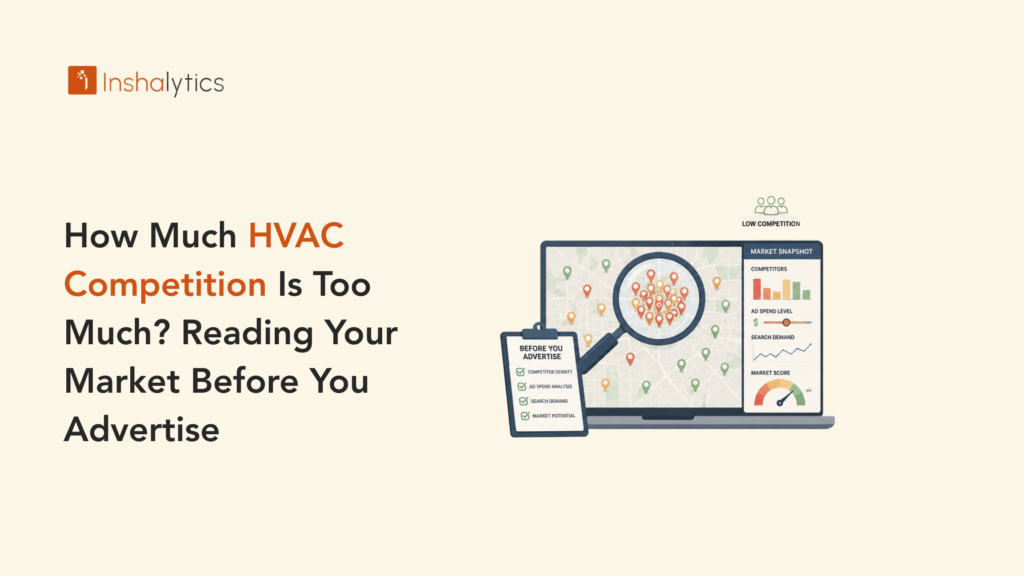
Running a real search for the core service terms and counting how many Local Services Ads, standard search ads, and established map pack listings appear gives an honest read on density. A search result stacked with well-established, heavily-reviewed competitors signals a much steeper climb than one with a thin, inconsistent field.
It’s worth running this check at different times of day and for a few different core service terms, not just one search, since results can shift and a single snapshot might not reflect the full competitive picture.
Screenshotting these results and revisiting them each season builds a simple record of how the competitive field is actually changing over time, rather than relying on memory or impression.
Reading Competitor Review Counts and CPC Signals
Competitor review counts give a rough sense of how long-established and well-optimized the field already is. Rough visibility into competitor ad spend and click cost, through keyword research tools or simply noting how aggressively competitors appear to be bidding, rounds out the picture before a single dollar gets committed.
A market where every top listing sits well above a hundred reviews and multiple businesses are clearly running aggressive ad campaigns is telling you something important before you’ve spent a cent.
A Pre-Flight Checklist Before You Commit Ad Budget
A short, honest audit before launch prevents most of the budget waste that shows up three months later when the numbers finally get reviewed.
Auditing the Top 3 in Your Market
Look closely at whoever currently holds the top three map pack spots and the top paid positions: their review count, how complete their profile looks, and how strong their website and offer appear. This becomes the realistic bar to clear, not an industry-wide average from somewhere else.
This audit takes an hour at most and should happen before any budget conversation, since it directly shapes what a realistic first-quarter goal actually looks like.
Estimating Realistic CPC and Cost-Per-Booked-Job Before Launch
Before committing a monthly budget, it’s worth running a rough estimate of likely cost per click in the market and working that forward to an estimated cost-per-booked-job, using a conservative close rate. If that number doesn’t leave room for a profitable job at the average ticket size, the market may need a different approach than jumping straight into paid search.
This estimate doesn’t need to be perfect. Even a rough version, built from a few minutes of keyword research, is enough to catch a budget that’s set up to lose money before the first ad even runs.
Running this math before launch, rather than discovering it three months into a live campaign, is the difference between an informed decision and an expensive lesson.
When Paid Ads Make Sense vs. When to Lead With SEO Instead
Heavy competition doesn’t automatically rule out paid ads. It just changes which approach is likely to pay off first, and forcing the wrong one rarely ends well.
Markets Where PPC Still Wins
In markets with high urgency demand and a budget that can sustain a real testing period, paid ads can still work even against heavy competition, particularly for emergency and high-intent searches where a business simply needs to be visible today rather than in six months.
A business with the cash flow to absorb a genuine testing period, rather than needing profitability from week one, is in a much stronger position to compete in a saturated market than one operating on thin margins.
Markets Where SEO Is the Smarter First Move
In markets where paid competition has pushed cost per click to a level that makes profitable cost-per-booked-job difficult, building organic visibility first and layering in a smaller, more targeted ad budget later is often the more sustainable path, even though it takes longer to show results.
This isn’t a consolation prize. Many HVAC businesses in the most saturated metros have built their strongest lead channel through organic search precisely because it doesn’t require outbidding a dozen well-funded competitors every day.
Advertising Around Your Competition Instead of Against It
A saturated market doesn’t have to mean bidding head-on against everyone else for the exact same searches at the exact same time of year.
Timing Spend Ahead of Seasonal Demand Peaks
Most competitors increase spend once demand has already spiked, which drives cost per click up right when it matters most. Increasing budget a few weeks ahead of a predictable seasonal peak, before competitors follow the same instinct, often captures the same demand wave at a meaningfully lower cost.
This requires planning slightly ahead of the obvious moment, which is exactly why most competitors don’t do it and why it remains an effective edge for the businesses that do.
Budget Benchmarks by Market Saturation Level
As a general pattern, more saturated markets tend to require a higher share of revenue allocated to marketing to maintain visibility, while newer or less competitive markets can often compete on a leaner budget, at least until competitors catch up.
Reviewing this benchmark annually, rather than setting a budget once and leaving it fixed, keeps spend aligned with how the market is actually shifting rather than how it looked a year ago.
Revisiting Your Market Read Every Season
A market’s competitiveness isn’t fixed. It shifts as competitors enter, exit, or change strategy, sometimes faster than a business expects.
Signs the Competitive Landscape Has Shifted
A sudden jump in cost per click, a new well-funded competitor appearing in the map pack, or a previously dominant competitor going quiet are all signals worth reassessing rather than assuming last quarter’s strategy still applies unchanged.
Checking in on this once a season, rather than only when something feels off, catches shifts earlier and avoids reacting to a problem that’s already been building for months.
When to Get an Outside Market Audit
If the business isn’t growing despite consistent effort and it’s unclear whether the cause is the market itself or the strategy being used in it, an outside read on the competitive landscape often surfaces the answer faster than another quarter of guessing.
An owner too close to the day-to-day operation often has a harder time seeing shifts in the competitive field than a fresh set of eyes brought in specifically to look for them.
Competitive doesn’t have to mean unwinnable, but it does mean the strategy needs to match the market rather than defaulting to whatever worked somewhere else. Reading the real competitive density, estimating cost-per-booked-job honestly before committing spend, and choosing the right channel for the level of saturation are what separate a market that’s simply tough from one that’s genuinely not worth advertising into yet.
Not sure whether your market can support the ad budget you’re considering? Get a free competitive market read before committing spend.