Three months into an SEO campaign, an HVAC owner checks the numbers, sees a modest bump in traffic and not much else, and starts wondering if the whole thing is working. This moment is completely normal, and it’s also the point where a lot of businesses give up right before results actually start compounding.
This guide covers a realistic month-by-month timeline for HVAC SEO, why the industry’s extreme seasonality makes that timeline harder to read than it looks, and what should be happening to paid ad spend as organic traffic takes over. The goal is to know what a normal quiet period looks like versus an actual stalled campaign.
The Short Answer: 3-6 Months for Traction, 6-12 for Full ROI
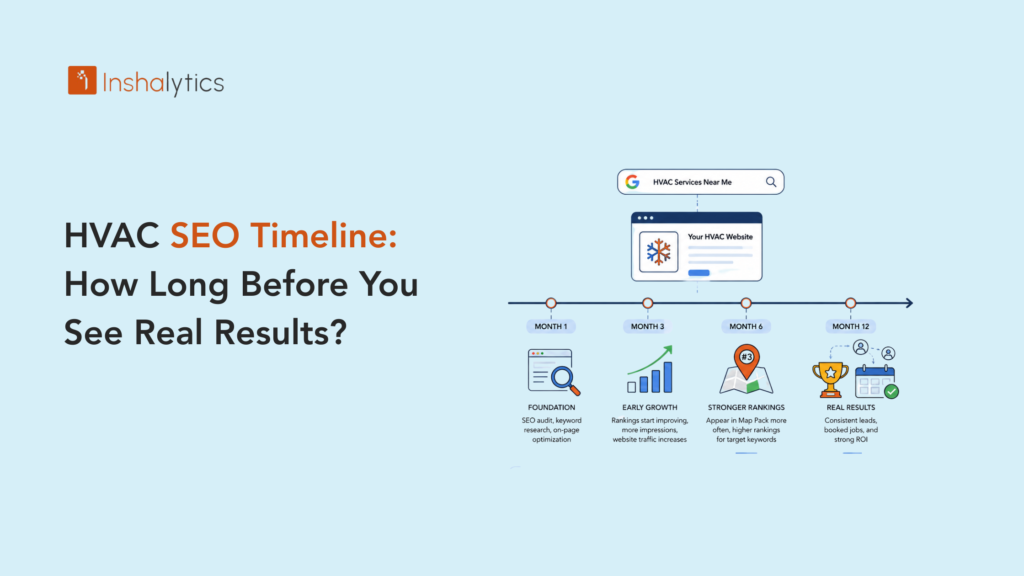
Most HVAC businesses start seeing early ranking movement within 60 to 90 days, meaningful lead flow by month 3 to 6, and full return on investment somewhere between month 6 and 12, depending heavily on how competitive the local market is.
What “Results” Actually Means at Each Stage
Early results look like rising impressions and a few page-two rankings, not phone calls. Mid-stage results look like page-one rankings for core service terms and a trickle of organic leads. Full results look like organic search becoming a genuinely reliable lead source that reduces reliance on paid ads. Confusing these stages is the number one reason SEO campaigns get judged unfairly at month three.
An owner expecting phone calls in month one is measuring against the wrong stage entirely, and that mismatch alone is responsible for more abandoned SEO campaigns than any actual strategy failure.
Why Your Timeline Depends on Market Competition
A business in a smaller market with light existing competition can see meaningful movement faster than a business fighting for visibility in a major metro against a dozen established competitors. Website age, technical health at the outset, and how aggressively competitors are also investing in SEO all shift the timeline in either direction.
Two businesses starting SEO on the same day, in different markets, can reasonably see results three or four months apart from each other, and neither timeline is wrong. They’re just solving different-sized problems.
Month-by-Month: What’s Actually Happening Behind the Scenes
Understanding what’s happening in the background during each phase makes the quiet early months much easier to sit through without losing confidence in the process.
Months 1-3: Foundation and Technical Fixes
The first phase is mostly invisible work: technical fixes, Google Business Profile optimization, on-page structure, and initial content built around the right service and location keywords. Rankings may begin shifting slightly by the end of this window, but lead volume is usually still minimal, and that’s expected, not a warning sign.
This is also when Google is still learning about the changes made to the site, a process that simply takes time regardless of how correctly the work was done.
An owner checking Google Search Console during this window will often see impressions climbing well before clicks or calls do, which is actually a healthy early signal rather than a sign that nothing is happening.
Months 4-6: Rankings Climb, Leads Start Trickling In
This is typically when core service pages start reaching page one for local searches, and organic leads begin arriving with some regularity, even if the volume is still modest compared to paid channels. This is also the point where some businesses start cautiously reducing spend on the keywords now ranking organically.
The trickle at this stage can be deceiving. It often looks unremarkable next to paid lead volume, but it represents the first sign that the investment is compounding rather than starting from zero every month like ad spend does.
Months 6-12: Compounding and Market Stabilization
By this stage, rankings across multiple service and location terms tend to stabilize into more durable positions, having been tested by Google through at least one seasonal cycle. Organic lead flow becomes a genuinely reliable channel rather than an occasional bonus, and the earlier technical and content investment starts compounding rather than needing constant rebuilding.
This is the phase where the return on the earlier months’ quiet work actually becomes visible in the numbers a business owner cares about most.
Why Does Seasonality Make HVAC SEO Timelines So Confusing?
Seasonality makes HVAC SEO timelines confusing because demand itself swings dramatically across the year, which can make a normal seasonal dip look like SEO failure and a seasonal spike look like SEO success, when neither is actually about the SEO work itself.
Reading Results Across a Full Demand Cycle, Not a Calendar Quarter
AC repair searches surge dramatically in summer heat and furnace repair spikes in winter cold, which means a fair read on SEO progress requires comparing performance across a full seasonal cycle, not one calendar quarter in isolation. A business launching SEO work heading into its slow season needs to factor that timing into expectations from the start.
Judging a campaign launched in October by its December numbers, without accounting for the industry’s natural winter lull in certain services, is comparing the wrong things entirely.
The only reliable fix is patience paired with year-over-year comparison once enough time has passed, rather than reacting to any single month in isolation.
Avoiding False Alarms During Slow Season
A dip in leads during a naturally slower season can look identical to a stalled campaign if the two aren’t separated carefully. Comparing performance to the same period a year prior, once that data exists, is a far more reliable check than comparing month over month during a seasonal transition.
This is also where rankings can be a more honest signal than raw lead count during a slow month. Holding position on page one through an off-season, even with fewer total searches happening, is a sign the work is holding rather than failing.
What Should Be Happening to Your Ad Spend as SEO Ramps Up
A healthy SEO campaign should eventually show up in the paid ads budget too, not just in the rankings, and this is one of the clearest practical signs that the investment is paying off.
Reducing Reliance on Paid Leads as Organic Grows
As specific keywords start ranking organically, spend on those exact terms in paid search can often be reduced or reallocated without losing overall visibility, since the organic listing is now doing some of that work for free. This shift usually becomes noticeable somewhere in the month four to six range for the strongest-performing terms.
This doesn’t mean cutting ad spend entirely. It means redirecting it toward terms and services that organic hasn’t caught up to yet, so the two channels reinforce each other instead of overlapping unnecessarily.
Tracking Cost-Per-Booked-Job Across Both Channels Together
The clearest sign that SEO is working isn’t a rankings report. It’s a declining blended cost-per-booked-job across paid and organic combined, as organic leads, which cost nothing incremental per booking, start making up a larger share of total volume.
This blended view is a far more honest measure of SEO’s return than looking at organic traffic in isolation, since it captures the actual financial impact rather than just a vanity metric like rankings or sessions.
What to Do If You’re Past Month 6 With Nothing to Show
If six months have passed with no meaningful movement, something in the campaign likely needs a real look rather than more patience alone.
Common Reasons SEO Stalls
Thin or generic content, unresolved technical issues, an underpowered Google Business Profile, or simply being outmatched by significantly more established competitors are the most common reasons a campaign stalls well past when results should be showing.
In some cases, the strategy itself was never wrong, but execution slipped somewhere along the way, content stopped being published consistently, or technical issues introduced later went unnoticed.
When It’s Time for a Strategy Reset
If the fundamentals have genuinely been in place for six months with nothing to show, that’s the point to bring in a fresh audit rather than continuing the same approach for another quarter and hoping for a different outcome.
A reset doesn’t necessarily mean starting over completely. Often it means identifying the one or two structural issues that have quietly been holding everything else back and fixing those specifically.
HVAC SEO rewards patience measured in months, not weeks, and reads clearest across a full seasonal cycle rather than a single quarter. The businesses that stick with it past the quiet early phase are the ones that eventually watch organic search become one of their most reliable, lowest-cost channels, and one that keeps compounding long after the initial work is done.
Feel like your SEO timeline has stalled, or want a realistic read on where you actually stand? Get a free SEO progress audit and find out what’s really happening behind the numbers.
Related reading: questions to ask before hiring an HVAC marketing agency.