
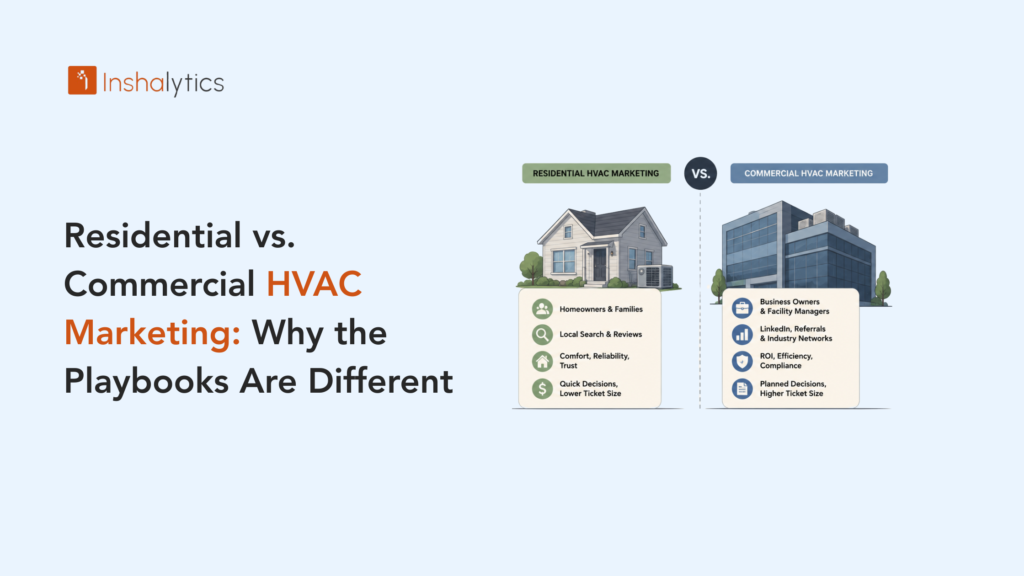
A homeowner with no air conditioning in July decides on a contractor within the hour. A property manager evaluating a commercial rooftop unit replacement might take weeks, comparing proposals and looping in a facilities director before anyone signs anything. Both are HVAC customers. Neither responds to the same marketing approach.
Businesses that treat residential and commercial demand as one audience usually end up serving neither particularly well. This guide covers why the two require genuinely different playbooks, and how to run both without one quietly starving the other of budget and attention.
Two Different Buyers, Two Different Sales Cycles
Before splitting campaigns or budgets, it helps to be clear on exactly how differently these two buyers actually behave, since the differences run deeper than just timeline.
The Homeowner: Fast, Emotional, Reputation-Driven
Residential HVAC decisions are often urgent and emotional: no cooling in a heat wave, no heat during a cold snap. Reviews, local reputation, and how quickly the phone gets answered carry enormous weight, because the homeowner is choosing under real time pressure and limited patience for research.
This buyer rarely requests multiple written quotes and compares them side by side. They call, get a sense of trust within the first minute of conversation, and decide.
The entire decision often happens in the span of a single phone call, which puts enormous weight on how that first conversation is handled, not just on how the business is marketed beforehand.
The Property Manager or Facilities Director: Slow, Procurement-Driven
Commercial decisions move at an entirely different pace, often involving multiple stakeholders, formal proposals, and a procurement process rather than a single phone call. The person making the decision is frequently not the person who will use the space, and they’re evaluating on reliability, service contracts, and long-term relationship rather than urgency.
This buyer is also thinking beyond the immediate repair, toward an ongoing maintenance relationship that could span years and multiple properties, which changes what actually earns their trust.
Winning this buyer once often means winning access to every other property they oversee, which is part of why the sales cycle, though slower, tends to pay off disproportionately once it closes.
Why the Same Ad Campaign Can’t Serve Both
A campaign optimized for one buyer type tends to actively work against the other when the two are blended together, even with a generous budget.
Separating Residential and Commercial Keywords and Budgets
Blending residential and commercial keywords into one campaign confuses the optimization signals Google uses to bid and target, since the two buyer types respond to completely different ad copy, timing, and landing pages. Separate campaigns, each optimized independently, consistently outperform a single blended one, even at the same total spend.
This separation also makes budget decisions clearer. It’s far easier to see whether commercial spend is actually paying off when it isn’t mixed into the same reporting as residential emergency calls.
Landing Pages and Messaging Built for Each Buyer
A residential landing page should lead with urgency, trust signals, and a fast path to booking. A commercial page should lead with reliability, service history, and an easy way to request a proposal. Sending both audiences to the same generic page undersells whichever one didn’t get built with in mind.
A facilities director looking for a service contract and a homeowner with a broken furnace are looking for entirely different reassurances on that page, and a single page trying to speak to both usually convinces neither fully.
Where Does Each Buyer Actually Make Their Decision?
The homeowner decides largely based on reviews and local search visibility in the moment of need. The property manager or facilities director decides largely based on proposals, service history, and an existing relationship built over time. Marketing that ignores where each buyer actually makes the call is marketing pointed in the wrong direction.
Reviews and Local SEO for Residential
For residential demand, showing up in the map pack with strong, recent reviews at the moment someone searches is often the entire game, since the decision gets made quickly and rarely involves much comparison shopping beyond the first few results.
Investment here compounds well, since a strong local presence keeps paying off across every future residential search, not just the current one.
Proposals, Case Studies, and Relationships for Commercial
For commercial demand, a strong proposal template, documented case studies from similar properties, and an existing relationship with the decision maker matter far more than local search visibility alone, since the sale rarely closes from a single search result.
This means commercial growth often depends on direct relationship-building and referrals as much as, or more than, any digital channel, which is easy to underinvest in when most marketing attention defaults to the faster residential wins.
Building a Marketing System That Runs Both Playbooks at Once
Running both segments well doesn’t mean doubling every effort. It means tracking and structuring each one separately from the start.
Tracking Cost-Per-Booked-Job Separately by Segment
Cost-per-booked-job looks completely different across residential and commercial work, given how differently they’re priced and how differently the sales cycle plays out, and blending the two into one average obscures which segment is actually performing. Reviewing current ad budget allocation against each segment separately often reveals spend that’s misallocated between the two.
A blended average can hide a commercial segment that’s quietly underperforming behind a residential segment that’s doing well, which delays fixing a real problem.
CRM Workflows for Long Commercial Sales Cycles
Commercial leads need a follow-up cadence built for a multi-week or multi-month decision process, not the same fast-turnaround workflow built for residential emergency calls. Without that separation, commercial opportunities tend to quietly go cold while the team focuses on faster-moving residential leads.
A commercial opportunity that goes quiet for six weeks isn’t necessarily lost, but it needs a system prompting follow-up at that pace, not the same next-day reminder built for a homeowner with no air conditioning.
Deciding Where to Put Your Next Marketing Dollar
Once both playbooks are running, the next question is where additional budget actually does the most good, and the answer isn’t always the obvious one.
Signals You’re Under-Investing in One Segment
If the business isn’t growing despite steady residential lead flow, commercial demand is often the underused half of the business, since it takes more deliberate relationship-building to develop and is easy to neglect in favor of faster residential wins.
The reverse is also common. A business that’s built its whole identity around commercial contracts can leave meaningful residential revenue on the table simply by never building the local visibility that segment depends on.
Building a Blended Growth Plan
The businesses that grow most reliably tend to run both segments deliberately: residential for consistent volume and cash flow, commercial for larger, stickier contracts that smooth out seasonal swings. Neither has to dominate. Both need their own strategy.
The right split between the two depends on the business’s own capacity, technician skill sets, and appetite for the slower commercial sales cycle, not a fixed ratio borrowed from somewhere else.
Residential and commercial HVAC customers aren’t the same audience wearing different hats. They decide differently, on different timelines, based on different signals, and marketing built for one rarely serves the other well without deliberate separation. Splitting campaigns, tracking cost-per-booked-job by segment, and building a CRM workflow that respects each sales cycle is what lets a business grow both at once instead of quietly favoring whichever one is easier to sell.
Wondering if your marketing budget is actually matched to where your growth opportunity really is? Get a free marketing mix review across your residential and commercial demand.
Related reading: how to win HOA and property manager contracts.