At first glance, buying HVAC leads looks like the rational choice. You pay a set amount, you get a contact, you make a call. No waiting six months for SEO to compound. No figuring out Google Ads. Just leads, now, in your inbox.
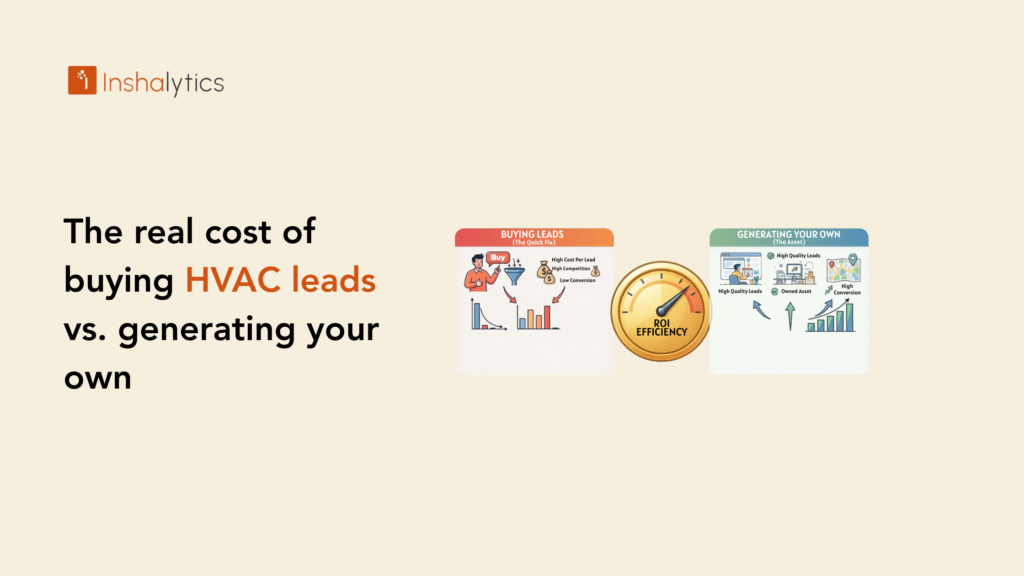
The problem is the math. When you run the full cost-per-booked-job calculation, not just cost per lead, the economics of buying HVAC leads look very different from what the platform pricing pages suggest. And when you extend that math over 12 or 24 months, the gap between buying leads and generating your own becomes one of the most important financial decisions an HVAC business owner makes.
This guide breaks down what buying HVAC leads costs actually, what generating your own leads actually costs, and how to decide which approach your business needs right now.
Why Cost Per Lead Is the Wrong Number to Compare
Every lead generation comparison starts in the wrong place. Cost per lead is what platforms advertise. It is not what matters for your business.
The Close Rate Gap: Shared Leads vs. Exclusive Inbound Leads
A shared lead from Angi or HomeAdvisor costs $15–$60 and goes to three to five HVAC contractors simultaneously. The moment that homeowners’ contact information hits your CRM, their phone is already ringing from your competitors. The race to respond first begins instantly, and even if you respond first, you’re still in a competitive situation with multiple contractors making their pitch.
Shared HVAC leads close at 8–15% in most markets. That means you’re paying for eight to twelve leads to book one job.
An inbound lead from your own Google Business Profile or a well-ranked website page is a homeowner who found you specifically, read your reviews, and chose to call your number. They are not waiting for four other contractors to call them. These leads close at 30–45%, sometimes higher for businesses with strong review profiles and fast response times.
That close rate difference is not marginal. It changes the entire economics of lead generation. Shared vs. exclusive leads for home services follow the same pattern regardless of trade; the exclusivity premium almost always produces better cost-per-booked-job math.
How to Calculate Cost Per Booked Job Across Both Models
The formula that matters: (Cost per lead ÷ close rate) = cost per booked job.
A shared Angi lead at $40 with a 10% close rate = $400 per booked job. An exclusive Google LSA lead at $70 with a 30% close rate = $233 per booked job. An organic SEO lead at $15 (once ranking) with a 40% close rate = $37 per booked job.
The shared lead looks cheapest at acquisition. It’s the most expensive per booked job. This arithmetic is why HVAC contractors who understand their true cost per lead consistently move budget away from shared platforms and toward owned channels over time.
The Lifetime Value Math That Makes Owned Leads Worth the Investment
HVAC customer lifetime value is one of the highest in home services. A homeowner who becomes a loyal HVAC customer with annual tune-ups and eventual system replacement is worth $8,000–$15,000 in lifetime revenue over a seven to ten year relationship. [STAT NEEDED: average HVAC customer lifetime value by market]
When you buy a shared lead from a marketplace, that homeowner does not become “your customer” in any durable sense. If they didn’t find you through a search, they have no particular reason to search for you again when their next HVAC need arises. They’ll go back to Angi or Google and end up in another competitive auction.
When a homeowner finds you through organic search, Google Maps, or a recommendation from a neighbor, you are building a relationship with a customer who knows your brand. That customer is dramatically more likely to call you directly next time, which means your second and third transaction with them costs you nothing in lead acquisition. The lifetime value math tilts overwhelmingly in favor of owned channels.
What Buying HVAC Leads Actually Costs in 2026
Let’s look at what you’re actually paying in total cost and in time when you rely on lead purchasing as your primary acquisition strategy.
Shared Lead Platforms: Per-Lead Pricing, Volume Realities, and Close Rates
Angi, HomeAdvisor, and Thumbtack-style platforms charge $15–$80 per HVAC lead depending on service type, market, and lead exclusivity tier. Most of the leads in the lower price range are shared and sent to multiple contractors simultaneously.
The math at scale: if you need 20 booked HVAC jobs per month, and your shared lead close rate is 12%, you need approximately 167 leads per month. At $35/lead, that’s $5,845 per month in lead costs alone, before any management fees. That number grows every year as platforms raise prices and add more contractors to their networks.
The closer problem compounds this. On shared leads, speed-to-call is the primary competitive variable. If your office answers within two minutes, you win a disproportionate share. If you’re slower because you’re on a job, your CSR is tied up, or the call came in at 7 PM, you’re paying for leads you’ll never convert regardless of how good your technicians are.
Exclusive Pay-Per-Lead Services: Higher Cost, Better Conversion But Still Rented
Some services offer exclusive HVAC leads, one contact sold to one contractor. These leads convert at significantly higher rates (25–40% depending on service type) but cost more upfront: $45–$150 per lead depending on market and service type.
The close rate improvement is real. But the fundamental structure is the same: you’re renting access to homeowners, not building an audience. When you stop paying, the leads stop. There is no asset accumulating. No GBP authority compounding. No rankings building. Just a monthly transaction with a vendor who controls your pipeline.
Exclusive bought leads are better than shared bought leads. They’re still structurally less efficient than leads your owned channels generate at maturity.
The Hidden Costs: Speed-to-Lead Requirements and the Staff Time Nobody Counts
Every lead platform emphasizes that you must respond immediately. Some platforms downrank contractors who take more than five minutes to respond. This is not just a sales tip; it’s a staffing requirement.
If you’re relying on bought HVAC leads as your primary acquisition channel, you need someone available to answer the phone or return calls within two to three minutes, seven days a week, including evenings. That either means the owner is always available, or you’re paying for a CSR or call answering service.
That staffing cost is almost never included in lead cost calculations, but it’s real. Add $800–$2,000/month for a quality call answering service to your bought lead costs, and the economics shift further away from the platform’s advertised CPL.
What Generating Your Own HVAC Leads Actually Costs
Generating your own HVAC leads requires upfront investment and a 3–6 month runway before organic channels produce meaningful volume. The payoff is a lead cost structure that improves every month rather than staying flat or rising.
Google LSA and Google Ads: Management Fees + Ad Spend Benchmarks
Google Local Services Ads are the fastest path to exclusive, high-intent HVAC leads. You pay per qualified contact, not per click, and the lead is yours alone. LSA leads for HVAC in most markets cost $40–$80 per contact, with close rates of 20–35%.
LSA management typically runs $300–$600/month in agency fees. Total investment for a well-run LSA program: $1,500–$3,500/month depending on market. For a business doing $800K+ in annual revenue, this investment is almost always positive on cost-per-booked-job math.
Google Search Ads produce similar quality leads with more targeting control. HVAC campaigns require careful keyword selection, separate campaigns for emergency repairs vs. replacements, and dedicated landing pages that match the specific search. HVAC Google Ads budget benchmarks break this down further. Expect $500–$1,200/month in management fees plus $1,500–$5,000/month in ad spend depending on market competitiveness.
Local SEO: Monthly Investment, Timeline to Results, and Cost Per Lead Once Ranking
Local SEO is the slowest channel to produce results and the most valuable channel once it does. A well-ranked HVAC contractor generates inbound calls from Google Maps and organic search at zero cost per click, which means the cost per lead from organic channels drops every month as rankings improve.
Monthly investment for a comprehensive HVAC local SEO program: $1,200–$3,000/month. Timeline to meaningful results: 3–6 months for GBP improvements, 6–12 months for significant organic ranking changes in competitive markets. The cost per lead from organic channels at maturity typically runs $8–$25, the lowest of any acquisition channel.
The investment in local SEO for HVAC contractors is a long game. The contractors who started 12 months ago are now generating leads at a fraction of what their competitors are paying on shared platforms.
Google Business Profile Optimization: The Lowest-Cost Channel With the Highest ROI
Your Google Business Profile is the single highest-return marketing investment available to an HVAC business, and the baseline work to optimize it is far less expensive than any paid channel.
A fully optimized, actively managed GBP with strong review velocity generates Map Pack visibility that captures 30–40% of local HVAC search clicks. The investment: professional setup and optimization typically runs $500–$1,000 as a one-time project, with ongoing management at $200–$400/month.
The leads generated through your GBP are exclusive by definition: the homeowner clicked your listing and called your number. They’re high-intent because they were searching when they called. And the cost per lead trends toward zero over time as your ranking consolidates.
The Compounding Advantage of Owned Lead Channels
This is the part of the analysis that changes how most HVAC operators think about the decision.
Why Your Cost Per Organic Lead Drops Every Month You Invest
Bought leads have a flat or rising cost structure. You pay $40/lead in January and $45/lead in December because platform costs trend up over time.
Owned channels work the opposite way. The SEO work done in month three generates rankings that produce leads in month nine. The GBP authority built over 12 months produces Map Pack visibility that continues delivering even if you reduce spend on other channels. Every month of consistent investment compounds into a lower cost per lead from organic sources.
At 18–24 months into a well-run owned channel strategy, HVAC businesses typically see their blended cost per lead drop by 40–60% compared to where it was at launch because the organic channels that cost nothing per click are now producing a significant portion of total lead volume.
What Happens to Bought Leads When You Stop Paying
When you stop paying a lead platform, you receive zero leads. No inventory. No legacy value. No customers who remember your name because they found you there. The entire channel goes to zero instantly.
When you stop paying for an SEO retainer after 18 months of consistent work, you don’t lose your rankings overnight. The authority you’ve built decays slowly. Your GBP continues generating calls. Your organic content continues ranking. The asset you built has a residual value that rented channels never develop.
This asymmetry is the core argument for owned channels, and it’s why the true cost of bad leads for handyman and HVAC businesses is almost always underestimated when compared at the per-lead price alone.
Building an Asset vs. Renting Access: The Five-Year Math
Consider two HVAC businesses starting from the same position. Business A spends $3,000/month on shared leads for five years, $180,000 total. At the end of year five, they have the same cost per lead they started with and no marketing asset.
Business B invests $2,500/month in a blended owned channel program for five years $150,000 total. At the end of year five, they have established GBP authority, ranking organic content, call tracking data that shows which channels produce which jobs, a customer database worth tens of thousands in reactivation value, and a blended cost per lead that is significantly lower than it was at the start.
Same approximate investment. Completely different outcomes. The asset compounds. The rental does not.
When Buying Leads Makes Sense And When to Stop
Bought leads are not categorically wrong. They serve a specific purpose at a specific stage of business.
Using Bought Leads to Bridge the Gap While SEO Builds
The honest advice: if you need leads now and you’re starting from zero online presence, buying leads while you build owned channels is a legitimate strategy. The problem is treating that bridge as a destination.
Use shared and exclusive leads to fill your calendar in the first 6–12 months. Simultaneously invest in GBP optimization, citation building, and the early SEO work that takes time to produce results. As your organic channels start producing, reduce your dependence on bought leads proportionally.
The Threshold: When More Than 20% of Leads Come From Shared Platforms
A practical rule: if more than 20% of your total HVAC leads are coming from shared marketplace platforms, you’re building on rented land. The majority of your pipeline is controlled by a platform whose pricing and policies can change independently of your business performance.
Below that 20% threshold where shared leads are filling gaps during slow periods and your core volume comes from owned channels, the model works. Above it, you’re in a dependency that will cost more every year to maintain.
How to Transition Out of Lead Dependency Without Killing Your Pipeline
The most common mistake in this transition is stopping bought leads before owned channels are producing. Don’t cut the bridge before you’ve crossed it.
The practical transition: start owned channel investment while maintaining bought lead volume. As your LSA program generates consistent leads and your GBP starts appearing in the Map Pack, reduce your marketplace spend by 10–15% per quarter. Track your total lead volume and cost per booked job monthly. Reduce further when the math confirms your owned channels are covering the gap.
The transition typically takes 12–18 months to complete fully. The businesses that try to do it in three months either lose pipeline or panic and go back to platforms. Steady, measured reduction while owned channels mature is the only reliable approach.
How Inshalytics Builds HVAC Lead Generation Systems That You Own
At Inshalytics, the owned vs. rented distinction is not a marketing talking point; it’s the foundation of how we build every HVAC program. Our goal is not to make you dependent on us. It’s to build lead generation assets that produce results whether or not you continue working with us.
The Channels We Prioritize and Why
Every Inshalytics HVAC program starts with the highest-return owned channels first: GBP optimization and review generation (immediate impact, zero cost per lead), LSA setup and management (immediate paid leads, exclusive, high-converting), and local SEO (compounding value over 6–18 months).
We do not recommend Facebook ads for HVAC businesses until the Google channels are producing consistently. Too many HVAC businesses spread budget across every channel at once and produce mediocre results everywhere. Depth in the right channels beats coverage across all of them.
How We Track Cost Per Booked Job, Not Cost Per Lead
Every Inshalytics HVAC program is tracked at the booked job level, not the lead level. We set up call tracking by channel, form tracking in GA4, and monthly reporting that shows you exactly which marketing dollars produced which revenue. You always know whether your investment is producing an acceptable return, and you have the data to make decisions based on what’s actually working.
Ready to stop renting your pipeline and start building one you own? Talk to the Inshalytics team about what an owned channel program looks like for your HVAC business in your market.
The cost of buying HVAC leads is almost always higher than it appears on the platform pricing page. The cost of generating your own leads is almost always lower over time than the upfront investment suggests.
Run the cost per booked job math, not the cost per lead comparison. Use bought leads as a bridge, not a foundation. And invest in the owned channels GBP, LSA, local SEO that produce an asset with compounding value rather than a monthly transaction that produces nothing when the invoice stops.