Your handyman website is getting traffic. You can see it in Google Analytics: people are landing on your pages. But the phone isn’t ringing. That gap between visitors and calls is not a traffic problem. It is a conversion problem, and it has specific, fixable causes. This guide focuses on what a high-converting handyman website actually looks like, not a list of mistakes to avoid (we’ve covered why most handyman websites don’t convert separately) but the positive architecture of a site that turns visitors into booked jobs. If your site has traffic and no calls, this is where to start. In this guide, we cover handyman website design and what to do next.
Why Most Handyman Websites Get Traffic But Not Calls
Understanding the conversion gap starts with understanding what a visitor actually experiences when they land on a typical handyman website.
The Difference Between a Brochure Site and a Lead-Generating Site
Most handyman websites are brochure sites they exist to confirm that the business is real and list the services it offers. A homeowner can read them, feel vaguely reassured, and then leave without taking any action. A lead-generating site is designed around a single goal: getting the visitor to call, text, or fill out a form. Every design decision layout, content, color, button placement is made in service of that goal. The difference is not cosmetic. A brochure site has information. A lead-generating site has a system. The system is what converts.
What Visitors Decide in the First 5 Seconds
Research consistently shows that website visitors make a credibility judgment in the first 3–5 seconds of landing on a page. In that window, they answer one question: do I trust this business enough to keep reading? If the answer is no because the design looks dated, the page loads slowly, the phone number is buried, or the messaging is unclear they’re gone. For handyman websites, that judgment happens even faster because homeowners are usually looking at multiple options simultaneously. Your site doesn’t need to be the most beautiful site they’ve ever seen. It needs to look credible, load fast, and make the next step obvious.
The Trust Gap: Why Homeowners Click Away Before Calling
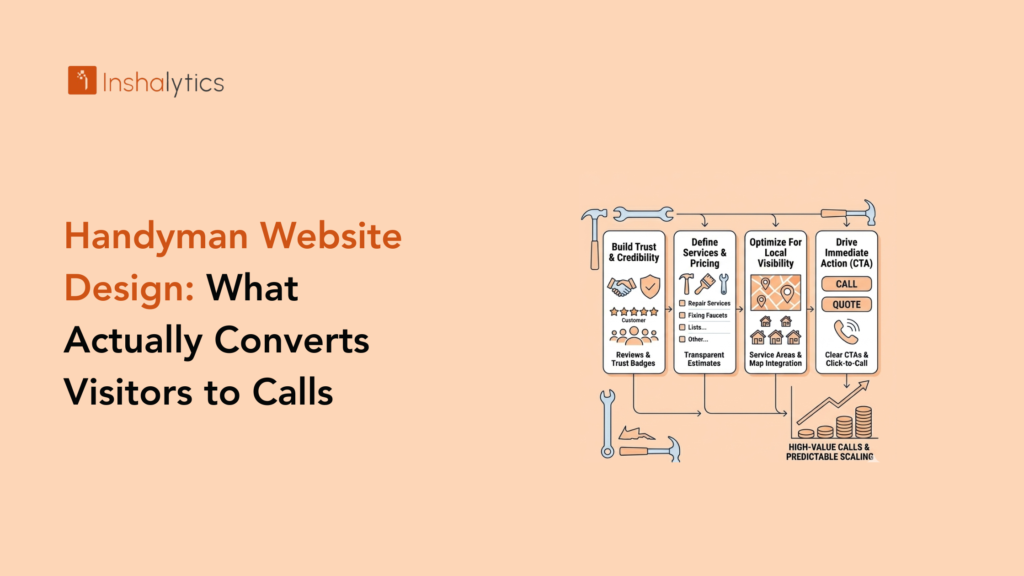
Inviting a handyman into your home is a trust decision. Homeowners vet businesses online specifically because a stranger with tools is coming to a space they care about. The trust gap is the distance between what a visitor sees on your website and the level of confidence they need to pick up the phone. Businesses that close this gap quickly with visible credentials, real photos, authentic reviews, and clear service descriptions convert at higher rates than those that don’t, regardless of how much traffic they get. The trust signals a handyman website needs are specific to the trade, and they’re different from what works for an e-commerce store or a law firm.
What Does a High-Converting Handyman Website Look Like?
A high-converting handyman website is not defined by its visual style. It is defined by whether it reliably produces contacts. Here is what the structure looks like.
Above the Fold: What Has to Be Visible Without Scrolling
The above-the-fold section everything a visitor sees without scrolling does the most conversion work of any part of your site. It must contain: your clickable phone number (large, prominent, top right), a clear headline that states what you do and where (“Trusted Handyman Services in [City]”), a primary CTA button (“Get a Free Estimate” or “Book Now”), and at least one trust signal (your review rating, years in business, or a key credential). If a homeowner has to scroll to find any of these, your above-the-fold section is losing calls. On mobile, which accounts for over 60% of handyman searches, this section needs to fit in a single phone screen without pinching or zooming.
The Phone Number Rule: Click-to-Call on Every Page, Every Device
Your phone number should appear in at least three places on every page: the header (sticky, so it follows the user as they scroll), within the main content area of each service page, and in the footer. On mobile, every instance of your phone number should be a tap-to-call link a homeowner should be able to go from “found your site” to “phone ringing” in a single tap. The friction of copying a phone number and switching to the dialer loses real leads. This is one of the highest-leverage, lowest-effort improvements a handyman website can make, and it costs nothing to implement.
Service Pages vs. a Single Homepage: Why Separation Wins
A single homepage that lists all your services in one block does two things wrong: it gives Google nothing specific to rank, and it gives homeowners nothing relevant to read. Homeowners searching for “drywall repair near me” are not looking for a page that mentions drywall repair alongside 12 other services. They want a page that speaks directly to their specific problem. Dedicated service pages one page per primary service type, rank for specific searches and convert the visitors those searches deliver. Each service page should cover what the service includes, typical job scenarios, pricing context, your service area, and a clear call-to-action. See how this connects to how homeowners search for handymen online; the search behavior and the page structure should match.
What Makes Homeowners Trust a Handyman Website Enough to Call?
Trust is not built by claiming you’re trustworthy. It’s built by showing evidence that others have trusted you and been satisfied. Here is how high-converting handyman sites do it.
Reviews, Badges, and Licenses: What Signals Legitimacy
Every handyman website should display, prominently, at minimum: a Google review widget showing your current star rating and review count, a general liability insurance badge (most homeowners want to know you’re insured before letting you into their home), and any state licensing credentials that apply to your trade in your state. If you’re Google Screened through LSA, display that badge too it carries specific recognition among homeowners who research online. These signals should appear on the homepage and on every major service page, not just a dedicated “About” page that most visitors never read.
Before-and-After Photos vs. Stock Images: What Actually Converts
Stock photos of a smiling handyman in a hard hat do not convert. Real before-and-after photos of your actual work do. A homeowner considering drywall repair wants to see what a patch looks like before and after your team addresses it. A homeowner considering deck work wants to see a deck you’ve refinished. Real photos signal two things simultaneously: that you do the work (not just talk about it) and that you do it well. If your website uses only stock imagery, replacing it with real job photos is the single highest-impact visual change you can make. Even mediocre photo quality is better than perfect stock photography for conversion purposes.
Response Time Indicators and Availability Signals That Reduce Friction
Homeowners with urgent repair needs a leaky faucet, a broken door, a safety issue are anxious. They want to know how fast you’ll respond. Adding response time language to your site reduces that anxiety and increases the likelihood they’ll contact you instead of moving on. Examples: “Same-day estimates available”, “We respond to all inquiries within 2 hours”, “Emergency repairs call now”. These statements don’t need to be exaggerated; they just need to reflect reality. If you genuinely offer same-day availability, say so clearly. Homeowners will choose the business that sets that expectation over one that says nothing about response time.
Mobile Performance: Where Most Handyman Sites Lose the Lead
The majority of handyman searches happen on smartphones. A website that works on desktop and breaks on mobile is not a handyman website it’s a desktop brochure.
Why Over 60% of Handyman Searches Happen on Mobile
Most handyman searches are triggered by a problem happening right now. A homeowner notices the issue, pulls out their phone, and searches immediately. They’re not sitting at a computer comparing options at leisure they’re standing in the room with the broken thing. This means your site will almost always be evaluated on a 4–6 inch screen, often on a slower cellular connection, by someone who wants a result quickly. A site that’s hard to navigate on mobile, slow to load, or displays text that requires pinching and zooming will not hold that person’s attention for the 20–30 seconds it takes to convert them into a call.
Page Speed and Core Web Vitals What Slow Sites Cost You in Calls
Page load speed has a direct relationship with conversion rate. A site that loads in under 2 seconds converts measurably better than one that takes 5 seconds. Google’s Core Web Vitals LCP (Largest Contentful Paint), INP (Interaction to Next Paint), and CLS (Cumulative Layout Shift) are both ranking factors and conversion drivers. A slow site ranks lower in Google search results and converts fewer of the visitors it does get. For handyman websites, common speed killers include oversized images, unoptimized video embeds, too many plugins, and cheap shared hosting. Every second of load time you eliminate improves both your SEO and your conversion rate simultaneously.
Mobile CTA Design What a Thumb-Friendly Site Actually Means
Mobile users navigate with their thumbs. Buttons that are too small to tap accurately, CTAs that are positioned in corners where thumbs don’t naturally reach, and form fields that require switching between keyboard and content kill mobile conversions. A thumb-friendly handyman website has large tap targets (at least 44×44 pixels), CTAs positioned in the natural thumb zone (center and lower-center of the screen), and a sticky header with a phone number visible at all times. The contact form if you use one should require as few fields as possible. Name, phone, and a brief description of the job is enough. Every additional field reduces completion rate.
How Does Your Website Connect to Your Cost Per Booked Job?
Website performance is not a vanity metric. It has a direct, calculable relationship to the revenue your marketing investment generates.
Conversion Rate Math: What a 1% CRO Improvement Is Worth
If your handyman website receives 300 visitors per month and converts at 2% (6 contacts), and your average booked job is worth $400, your website generates $2,400/month in pipeline. Improve your conversion rate to 3% (9 contacts), and that number becomes $3,600/month, an additional $1,200 per month from the same traffic, with zero increase in marketing spend. At scale, over a year, that’s $14,400 in additional revenue from a 1% conversion improvement. This is why CRO investment returns more than traffic investment for websites that already have reasonable visitor volume. More traffic through a leaking funnel does not solve the problem.
How Traffic Source Affects What Your Site Needs to Do
A visitor arriving from a “handyman near me” search is in a different mindset than a visitor arriving from a Facebook ad. The Google search visitor has already decided to hire they need trust signals and a fast path to contact. The Facebook ad visitor may not have been thinking about hiring a handyman at all; they need problem framing and a softer conversion path (like an estimate calculator or a service guide) before they’re ready to call. Your website’s conversion architecture should account for both traffic types. Understanding how homeowners search for handymen online helps you design the right experience for each entry point.
Tracking Calls and Form Fills: You Can’t Improve What You Don’t Measure
Most handyman websites have no call tracking in place. Without it, you have no idea how many calls your website generates, which pages produce them, or whether any of your improvements are working. Call tracking tools assign a unique phone number to your website that forwards to your real number; every call is logged with the source page, duration, and outcome. Google Analytics tracks form submissions. Without both, you’re flying blind on the most important metric your website has. Set up call tracking before making any other conversion improvements; otherwise, you’re optimizing without feedback.
When to Fix Your Website vs. When to Rebuild It
Not every underperforming handyman website needs to be replaced. Some need specific fixes. Some need to be started over. Knowing the difference saves significant time and money.
The DIY CRO Checklist for a Handyman Site
Before investing in a full rebuild, check whether these high-impact, low-cost fixes resolve the conversion problem:
• Add a click-to-call phone number in the header and make it sticky on scroll
• Replace stock photos with real before-and-after job photos on the homepage and service pages
• Add a Google review widget to the homepage and at least two service pages
• Create dedicated service pages for your top three services if they don’t exist
• Run a mobile speed test (Google PageSpeed Insights) and compress any images over 200KB
• Simplify your contact form to three fields maximum: name, phone, job description
• Add response time language above the fold and on your contact page
If your site has all of these and still isn’t converting, the issue may be structural: the site was built as a brochure and needs to be rebuilt as a conversion tool.
What a Lead-Optimized Handyman Website Actually Costs to Build Right
A website built specifically to generate handyman leads with dedicated service pages, mobile-first design, call tracking, proper on-page SEO, and conversion-optimized layout typically costs $2,500–$6,000 for a custom build from a specialist. Website builders (Wix, Squarespace) can produce functional sites for less, but they often introduce speed and SEO limitations that hurt the lead generation performance you’re trying to build. The right question is not “what does the website cost?” but “what does a website that doesn’t convert cost in missed revenue per month?” Most handyman businesses that run that calculation find the math strongly favors investing in a site built correctly. For context on how website performance connects to your broader lead system, see how it fits alongside Google Business Profile optimization and LSA for handyman businesses.
Not sure whether your site needs fixes or a rebuild? Inshalytics reviews handyman websites and identifies the specific conversion barriers costing you calls no guesswork, no generic advice.