When your AC stops working at 10 PM in July, you’re not comparing five contractors on price. You’re opening Google, scanning the first thing that looks credible, and making a call. The contractor who gets that call didn’t win it. They had the best website or the lowest price they won it because they were visible, they looked trustworthy at a glance, and they were easy to reach.
Understanding how homeowners actually choose an HVAC company not how you hope they do, but what the research consistently shows changes how you should invest your marketing budget. The data is not ambiguous. Certain signals drive the decision reliably, in a predictable sequence, and the HVAC contractors who build their marketing around that sequence win more jobs at lower cost per acquisition than those who don’t.
Here’s what the data says.
The Research Homeowners Do Before They Ever Call Anyone
The assumption that emergency HVAC calls skip the research phase is wrong. Even under urgency, most homeowners do some form of validation before committing to a contractor. The nature of that research has changed significantly in the past three years.
77% of Homeowners Research Before Purchase What They’re Looking For
Research from Decision Analyst shows that 77% of homeowners conduct research before making an HVAC purchase, up from 67% in 2022. Of those, 56% turn to the internet first, 34% turn to contractors directly, and the remainder rely on family or friends.
What they’re looking for during that research phase is not primarily price. They’re looking for confidence that the contractor is real, qualified, and trustworthy enough to let into their home. The comfort signals they’re scanning for reviews, photos, credentials, clear service descriptions are more determinative of whether they call than any marketing message you write.
This means your marketing’s primary job is not persuasion. It’s reassurance. A homeowner who lands on your Google Business Profile or website is not waiting to be convinced to hire an HVAC contractor; they’ve already made that decision. They’re deciding whether to hire you. Everything you’ve built online either gives them the confidence to call or sends them back to the list.
The Role of AI Search in 2026: ChatGPT and Perplexity as Contractor Recommenders
In 2026, the research journey has expanded significantly beyond Google. A BrightLocal survey found that 45% of consumers now use AI tools ChatGPT, Perplexity, Google AI Overviews, and similar platforms to find local services. A year earlier, that number was 6%.
AI tools recommend HVAC contractors based on structured, authoritative content. Contractors whose websites clearly describe their services, service area, licensing, and experience and who have substantial, recent review content appear in AI-generated recommendations at dramatically higher rates than those with thin or generic content.
This is not a future concern. Homeowners are already asking AI assistants “who’s a good HVAC contractor near me” and receiving specific company names in response. If your HVAC website isn’t converting or your GBP profile is incomplete, you are invisible to a growing share of the homeowner research process. The contractors building structured content now are compounding an advantage that will widen every month.
Why Map Pack Visibility Is Still the First Impression That Matters
Despite the AI search shift, Google Maps and the local Map Pack remain the dominant discovery channel for HVAC services. Research shows that HVAC companies ranking in the top three positions of the Map Pack capture approximately 75% of all local clicks for HVAC searches in their area.
The Map Pack is where the research journey ends for most homeowners; they see three contractors, scan the star ratings and review counts, click the one that looks most credible, and either call from the listing or visit the website briefly before calling. The entire evaluation happens in under 60 seconds for a significant portion of homeowners, particularly those in emergencies.
This is why ranking your HVAC business on Google Maps is not just an SEO goal; it’s a revenue prerequisite. If you’re not in the top three for “HVAC contractor near me” in your primary service city, you’re not in consideration for the majority of inbound opportunities.
What Actually Drives the Hiring Decision
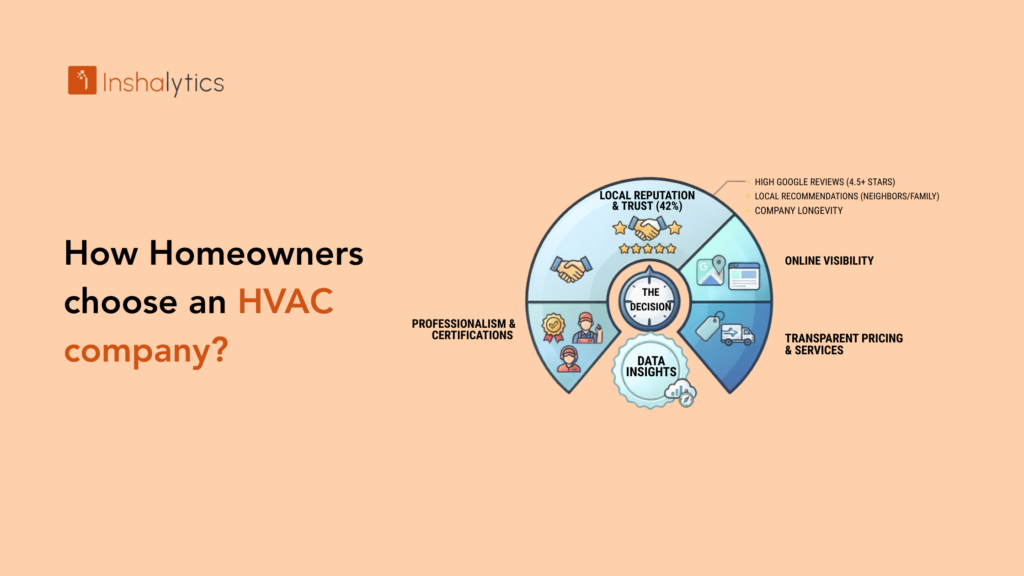
Once a homeowner has identified your business through the Map Pack, an AI recommendation, or a search result, the decision comes down to a handful of signals that research consistently identifies as the primary drivers of the call.
Reliability Over Price: Why 38% of Homeowners Rank Trust First
Data from multiple HVAC consumer surveys identifies reliability and trustworthiness as the leading decision factor, ahead of price, for a significant plurality of homeowners. One study found that 38% of consumers ranked system reliability as their top priority when selecting HVAC services, while 83% ranked something other than cost as their primary factor.
This finding runs counter to how most HVAC operators position themselves. Competing on price “the best rates in ” targets the minority of homeowners whose primary driver is cost, while leaving the majority looking for a more credible signal that you’re the trustworthy, reliable option.
The practical implication: trust signals your Google star rating, your review content, your licensing and insurance credentials displayed clearly, and your manufacturer certifications do more to win the job than a price guarantee. Build the signals that answer “can I trust this contractor?” before you invest in messaging around your rates.
Reviews as the Decision Trigger: What 91% of Homeowners Check Before Calling
Research from ACHR News found that 91% of consumers rely on online reviews when selecting HVAC contractors. A separate study found that 73.9% of homeowners made their HVAC purchase after consulting at least one online review site.
This is not a soft preference. It’s a near-universal behavior. A homeowner who is choosing between three Map Pack results will almost always pick the contractor with more, better, and more recent reviews even if that contractor is slightly more expensive than the alternative.
Review volume matters. Review recency matters. And critically, review content matters. Google’s algorithm weighs reviews that mention specific services (“they fixed our furnace in one visit”) and locations (“they came to our house in [neighborhood]”) more heavily than generic five-star ratings with no text.
The HVAC operators who build a systematic review generation process asking after every completed job, with a direct link to their Google review page, compound a ranking and conversion advantage that competitors who don’t ask can never easily close.
Speed as a Differentiator: Why the First Contractor to Respond Wins 78% of the Time
Research on lead response time in home services consistently identifies a pattern: the contractor who responds to a new inquiry first wins the job roughly 78% of the time, regardless of whether their price is the lowest. In emergency HVAC situations, that advantage is even more pronounced.
This finding has specific implications for how you structure your operations. If your business goes to voicemail after 5 PM, you are surrendering a disproportionate share of evening emergency calls to competitors with answering services or after-hours coverage. If your average callback time is 45 minutes, you are losing jobs to competitors who call back in 8 minutes.
Speed-to-response is not a marketing metric; it’s an operations metric. But it directly determines how much revenue your marketing investment produces. The HVAC Google Ads budget discussion always comes back to this: an HVAC business spending $3,000/month on paid ads while missing 20% of inbound calls is buying leads and throwing away a fifth of them before anyone speaks to a homeowner.
The Emergency vs. Planned Purchase Split And Why It Changes Everything
HVAC homeowners are not a monolithic audience. They’re in two fundamentally different situations when they contact a contractor, and the marketing that reaches them effectively looks very different depending on which situation they’re in.
Emergency Searches: What Homeowners Do at 11 PM When the AC Dies
Emergency HVAC searches are high-intent, time-compressed, and conversion-dominant. A homeowner whose system failed in July is not browsing they’re searching, scanning, calling, and booking within minutes. Reviews and Map Pack ranking are the primary decision drivers. Website visits are brief. Price comparison rarely happens.
The marketing investment that captures emergency searches most effectively is Google Local Services Ads, which appear at the very top of search results, above paid ads, above the Map Pack, combined with a dominant Map Pack position from strong GBP optimization. Paid ad relevance for emergency keywords (“emergency AC repair near me,” “HVAC repair 24 hours”) is the paid complement to organic Map Pack visibility.
Emergency conversion also depends on operational factors more than marketing factors. A homeowner willing to call at 11 PM will book the first contractor who answers, which means your answering capability, not just your visibility, determines what percentage of those searches become revenue.
Planned Replacement Searches: The Seven-Day Research Window Before They Call
Planned HVAC replacements follow a completely different pattern. A homeowner with an aging system 12+ years old, increasingly unreliable, generating rising energy bills is not in a crisis. They’re researching over days or weeks, comparing contractors, reading reviews carefully, and often reaching out to multiple companies before committing.
Research from Decision Analyst shows that HVAC purchases take an average of seven days from initial awareness to decision. Emergency purchases compress that to five days; planned replacements extend it to nine days or longer. During that research window, the homeowner is evaluating your company across multiple touchpoints: your GBP, your website, your reviews, and increasingly your AI search visibility.
Facebook advertising is particularly effective at reaching homeowners in the planned replacement phase before they start actively searching. A homeowner who sees a Facebook ad about aging HVAC systems, efficiency upgrades, or financing options while their 14-year-old unit is still technically functioning is a homeowner who is being reached before they enter the Google auction. Facebook and Instagram advertising for HVAC businesses covers this pre-search channel in detail.
Why Your Marketing Needs to Win Both Scenarios
Most HVAC companies optimize for one scenario at the expense of the other. Emergency-focused operators invest heavily in Google Ads and LSA for immediate high-intent searches but have no strategy for reaching planned replacement customers before they’re ready to call. Planned-purchase focused operators invest in content and Facebook but miss the emergency calls that would have converted at high rates.
A complete HVAC marketing system captures both. Google Ads and LSA for emergency and high-intent search demand. Local SEO for HVAC contractors for organic Map Pack visibility in both emergency and planned searches. Facebook and content marketing to reach homeowners in the pre-search awareness phase before the urgency that drives the Google auction.
What Homeowners See Before They See You: Website, Reviews, and GBP
The research phase ends at a specific moment: when the homeowner makes contact. Everything your marketing has built either gave them the confidence to call before they ever spoke to you, or didn’t.
The Website Visit That Happens Before the Phone Call
A survey by HVAC Webmasters found that when homeowners discover a well-rated HVAC company on Google Search, the majority visit the website before calling, even when the phone number is visible directly in the listing. This held true across all age groups studied.
What they’re doing during that visit is not reading content. They’re scanning for comfort signals: a clear description of services, a phone number that’s easy to find and click, photos that look like real work from real technicians, and social proof in the form of reviews or testimonials. The average visitor makes this evaluation in under 20 seconds.
A website that loads slowly, has no photos of real work, buries the phone number, or lacks a clear description of what you do will lose homeowners who were fully prepared to book before they arrived. This is why HVAC website conversion optimization is not a design project; it’s a revenue recovery project. Every conversion rate improvement doubles down on whatever you’re spending to drive traffic.
Testimonials as the #1 Comfort Factor on HVAC Websites
Survey data from HVAC Webmasters found that customer testimonials ranked as the number one comfort factor homeowners look for when evaluating an unfamiliar HVAC company’s website, outranking clear service descriptions, industry certifications, and owner photos.
Critically, testimonials that feel authentic real names, specific jobs, local references outperform generic five-star quotes without attribution. A testimonial that says “They replaced our furnace in December when it failed at 9 PM and had heat back by midnight” tells a specific story that generic “great service!” language cannot replicate.
Pull your real Google reviews onto your website with a live review widget. Add testimonials from customers willing to be quoted by name. If you have case studies or specific job stories, those carry even more weight than general praise. The homeowner on your website is looking for evidence that you’ve done this job before, for people like them, with results they can predict.
What a Weak Google Business Profile Costs You in the Decision Moment
Your GBP is not a static listing; it’s a living decision asset. A GBP with outdated photos, an incomplete services section, no recent posts, and a review profile that stalled 18 months ago signals to homeowners scanning listings at 11 PM that the business is inactive and who to call.
Specific GBP elements that research shows homeowners evaluate:
- Star rating and review count (the first thing visible in the Map Pack)
- Recency of reviews (a contractor with 80 reviews and the most recent from six months ago loses to a competitor with 45 reviews and three from last week)
- Photos listings with real job photos receive 42% more requests for directions and calls than listings without
- Response to reviews: homeowners read how contractors respond to negative reviews as a proxy for professionalism
How Repeat and Referral Behavior Changes When Homeowners Trust You
The hiring decision is not only about the first transaction. The way homeowners choose their second, third, and eventual replacement contractor tells you something important about what long-term marketing investment is actually building.
73% of Homeowners Reuse the Same HVAC Company: How to Be That Company
ACHR News research found that 73% of homeowners contact the same HVAC contractor they’ve used in the past when they have a new need. This is a 44% increase from the same survey the prior year, where only 29% reported reusing their previous contractor.
This data point changes how you should think about customer acquisition cost. If 73% of your customers will call you again for their next HVAC need without any paid acquisition cost, the lifetime value of a first-time customer is dramatically higher than a single-transaction calculation suggests.
The implication for your marketing: acquiring a new customer is the beginning of a revenue relationship, not a single transaction. The contractor who stays top-of-mind between service visits through annual maintenance reminders, seasonal tune-up campaigns, and consistent communication captures that 73% repeat behavior. The contractor who acquires a customer and then goes silent loses that relationship to whatever contractor shows up first in the Map Pack at the next moment of need.
Word of Mouth Has Gone Digital: Reviews, Social, and Community Groups
The survey found that 67% of homeowners reported finding their HVAC contractor via word of mouth or recommendation, including social media. This represents a significant evolution: “word of mouth” now includes online reviews, community Facebook groups, Nextdoor recommendations, and social media posts, not just neighbor-to-neighbor conversations.
For your marketing, this means every review you receive is a digital word-of-mouth referral to every homeowner who reads it. A contractor with 150 well-written reviews is receiving the marketing benefit of 150 satisfied customers telling strangers they did a good job at zero additional cost per impression.
Building a review generation system asking after every completed job, sending a direct link, and following up once if the homeowner hasn’t responded is the highest-leverage word-of-mouth strategy available to an HVAC business in 2026. For a broader look at HVAC SEO and keyword strategy that supports this visibility, that context rounds out the full picture.
Maintenance Agreements as the Loyalty System That Keeps You the Default Choice
A homeowner with an active maintenance agreement is a homeowner who sees you twice a year, receives your seasonal communications, and has your technician’s face in their mind when something breaks. They are not going to open Google and start comparing contractors when their heating system acts up; they’re calling the company on their maintenance agreement.
Maintenance agreements are the structural answer to the “how do I become the contractor homeowners call back” question. Research from multiple sources shows that maintenance customers refer at higher rates, spend more per service call, and accept replacement quotes at higher close rates than one-time service customers.
If you don’t currently have a maintenance agreement program, building one should be a higher priority than most marketing investments. It converts one-time revenue into recurring revenue and converts acquisition costs into lifetime relationships.
How Inshalytics Builds HVAC Marketing Around How Homeowners Actually Decide
At Inshalytics, every HVAC marketing program we build is structured around the decision journey the data describes, not around what’s easiest to report on or what looks active in a monthly dashboard.
Visibility at Every Stage of the Research Journey
A homeowner researching HVAC contractors in your market should encounter your business at multiple points in their research process: in the Google Map Pack when they search for “HVAC near me,” in organic search results when they research “how long does an AC unit last,” in AI search results when they ask ChatGPT for a recommendation, and in Facebook when they’re in the pre-search awareness phase with an aging system.
Multi-touchpoint visibility is not about spending money on every channel simultaneously. It’s about building the owned channels GBP, organic content, LSA that produce visibility at zero or low cost per contact, and supplementing with targeted paid channels at the stages where paid has clear ROI advantage.
Trust Signal Architecture: What We Build and Where We Put It
The trust signals homeowners evaluate reviews, credentials, real photos, response time, website clarity don’t appear automatically. They’re built systematically. Every Inshalytics HVAC program includes a trust signal audit: what signals currently exist, what’s missing, and a prioritized plan for building what the data shows homeowners are looking for.
For most HVAC businesses we work with, the highest-priority trust signal gaps are review velocity (not enough new reviews), GBP photo recency (no job photos in the past 60 days), and website conversion readiness (phone number not visible above the fold on mobile). These gaps are fixable in 30–60 days and produce measurable conversion rate improvements before any significant paid investment is made.
Want to know specifically which trust signals your HVAC business is missing and how that’s affecting the homeowners who are already finding you? Talk to the Inshalytics team; we’ll audit your current presence and show you exactly what the data says about where you’re losing potential customers.
The data on how homeowners choose an HVAC company is consistent, specific, and actionable. Reliability signals drive the hiring decision more than price. Reviews are checked by nearly every homeowner before they call. Speed of response determines a disproportionate share of who wins competitive inquiries. And 73% of satisfied customers will call the same contractor again if that contractor stays visible and relevant between service visits.
Build your marketing around what the research shows, not what feels intuitive. The contractors who study homeowner behavior and engineer their visibility and trust signals around the actual decision process consistently outperform those running campaigns based on guesswork. The data is available. The patterns are clear. The only variable is whether you build a system that takes advantage of them.