A commercial real estate firm lists 40 properties across three markets. Each vacancy page sits on the website with a generic description, a few photos, and no connection to related content. The result? Google treats every listing like an orphan page, isolated, low-authority, and buried beneath competitors who have been building structured content around the same property types and locations for years.
That is not a traffic problem. It is an architecture problem. And for commercial real estate websites that rely on vacancy pages to generate tenant leads, investor inquiries, and leasing conversions, the fix starts with how the site is organized, not how much content gets published.
Content silos give commercial real estate websites the structural backbone they need to rank for competitive property searches, build topical authority across multiple markets, and turn vacancy listings into genuine lead-generation assets. This guide walks you through exactly how to plan, build, and scale a silo architecture designed specifically for CRE vacancy pages, from choosing the right silo model to mapping your internal links and creating pillar content that supports every listing in your portfolio.
Navigate This Post
What Is a Content Silo Structure and Why Does It Matter for CRE Websites?
How Content Silos Work in Simple Terms?
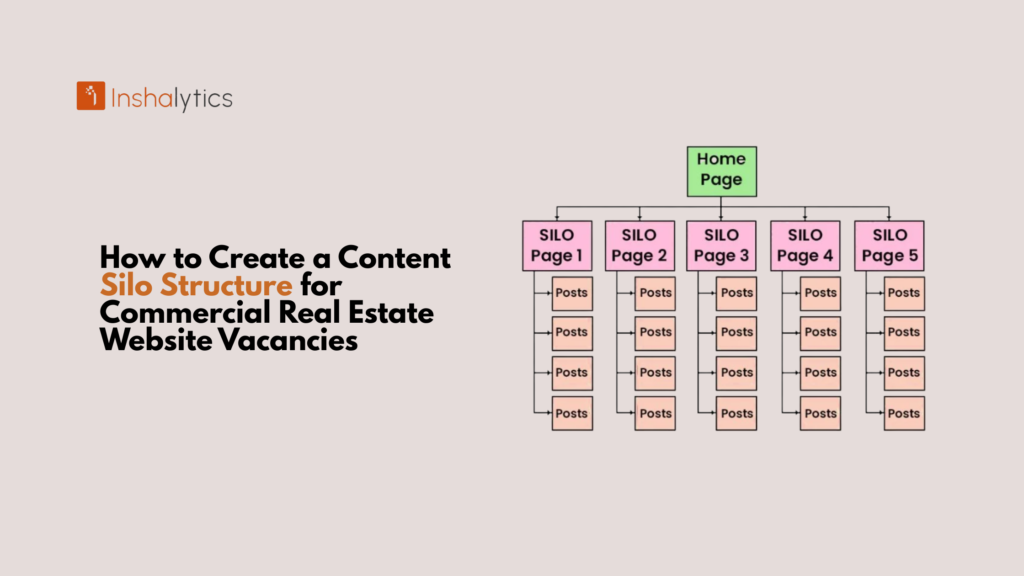
A content silo is a way of organizing your website into distinct thematic sections where every page within a section focuses on the same core topic and links to related pages in that group. Think of it as building a filing cabinet where each drawer represents one subject, and every document inside that drawer reinforces the drawer’s label.
In practice, a silo has three layers. At the top sits a pillar page, a comprehensive, keyword-targeted page that covers a broad topic. Beneath it are cluster pages that explore specific subtopics in more depth. And at the bottom are supporting articles or individual listing pages that target long-tail keywords and feed authority back up to the pillar through internal links.
Search engines use this structure to understand relationships between pages, assess the depth of your expertise on a subject, and decide which sites deserve to rank highest for competitive queries.
Why Commercial Real Estate Sites Need Silos More Than Most Industries?
Commercial real estate websites face a unique structural challenge that most other industries do not. A typical CRE site has dozens or even hundreds of individual vacancy pages, each targeting a different property, location, and tenant type. Without a silo structure, these pages compete against each other for similar keywords, confuse search engine crawlers, and fail to build the cumulative authority needed to outrank platforms like LoopNet, CoStar, and Crexi.
Silos solve this by grouping related vacancy pages under pillar content that tells Google exactly what your site is about. When a search engine sees that your “Dallas Office Space” pillar page links to 15 individual office listings in Dallas, and those listings link back, it recognizes your website as an authoritative source for office space in that market. That recognition translates directly into higher rankings, more qualified organic traffic, and better lead quality.
The Cost of Disorganized Vacancy Pages on SEO Performance
Disorganized vacancy pages create three measurable problems. First, they produce keyword cannibalization, multiple listings targeting the same terms without any hierarchy telling Google which page to rank. Second, they create orphan pages that have no internal links pointing to them, making them nearly invisible to crawlers. Third, they waste the SEO value of any backlinks the site earns, because there is no internal linking structure to distribute that authority across related pages.
A 2024 analysis by Ahrefs found that pages with strong internal linking structures earn significantly more organic traffic than isolated pages targeting the same keywords. For CRE websites with large property portfolios, the difference between a structured site and an unstructured one can mean the difference between page-one rankings and page-five obscurity.
Types of Silo Structures That Work Best for Commercial Property Listings
Property-Type Silos (Office, Retail, Industrial, Flex Space)
The most intuitive silo model for commercial real estate organizes content by property type. Each silo focuses on a single asset class, office, retail, industrial, flex, or mixed-use, with a pillar page that covers everything a tenant or investor needs to know about that property type.
Under this model, a pillar page titled “Available Office Space for Lease” would link to individual office vacancy listings, supporting blog posts about office market trends, and comparison guides for different office subtypes (Class A vs. Class B, coworking vs. traditional). Every page within the silo reinforces the site’s authority on office space, and the internal links keep all of that authority circulating within the silo.
Location-Based Silos for Multi-Market Vacancy Pages
For CRE firms operating across multiple cities, metro areas, or submarkets, location-based silos often deliver the strongest local SEO results. Each silo targets a geographic market: “Houston Commercial Real Estate,” “Austin Industrial Space,” “Dallas Retail Properties”, and groups all vacancy pages and supporting content for that market under one pillar.
This model works particularly well because commercial real estate searches are inherently local. Tenants search for “warehouse space in North Houston” or “retail space near downtown Austin,” and Google prioritizes websites that demonstrate geographic expertise. Location-based silos signal that expertise clearly by concentrating relevant content under one geographic umbrella.
Service-Based Silos (Leasing, Sales, Tenant Representation)
Some CRE firms benefit from organizing silos around service lines rather than property types or locations. A leasing silo might include vacancy listings, tenant guides, and lease comparison content. A sales silo might feature properties for sale, investment analysis articles, and cap rate guides. A tenant representation silo might focus on market reports and tenant advisory content.
This model is especially useful for firms that differentiate themselves by service rather than geography, for example, a brokerage that specializes in tenant representation across multiple states.
Hybrid Silo Models That Combine Property Type and Location
The most effective CRE websites often use a hybrid approach that nests property-type silos inside location silos, or vice versa. For example, a top-level silo for “Houston Commercial Real Estate” might contain sub-silos for “Houston Office Space,” “Houston Retail Properties,” and “Houston Industrial Warehouses.”
This layered structure mirrors how tenants and investors actually search. A prospect might start broad (“commercial space Houston”) and then narrow their search by property type (“office space The Woodlands”). A hybrid silo catches them at both stages, guiding them from broad pillar content down to specific vacancy pages without ever leaving the site.
How Do You Plan a Silo Architecture for a CRE Vacancy Website?
Step 1 — Audit Your Existing Vacancy Pages and Content
Before building anything new, catalog every existing page on your site. Identify which vacancy pages have organic traffic, which ones are orphaned (no internal links pointing to them), and which ones target overlapping keywords. Tools like Screaming Frog or Ahrefs Site Audit can map your current internal linking structure and reveal exactly where the gaps are.
This audit will show you what you already have to work with and highlight the biggest structural problems that need to be addressed first.
Step 2 — Conduct Keyword Research by Property Type and Market
Group your target keywords into clusters based on the silo model you have chosen. For a location-based silo, cluster keywords by city and submarket: “office space Uptown Dallas,” “warehouse lease DFW,” “retail space Deep Ellum.” For a property-type silo, cluster by asset class: “Class A office lease,” “NNN retail properties,” “cold storage warehouse for rent.”
Use tools like Google Keyword Planner, Ahrefs, or SEMrush to identify search volume, competition, and long-tail variations for each cluster. The clusters with the highest combined search volume and commercial intent should become your primary silos.
Step 3 — Map Your Pillar Pages and Supporting Cluster Content
For each silo, define one pillar page and the cluster content that will support it. A pillar page for “Austin Office Space for Lease” might be supported by cluster articles like “Best Neighborhoods for Office Space in Austin,” “Austin Office Market Trends 2026,” and “How to Negotiate a Commercial Office Lease in Texas.” Individual vacancy listings for Austin office properties also feed into this silo as supporting pages.
Map these relationships visually before you start building. A simple spreadsheet or mind map that shows pillar → cluster → listing connections will prevent structural mistakes during implementation.
Step 4 — Design Your URL Structure and Navigation Hierarchy
Your URL structure should reflect your silo hierarchy. For a location-based silo, this might look like:
yoursite.com/houston-commercial-real-estate/ (pillar page) yoursite.com/houston-commercial-real-estate/office-space/ (cluster page) yoursite.com/houston-commercial-real-estate/office-space/123-main-street/ (vacancy listing)
This physical silo structure gives search engines an additional signal about how pages relate to each other. It also creates clean, readable URLs that perform well in both traditional search and AI-powered search features. Ensure your site navigation mirrors this hierarchy with logical menu structures and breadcrumb navigation that shows users exactly where they are within the silo.
Building Your Pillar Pages and Cluster Content for Vacancy Listings
What a CRE Pillar Page Should Include? (With Examples)
A strong CRE pillar page is not just a list of available properties. It is a comprehensive resource that covers everything a tenant or investor needs to know about the topic, the market, the property type, the leasing process, and the current inventory. The page should be 1,500 to 2,500 words, include relevant statistics, embed an interactive property map or search tool, and link to every cluster page and vacancy listing within the silo.
For example, a pillar page for “Dallas Industrial Space for Lease” might include sections on the DFW industrial market overview, submarket breakdowns (South Dallas, Alliance Corridor, East Dallas), lease structure comparisons, and a curated list of available industrial properties, each linked to its own listing page.
Creating Cluster Content That Supports Each Vacancy Silo
Cluster content serves two purposes: it targets long-tail keywords that the pillar page alone cannot rank for, and it provides additional depth that strengthens the entire silo’s topical authority. Strong CRE cluster content includes market trend reports, submarket analysis articles, property comparison guides, tenant decision-making guides, and FAQ pages that answer common commercial leasing questions.
Each cluster article should link back to the pillar page and to at least one or two related cluster articles within the same silo. This creates the internal linking loop that distributes authority throughout the silo and keeps users engaged with related content.
Writing SEO-Optimized Property Descriptions That Fit the Silo
Individual vacancy listings are the bottom layer of the silo, but they should not be afterthoughts. Each listing page needs a unique, keyword-rich property description that avoids the duplicate content problem plaguing most CRE websites. Include the property address, submarket, square footage, lease terms, nearby amenities, and transportation access, all written in natural language that targets the specific long-tail keywords a tenant would search.
Link each listing page back to the relevant pillar page and to one or two cluster articles that provide additional context. This ensures no listing sits as an orphan page and every listing contributes to the silo’s collective authority.
Internal Linking Strategy for Commercial Real Estate Silos
How to Link Vacancy Pages to Pillar Content Without Cross-Silo Leaks?
The most important rule of silo architecture is keeping internal links within the silo. Your Houston office listings should link to the Houston office pillar page, not to the Dallas retail pillar page. Cross-silo links dilute the topical focus that makes silos effective in the first place.
That said, occasional cross-silo links are acceptable when they serve the user’s intent. A Houston market overview page might legitimately link to a Texas-wide market report that spans multiple silos. The key is intentionality; every cross-silo link should exist because it genuinely helps the reader, not because it was placed randomly.
Breadcrumb Navigation and URL Path Best Practices
Breadcrumb navigation reinforces your silo structure for both users and search engines. A breadcrumb trail like Home > Houston Commercial Real Estate > Office Space > 123 Main Street tells Google exactly where the page sits in the hierarchy and provides schema markup opportunities that can enhance your search result appearance.
Implement breadcrumb schema markup on every page within the silo to give search engines structured data about your site’s hierarchy. This is one of the simplest technical SEO wins available to CRE websites and takes minimal development effort.
Using Contextual Links to Pass Authority to High-Priority Listings
Not every vacancy listing carries equal business value. A 50,000-square-foot flagship office listing deserves more internal link authority than a 500-square-foot sublease. Use contextual links within pillar pages, cluster articles, and even other listings to send additional internal link equity to your highest-priority properties.
This “priority power-up” approach ensures that your most important listings get the ranking boost they need without disrupting the overall silo structure. Feature these priority properties in pillar page content, link to them from related blog posts, and include them in market trend articles to multiply their internal link count.
How Many Silos Does a Commercial Real Estate Website Actually Need?
Sizing Your Silo Strategy Based on Portfolio Size and Markets
The number of silos your site needs depends on two factors: the number of distinct property types you handle and the number of geographic markets you serve. A single-market brokerage specializing in office and retail might need just two or three silos. A multi-market firm covering office, industrial, retail, and flex space across five cities might need fifteen or more.
Start with the silos that represent your highest-revenue property types and markets. Build those out thoroughly before expanding. A single well-built silo with comprehensive pillar content, strong cluster articles, and properly linked vacancy pages will outperform five half-built silos every time.
When to Add New Silos vs. Expanding Existing Ones?
Add a new silo when you enter a new geographic market or begin handling a new property type that has enough search volume to justify dedicated content. Expand an existing silo when you add more properties to a market you already serve or when new long-tail keyword opportunities emerge within a topic you already cover.
Monitor each silo’s performance through Google Search Console and analytics. If a silo is ranking well and generating leads, prioritize expanding it with additional cluster content before starting a new silo from scratch.
How a Digital Marketing Agency Can Build and Scale Your CRE Silo Strategy?
SEO and Website Architecture Expertise for Commercial Real Estate
Building a silo structure for a commercial real estate website requires expertise in both technical SEO and CRE-specific content strategy. The architecture decisions, URL structures, internal linking rules, breadcrumb implementation, and schema markup need to be made correctly from the start. Retrofitting a poorly structured site is significantly more expensive and time-consuming than building it right the first time.
Inshalytics provides end-to-end website architecture and SEO services specifically designed for businesses that need structured, scalable websites. From conducting the initial site audit and keyword clustering to designing the silo hierarchy and implementing the technical infrastructure, the process is handled by a team that understands both the SEO mechanics and the commercial real estate landscape.
Content Marketing That Fills Your Silos With High-Intent Pages
A silo structure without content is just an empty framework. Filling each silo with high-quality pillar pages, cluster articles, market reports, and optimized property descriptions requires a sustained content marketing effort, not a one-time batch of blog posts. Each piece needs to target specific keywords, link to the right pages within the silo, and provide genuine value to tenants, investors, and property owners.
Inshalytics builds content calendars aligned to each silo, ensuring that new content is published consistently and strategically placed within the architecture to maximize SEO impact.
Ongoing Optimization, Reporting, and Silo Expansion
SEO is not a set-it-and-forget-it strategy. Silo performance needs ongoing monitoring through organic traffic analysis, keyword ranking tracking, and internal link audits. As properties are leased and new vacancies are added, the silo structure needs to be updated, old listings archived or redirected, new listings integrated, and cluster content refreshed to reflect current market conditions.
Inshalytics provides ongoing SEO management and reporting that keeps your silo architecture performing at its peak, with regular content updates, technical audits, and strategic expansion recommendations based on real performance data.
Start Building Your Commercial Real Estate Content Silos Today
Quick-Start Checklist for CRE Website Silo Implementation
Getting started does not require a full website rebuild. Begin with these foundational steps: audit your current site structure and identify orphan pages, choose your initial silo model (property-type, location-based, or hybrid), create your first pillar page targeting your highest-value market or property type, write three to five cluster articles that support the pillar, link every relevant vacancy listing to the pillar page, and implement breadcrumb navigation with schema markup across the silo.
That baseline silo will immediately improve your site’s topical authority and give Google a clear signal about your content’s structure and relevance.
Next Steps to Improve Your Vacancy Page Rankings
Once your first silo is live and generating data, expand methodically. Add more cluster content to strengthen existing silos before launching new ones. Monitor keyword rankings and organic traffic at the silo level, not just the page level. And prioritize internal linking, every new piece of content should link to at least two existing pages within its silo, and receive links from at least one existing page.
If your CRE firm is ready to transform its website from a collection of disconnected vacancy pages into a structured, SEO-driven lead generation platform, Inshalytics can help. From silo planning and pillar page development to ongoing content marketing and technical SEO management, we build the architecture that gets your listings found by the right tenants and investors. Reach out today to start the conversation.