In digital marketing and SEO, how you organize your website is just as important as the content you publish. A well-structured site helps search engines understand your pages, improves rankings, strengthens topical authority, and enhances user experience. One of the most effective website architecture strategies for achieving all of this is the Silo Structure.
A silo structure organizes content into clear sections or themes, grouping related pages together in a logical hierarchy. This allows search engines and users to easily understand what your site is about, how your content connects, and why your pages deserve to rank higher than competitors.
This glossary entry explains what silo structure means, how it works, why it matters in SEO, and how to implement it effectively.
Navigate This Post
What Is a Silo Structure?
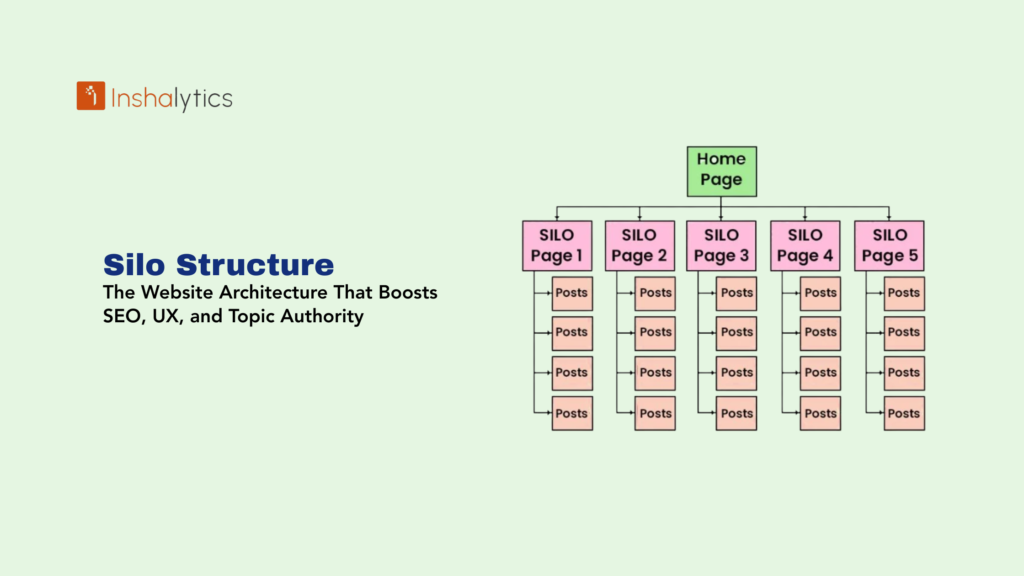
A Silo Structure is a website architecture strategy that categorizes content into distinct thematic groups — often referred to as “silos.” Each silo represents a core topic and contains all supporting pages related to that topic.
Think of it like organizing a library:
- Each subject gets its own section.
- Books on the same subject are grouped together.
- Subtopics are shelved under the same category.
- Content is arranged in an easy-to-follow hierarchy.
Similarly, a website using silo structure groups content so search engines can understand the relationship between pages and the broader theme they represent.
Why Silo Structure Matters in SEO
Google aims to show the most authoritative, trustworthy, and relevant content for any search. Silo structures help demonstrate all three by organizing information in a way that makes sense both logically and semantically.
Below are the major SEO advantages of using silos.
1. Builds Strong Topical Authority
Topical authority is one of the most important ranking signals today.
When you create grouped content around a single theme — such as SEO, fitness, real estate, or marketing — your website sends a clear signal to search engines:
👉 “We are an expert on this topic.”
A well-designed silo has:
- One main pillar page covering the core topic
- Multiple cluster pages exploring subtopics
- Supporting articles answering related questions
- Internal links connecting everything
This depth and structure help Google trust your content more.
2. Improves Crawlability and Indexing
Search engine bots crawl your site by following internal links.
A silo structure gives them:
- A clean navigation path
- Clear hierarchy
- Organized connections
- Easy access to deeper pages
This improves:
✔ crawl efficiency
✔ index coverage
✔ freshness of indexed content
When Google can crawl your content easily, your chances of ranking increase.
3. Enhances User Experience (UX)
Users love structure too.
A siloed website helps visitors:
- Understand what your site offers
- Move naturally from one topic to another
- Explore related content easily
- Stay longer on the website
Higher engagement signals such as longer session duration, lower bounce rates, and more page views contribute to better SEO outcomes.
4. Concentrates Link Equity (Link Juice)
Backlinks to one page of a silo can benefit the entire group.
For example:
If a blog post in the “SEO” silo gets strong backlinks, the link equity flows to the pillar page and other cluster pages connected through internal links.
Benefits:
✔ stronger ranking signals
✔ higher cluster-wide authority
✔ improved keyword visibility
✔ better performance for competitive terms
This makes silo architecture a powerful ranking strategy.
5. Helps Search Engines Understand Semantic Relationships
Modern search algorithms and LLM-driven search systems analyze topics in terms of:
- context
- meaning
- entity relationships
- semantic depth
A silo structure reinforces these signals by showing how your content fits within a topic.
This increases your likelihood of ranking for:
- semantic keywords
- long-tail queries
- questions and answers
- voice search
- AI-powered search features (like “AI Overviews”)
Types of Silo Structures
There are two main forms of silo structure:
1. Physical Silo Structure (URL-Based)
This type organizes silos within the URL path.
Example:
example.com/marketing/
example.com/marketing/email-marketing/
example.com/marketing/email-marketing/automation-tips/
Advantages:
- Clear hierarchy
- Predictable navigation
- Great for users
- Strong topical signals for search engines
2. Virtual Silo Structure (Internal-Linking-Based)
This type groups content through internal links instead of URLs.
Example:
- A “Content Marketing” pillar page links to all its related subtopic articles.
- Each subtopic article links back to the pillar page.
- Subtopics interlink with relevant sibling pages.
Advantages:
- Very flexible
- Easy to implement on large websites
- Works without changing URLs
- Strong for semantic SEO
Many powerful websites use BOTH physical and virtual silo structures for maximum effect.
How Silo Structure Works: The Pillar–Cluster Model
Most modern SEO strategies rely on the Pillar–Cluster Model, which is essentially a practical form of silo structure.
Pillar Page
The main, broad, comprehensive page covering the entire topic.
It targets high-volume, competitive keywords.
Example:
“Complete Guide to Digital Marketing”
Cluster Pages
Detailed articles on related subtopics.
They target mid-volume or long-tail keywords.
Example:
- Social Media Marketing
- PPC Advertising
- SEO Basics
- Email Marketing Trends
Supporting Pages
Highly specific or question-based content.
Example:
- “How often should businesses post on Instagram?”
- “What is CTR in PPC?”
All these pages are interlinked logically, strengthening the entire topic group.
Benefits of Using Silo Structure for LLM and AI Search
As search evolves, LLMs and AI models prioritize:
- structured content
- semantic relationships
- clear context
- topic depth
- coherent clusters
A silo structure naturally fulfils all of these.
AI benefits include:
✔ Better semantic understanding
✔ Higher likelihood of being used as AI-generated answers
✔ Stronger entity recognition
✔ Better content match for conversational queries
✔ Improved ranking in AI-powered search features
By using silos, you make your site future-proof for AI search.
How to Create a Silo Structure: Step-by-Step
Below is a simple method to build silos from scratch.
Step 1: Identify Main Topics
Choose your core themes — these become your silos.
Example:
- SEO
- Digital Marketing
- Web Design
- E-commerce
- Data Analytics
Step 2: Find Subtopics and Clusters
Research the questions people ask about each main topic.
Tools to use:
- Google Keyword Planner
- Ahrefs
- SEMrush
- People Also Ask
- AnswerThePublic
- Reddit & Quora
Cluster these subtopics under their respective pillars.
Step 3: Create a Hierarchical Structure
Every silo should include:
- 1 main pillar page
- 4–20 cluster pages
- Optional supporting pages
Step 4: Implement Internal Linking
This is the most important part.
Internal linking rules:
✔ Pillar → All cluster pages
✔ Clusters → Back to the pillar
✔ Clusters → Interlink when relevant
✔ Supporting articles → Link to cluster + pillar
✔ Avoid cross-silo links unless necessary
Step 5: Optimize Content Semantically
Use:
- structured headings
- synonyms
- related keywords
- FAQs
- semantic entities
- schema markup
This enhances your silo’s topical clarity.
Step 6: Keep Your Silos Updated
Silos are not “set and forget.”
Add new articles, revise outdated content, and strengthen internal linking over time.
Common Silo Structure Mistakes to Avoid
❌ Creating content without assigning it to a silo
❌ Too many cross-links between unrelated silos
❌ Missing pillar pages
❌ Poor internal linking
❌ Overlapping topics
❌ Orphan pages not connected to any cluster
Avoiding these mistakes keeps your silos clean, purposeful, and SEO-friendly.
Final Definition
A Silo Structure is a website architecture strategy that organizes content into distinct sections or themes, grouping related topics into structured hierarchies. By using pillars, clusters, and supporting content — all connected through logical internal linking — silo architecture strengthens topical authority, improves crawling and indexing, enhances user navigation, and boosts semantic relevance. This makes silo structure one of the most effective frameworks for modern SEO and AI-driven search.