In the world of SEO, every link tells a story. Some links bring value, some carry trust, and some do nothing at all. The term that captures this value-passing power is Link Equity, often casually referred to as “Link Juice.”
For digital marketers, understanding how link equity works is essential for improving rankings, boosting page authority, and creating a strong internal and external linking strategy.
This guide breaks down the meaning of link equity, how it flows, why it matters, and how you can optimize your website to capture and distribute it effectively.
Navigate This Post
What Is Link Equity (Link Juice)?
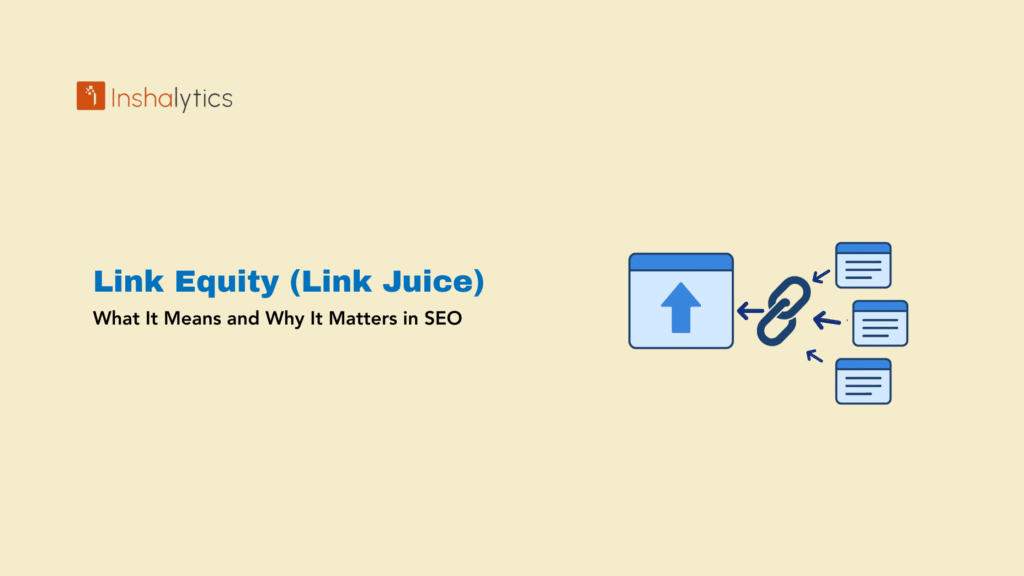
Link Equity refers to the measurable SEO value or authority that a hyperlink transfers from one page to another. When a website links to your page, it essentially passes a portion of its reputation, trust, and authority to you. This “value flow” is what marketers often call link juice.
Search engines like Google use links to understand:
- How trustworthy a page is
- How relevant the content might be
- How important the page is within the web’s structure
Pages with more high-quality, contextually relevant inbound links tend to rank higher in search results because search engines see them as more authoritative.
How Link Equity Works
While Google doesn’t publicly reveal the exact formula, link equity is influenced by several known factors. You can imagine link equity as water flowing through pipes—how much flows depends on the source, the size of the pipe, and the direction of the flow.
1. Authority of the Linking Page
Links from authoritative websites pass more link equity.
For example:
- A link from BBC, Forbes, or a top niche blog is worth more than one from a new or low-traffic website.
Authority is usually measured through third-party metrics like:
- Domain Authority (DA)
- Domain Rating (DR)
- Page Authority (PA)
- Trust Flow (TF)
2. Relevance of the Linking Page
If a link comes from a page with similar or related content, it passes more value.
Example:
A fitness blog linking to a workout guide passes more equity than a random recipe blog linking to it.
Relevance helps search engines understand topic clusters and content credibility.
3. Follow vs. Nofollow Attributes
Links can be:
- Follow (dofollow): Pass full link equity
- Nofollow: Pass very limited or indirect value
- Sponsored / UGC: Pass limited or specialized signals
While nofollow links can still help with traffic and visibility, follow links are the main source of link equity.
4. Placement of the Link on the Page
Links placed:
- Within the main content
- In context
- Surrounded by relevant text
…pass more link equity than links hidden in the footer, sidebar, or boilerplate.
5. Number of Outbound Links on the Page
If a page links to too many other pages, the link equity gets diluted.
Think of it like dividing one pizza among two people versus twenty.
Why Link Equity Is Important for SEO
1. Higher Search Rankings
Pages that receive more high-quality link equity generally rank higher in Google. Backlinks remain one of the strongest ranking signals because they represent trust and authority.
2. Faster Indexing
Links help Google discover new pages faster.
If a high-authority site links to your new blog post, Google can crawl and index it more quickly.
3. Builds Topical Authority
Link equity ties into content relevance. If multiple authoritative pages in your niche link to your content, Google sees your site as a topic expert.
4. Strengthens Your Entire Website
Good link equity doesn’t only help individual pages—it benefits your entire domain’s strength and credibility. This helps:
- New pages rank faster
- Existing pages maintain stable rankings
- Your domain stay competitive
Internal Links and Link Equity
Most people think link equity only comes from external backlinks, but internal links play a massive role.
Internal linking helps you:
- Distribute link equity across your site
- Strengthen key landing pages
- Create topic clusters
- Improve UX and crawlability
For example, when your homepage receives strong external backlinks, internal links allow you to pass that authority to deeper pages like blog posts, services pages, or product pages.
How to Optimize Internal Links for Link Equity
- Link to important pages using descriptive anchor text
- Avoid orphan pages (pages with zero internal links)
- Use topic clusters to build content relevance
- Place links high in the content
- Link from high-authority internal pages
Internal linking is one of the easiest, fastest ways to improve rankings without building new backlinks.
Factors That Reduce Link Equity
Not all links deliver full value. Some factors weaken or completely block link equity from flowing.
1. Nofollow Tags
These signal that the linking site does not want to pass authority.
2. Low-Quality or Spammy Sites
Links from thin, irrelevant, toxic, or spammy sites can:
- Pass little to no value
- Harm your SEO if they look manipulative
3. Link Farms or Paid Link Schemes
Google penalizes artificial link building.
If links come from networks, PBNs, or obvious paid placements, link equity may be ignored or result in penalties.
4. Broken Links
If the linking page is deleted or returns a 404, link equity is lost.
How to Build Link Equity (Ethically)
1. Create Link-Worthy Content
This includes:
- Data-driven posts
- Research studies
- Stats and infographics
- Ultimate guides
- Tools and calculators
Content that solves problems naturally attracts backlinks.
2. Guest Posting on Reputable Niche Sites
Writing helpful, high-quality guest posts is still one of the best white-hat methods to earn link equity.
3. Digital PR
Create stories or unique insights that journalists want to quote or reference.
4. Update and Improve Existing Content
High-quality, updated content attracts more natural backlinks over time.
5. Build Internal Links Strategically
Use your internal network to direct link equity to your:
- Money pages
- Commercial pages
- High-intent pages
6. Fix Broken Backlinks
If an external site linked to a page that no longer exists, redirect the broken URL to a relevant page to regain the lost link equity.
Link Equity and the Future of SEO
Google’s algorithms continue to evolve, and while it uses hundreds of signals, links—and the equity they pass—remain a foundational ranking factor.
Even in the era of:
- AI content
- Semantic search
- Personalized results
- E-E-A-T (Experience, Expertise, Authoritativeness, Trustworthiness)
Link equity still plays a crucial role.
Google uses links to validate trust, authority, expertise, and content credibility—everything that helps build stronger rankings and better user experience.
As AI-generated content increases, link equity becomes even more valuable because real backlinks serve as a validation signal that humans trust your content.
Final Thoughts
Link Equity (Link Juice) is one of the most important concepts in SEO. It determines how authority flows across the web and within your own website. The more high-quality, relevant backlinks you earn—and the better your internal linking structure—the stronger your entire domain becomes.
To optimize for link equity:
- Prioritize quality over quantity
- Build helpful, link-worthy content
- Strengthen internal linking
- Maintain a clean backlink profile
- Focus on relationships and relevance
By understanding how link equity works and how to manage it, you can significantly enhance your website’s rankings, visibility, and long-term SEO performance.