Ask a handyman who ran Facebook ads in 2018, and they’ll tell you a story of cheap leads, easy targeting, and packed schedules. Ask a handyman who ran Facebook ads in 2023 after Apple’s iOS changes and Meta’s targeting overhauls, and you’ll hear a different story about disappointing click quality, frustrating targeting limitations, and questions about whether the platform still works at all.
Here’s the reality in 2026: Facebook ads still work for handyman businesses, but they work differently than they used to. The targeting tricks from the golden era are gone. Homeowner targeting as a direct option was removed. Cost-per-click rose. And yet, handyman contractors who understand the new playbook still generate meaningful leads from Meta often at lower costs than Google Ads for planned, non-urgent services.
This guide walks through exactly how Facebook and Instagram ads work for handyman businesses today, which homeowners they can and can’t target, and how to build campaigns that produce leads despite the platform’s restrictions.
The Honest Truth About Facebook Ads for Handymen in 2026
Expectations matter. Set them wrong, and you’ll blame the platform for failing to do something it was never meant to do.
Why Targeting Is Harder Than It Was in 2020
Before 2022, Facebook let advertisers target “homeowners” directly as a demographic. That option disappeared along with targeting categories like income levels, ethnicity, and specific life events. The changes were driven partly by Apple’s iOS privacy updates (which blocked Meta’s tracking pixels on Apple devices) and partly by Meta’s own responses to regulatory pressure on ad targeting.
The result: handymen can no longer simply click “homeowners” and reach their exact audience. The targeting still exists, it’s just indirect.
What You Can and Can’t Target After iOS and Meta Policy Changes
What you can still target effectively:
- Geographic areas by ZIP code, radius, or custom polygon
- Interests related to home improvement, gardening, DIY, and real estate
- Behavioral signals based on site visits (via Meta Pixel)
- Custom audiences built from your existing customer list
- Lookalike audiences based on your best customers
What you can no longer target directly:
- Homeowners as a demographic
- Income brackets
- Specific life events (recent movers, retirees)
- Ethnicity or religious affiliation
The Difference Between “Meta Ads Don’t Work” and “Meta Ads Don’t Work as You Expected”
Most handymen who say “Facebook ads don’t work for my business” are actually running campaigns targeting the wrong stage of the buyer journey. Meta ads don’t generate emergency leads. Homeowners with broken water heaters aren’t scrolling Instagram. But Meta ads excel at planned services, maintenance agreements, and brand awareness that pays off when the homeowner eventually needs a handyman. Mismatched expectations, not platform failure, drive most negative reviews.
How Handyman Facebook Ads Work Differently From Google Ads
Different platforms, different psychology, different campaign strategies.
Demand Creation vs. Demand Capture
When a homeowner Googles “handyman near me,” they have an immediate need. Google Ads captures that demand. When the same homeowner scrolls Facebook, they’re not thinking about home repair. A well-crafted Meta ad plants the thought: “I should really get those small tasks done before summer.” Demand didn’t exist before the ad. The ad created it.
Why Facebook Leads Convert More Slowly Than Google Leads
Google search leads typically convert within 24–48 hours of the click. Facebook leads often take 7–14 days to convert from initial lead submission to booked appointment. The homeowner wasn’t actively shopping when they saw your ad; they were open to the idea. Follow-up systems matter more on Meta than on Google.
Brand Awareness vs. Direct-Response Campaigns
The two primary Meta campaign objectives for handyman businesses are brand awareness (staying top-of-mind with local homeowners so they call you when they need work) and direct-response lead generation (specific offers that drive form submissions or calls). Most handymen make the mistake of running only direct-response campaigns and missing the compounding value of awareness.
Can You Target Homeowners on Facebook?
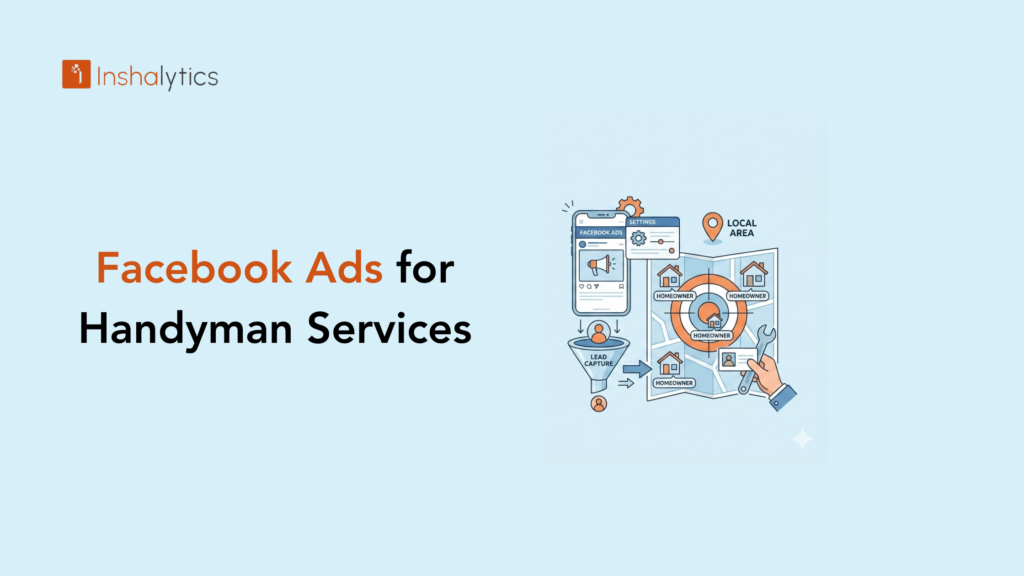
You can no longer target homeowners directly on Facebook after the 2022 policy changes, but you can reach them indirectly through geographic targeting, home improvement interest targeting, and custom audiences built from your own customer data. Lookalike audiences based on your existing homeowner customers produce the best targeting available today.
Geographic Targeting: ZIP Codes, Radius, and Custom Maps
Geographic targeting is your single strongest lever. Target by specific ZIP codes, by radius around your shop, or by drawing custom polygons around neighborhoods you serve. Tight geographic targeting prevents wasted spend and keeps messaging locally relevant.
For handymen, typical targeting runs 10–20 miles around your business location, excluding any ZIP codes you don’t want to serve.
Interest Targeting Workarounds for Home Improvement
Since direct homeowner targeting is gone, interest targeting becomes your best proxy. Target interests like:
- Home Improvement
- Do It Yourself (DIY)
- Gardening
- Real Estate
- Home Appliances
- HGTV
- This Old House
- Home Depot / Lowe’s
Layer interest targeting with geographic targeting to narrow your audience to local homeowners interested in home-related topics.
Custom Audiences From Your Existing Customer List
Upload your existing customer list to Meta and create a custom audience. You can run campaigns directly to this audience for repeat business or use it as the basis for lookalike audiences.
Lookalike Audiences Based on Your Best Customers
Meta builds lookalike audiences by finding users with similar characteristics to your custom audience. Build lookalikes from your highest-value customers (not just any customer) to get the best-quality leads. A 1% lookalike (the top 1% most similar users in your target region) typically produces the best results for handyman services.
The 4 Meta Ad Campaign Types That Work for Handymen
Different objectives serve different goals. Use the right campaign type for the right outcome.
Brand Awareness Campaigns for Local Visibility
Brand awareness campaigns optimize for impressions and reach rather than clicks or conversions. Run these at a low daily budget ($5–$15/day) to keep your business top-of-mind with local homeowners. Six months of consistent awareness campaigns make your company name familiar when homeowners eventually need service.
Lead Generation Ads With In-Platform Forms
Meta Lead Ads let users fill out a form directly inside Facebook or Instagram without visiting your website. Pre-filled fields (name, email, phone pulled from their Meta profile) reduce friction and boost completion rates. Best for: maintenance plans, seasonal promotions, and free estimates for larger projects.
Traffic Campaigns to Your Handyman Website
Traffic campaigns drive clicks to your website, where visitors can browse services, read about your business, and convert through your optimized website. These work best when paired with high-quality landing pages designed for handyman conversion.
Retargeting Campaigns for Website Visitors
Retargeting campaigns show ads to people who’ve already visited your website but didn’t convert. These audiences are pre-qualified; they showed interest in your services. Retargeting typically delivers the lowest cost-per-lead of any Meta campaign type, often 30–50% below cold traffic campaigns.
Handyman Facebook Ad Creative That Actually Gets Clicks
Your ad creative determines whether scrollers stop or keep scrolling. Handyman Creative has to earn attention.
Before-and-After Project Photos
Visual contrast stops scrolls. Photos showing a cracked wall before repair and clean drywall after, or a broken fence before and a perfectly aligned one after, create immediate visual interest. Pair the photos with a clear headline (“Saw something like this around your house?”) and a local offer.
Short Video of Real Jobs in Progress
Video of you actually working, drilling a hole, installing a fan, and patching drywall outperforms polished corporate content. 15–30 second clips work best. Show the problem, the work, and the finished result. Authenticity wins on Meta. [EXTERNAL LINK: Sprout Social’s content engagement data] shows that video generates multiples of the engagement of static images.
Carousel Ads Showing Service Range
Carousel ads let you showcase multiple images or videos in a single ad unit. Each card can display a different service, such as drywall repair, ceiling fan installation, deck maintenance, or small plumbing, with its own headline. This format works beautifully for general handyman services since homeowners have a range of possible needs.
User-Generated Content From Satisfied Customers
Ask satisfied customers if you can film a 15-second video of them showing the finished work in their home. User-generated content outperforms polished ads because it carries built-in trust. Offer a small incentive ($25 credit, a free small service) to encourage participation.
Handyman Facebook Ad Offers That Generate Leads
Your offer matters more than your creative. A great offer with mediocre ads beats great ads with a weak offer.
Specific Service Offers With Clear Pricing
Vague offers don’t convert. Specific, priced offers do. Examples that work:
- “Ceiling fan installation $99 flat rate”
- “Drywall repair up to 4 square feet $150”
- “Bundle of 5 small home repairs $399”
- “Seasonal gutter cleaning $175 complete”
Specific pricing removes hesitation and gives homeowners a reason to click now rather than later.
“Honey-Do List” Packages That Solve Real Homeowner Pain
Many homeowners accumulate lists of small tasks they keep putting off. A “Honey-Do List” package (3 hours of handyman services, any tasks needed, one flat price) addresses this exact pain point. Package offers typically produce higher average ticket values than single-service offers.
Seasonal Maintenance Bundles
Seasonal offers tie into natural homeowner triggers:
- Spring: “Post-winter home inspection and repairs $249”
- Summer: “Pre-vacation home checkup $179”
- Fall: “Winter preparation package $299”
- Winter: “Post-holiday repairs and hanging services $149”
Seasonal framing gives homeowners a reason to book now rather than think about it later.
First-Time Customer Discounts That Produce Repeat Business
Handyman businesses live on repeat customers. A “$25 off your first service” offer produces leads at slightly higher cost but converts them into lifetime customers worth hundreds or thousands in future revenue. Always factor lifetime value into first-customer acquisition math.
The Meta Pixel and Why Handyman Businesses Can’t Skip It
The Meta Pixel is the single most important technical asset for effective Meta ads.
What the Pixel Tracks (and Why It Matters)
The Meta Pixel is a piece of code installed on your website that tracks visitor behavior and reports it back to Meta. It tracks page views, form submissions, phone clicks, time on site, and more. This data feeds Meta’s algorithm and enables retargeting campaigns and lookalike audiences.
How Installation Affects Your Ad Performance
Without the Pixel installed, Meta’s algorithm can’t optimize your ads based on actual conversion data. It’s flying blind. Campaigns with proper Pixel tracking typically produce 40–60% lower cost-per-lead than campaigns without tracking.
Conversion Events You Should Be Firing
At a minimum, configure these Pixel events on your website:
- PageView (automatic when installed)
- ViewContent (fires when visitors view service pages)
- Lead (fires when a form is submitted)
- Contact (fires when the phone is clicked)
- CompleteRegistration (fires when scheduling is completed)
Each event teaches Meta’s algorithm what behavior is valuable and optimizes future ad delivery accordingly.
Budget and Cost Benchmarks for Handyman Meta Ads
Real cost benchmarks set realistic expectations before you launch.
Typical Cost-per-Click for Handyman Audiences
Handyman CPCs on Meta typically run $1–$4, significantly lower than Google’s $2–$8 for handyman keywords. Lower CPCs make sense: you’re interrupting scrolling, not capturing search intent. Cheaper clicks don’t automatically mean better ROI, but they give you more testing capacity per dollar.
Cost-per-Lead by Service Type
Meta cost-per-lead for handyman services varies by offer type:
- Service-specific offers: $15–$35/lead
- Handyman bundle packages: $25–$50/lead
- Generic “free estimate” offers: Often $50+ with lower lead quality
- Maintenance plan inquiries: $30–$60/lead
Specific, packaged offers consistently outperform generic ones.
Starting Budget Recommendations
Minimum viable budget for a handyman Meta campaign is $400–$800/month. Below that, you don’t generate enough data for Meta’s algorithm to optimize. At $800–$2,000/month, you typically see profitable performance with a properly structured campaign.
When to Scale Spend and When to Pull Back
Scale budget on campaigns with consistent cost-per-lead at or below your targets. Pull back on campaigns where cost-per-lead climbs over 30 days. This usually indicates audience fatigue (the same people seeing your ads too many times). Refreshing, creative, and offers solves most fatigue problems.
How Inshalytics Builds Handyman Meta Campaigns That Work in 2026
Most Meta ad strategies were built for a pre-2022 world. We build for the current reality.
Our Creative Testing Framework
Every Inshalytics handyman Meta campaign starts with testing multiple creative angles and offers at small budgets. Winners scale; losers get killed before they drain the budget. We rotate creatives every 4–6 weeks to prevent fatigue and keep cost-per-lead stable.
Integration With Google Ads and SEO
Meta ads don’t work in isolation. They work alongside Google Ads and SEO as a complete system. Meta builds awareness; Google captures demand; SEO produces owned lead flow. We integrate all three from day one.
Fast-Follow-Up Systems That Convert Meta Leads
Meta leads cool fast. We integrate lead forms with CRM systems, SMS automation, and email follow-up so new leads trigger an immediate response. Speed-to-lead is the single biggest lever on Meta conversion rates.
Your First 30 Days on Facebook Ads as a Handyman
A structured 30-day launch produces faster profitable performance than trial-and-error.
Days 1–7: Account, Pixel, and First Campaign Setup
Set up your Meta Business Manager account. Install the Meta Pixel on your website with all relevant conversion events. Upload your existing customer list as a custom audience. Create your first lookalike audience. Launch one brand awareness campaign to your local audience at a low budget ($5/day).
Days 8–21: Testing Creative and Audiences
Launch 2–3 lead generation campaigns with different offers and creative variations. Monitor cost-per-lead daily. Kill underperforming creatives after 7 days. Add retargeting campaigns once you have enough Pixel data (usually after 500+ website visitors).
Days 22–30: Scaling What Works
Identify your top-performing campaign and scale budget incrementally (20–30% weekly increases). Expand winning creative into new audiences. Document what’s working so you can replicate it. By day 30, you should have 2–3 stable campaigns producing leads at predictable costs. Facebook ads for handymen in 2026 work differently than they did five years ago, but they still work, and for the right services and offers, they produce leads at lower costs than Google Ads. The contractors who figure this out build sustainable lead systems that complement their other channels. The ones who dismiss Meta because “it doesn’t work anymore” miss a real opportunity. If you want help building Meta campaigns that produce leads despite current targeting restrictions, Inshalytics runs handyman social media ads designed for the current platform, not the 2019 version of it. Book a consultation, and we’ll map out a Meta strategy that actually fits your business stage.