Definition: PageRank is Google’s original algorithm for measuring page importance based on the quality and quantity of links pointing to a webpage. Developed by Google founders Larry Page and Sergey Brin at Stanford University in 1996, PageRank revolutionized search by treating links as votes of confidence pages with more high-quality links were deemed more important and deserving of higher rankings. While no longer the sole or even primary ranking factor, PageRank’s fundamental concept of link-based authority continues influencing modern search algorithms.
Navigate This Post
What Is PageRank?
PageRank is an algorithm that assigns numerical scores (originally 0-10) representing page importance based on link analysis. The core principle treats each link as a recommendation or vote when one page links to another, it passes a portion of its authority. However, not all links carry equal weight: links from high-authority pages pass more value than links from low-authority pages, and the value each link passes gets diluted by the total number of outbound links on the source page.
Key PageRank concepts:
Authority transfer: Links pass ranking power from source to destination Recursive calculation: A page’s PageRank depends on the PageRank of pages linking to it Vote splitting: Outbound links divide a page’s authority among linked destinations Dampening factor: Not all authority transfers approximately 85% passes through links Iterative computation: Multiple calculation passes determine final scores Link quality matters: Links from authoritative sources carry more weight
Named after Larry Page (not “web page”), PageRank provided Google’s competitive advantage in late 1990s search, delivering more relevant results than competitors relying primarily on keyword matching and basic popularity metrics.
The History and Evolution of PageRank
Understanding PageRank’s journey from revolutionary innovation to one factor among many reveals modern SEO’s complexity.
1996: Original Development
Larry Page and Sergey Brin develop PageRank at Stanford, recognizing that academic paper citations provide quality signals highly cited papers are generally more important. They apply this concept to web links, treating links as citations.
1998: Google Launch
Google launches with PageRank as its core differentiator, delivering superior search results by considering link-based authority rather than just keyword frequency.
2000: Public PageRank Toolbar
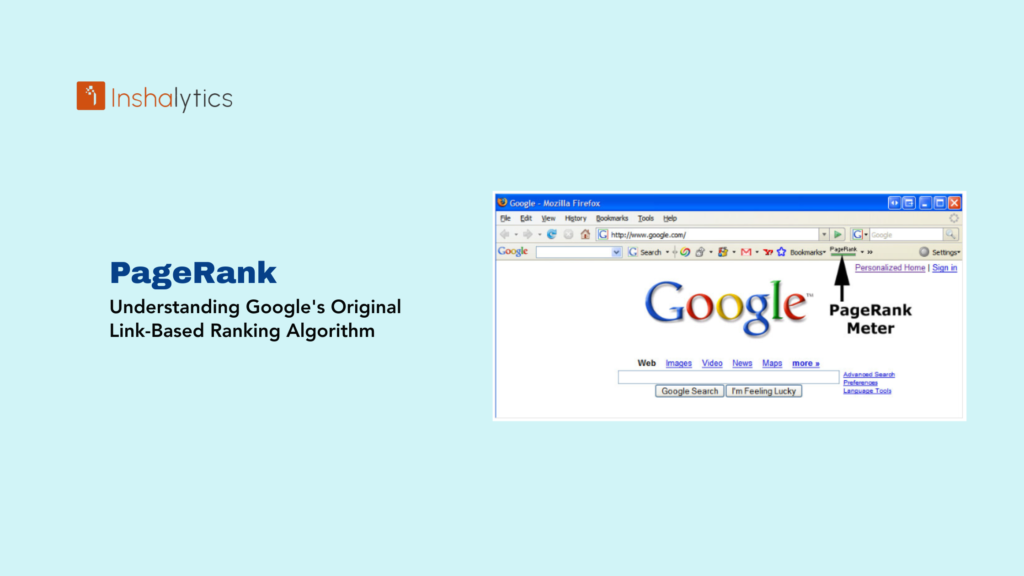
Google releases browser toolbar displaying PageRank scores (0-10 scale) for any webpage, creating obsession with the visible metric and spawning entire industries around “improving PageRank.”
2000s: PageRank Gaming
SEO practitioners aggressively manipulate PageRank through link schemes, link farms, and paid links. Google continuously updates algorithms to combat manipulation.
2009-2013: Declining Emphasis
Google begins emphasizing PageRank is “one of 200+ signals,” reducing its prominence as algorithms become more sophisticated.
2013: Toolbar Updates Stop
Google stops updating public PageRank scores in toolbar, though continues using PageRank internally.
2016: Toolbar Retired
Google officially removes PageRank from toolbar, ending public visibility of scores.
Present: Internal Use
PageRank continues operating behind the scenes as one factor among hundreds in modern algorithms, though far less dominant than historically.
How PageRank Works
Understanding the mathematical foundation clarifies why link quality and quantity both matter.
Basic Formula
The simplified PageRank formula:
PR(A) = (1-d) + d × (PR(T1)/C(T1) + … + PR(Tn)/C(Tn))
Where:
- PR(A) = PageRank of page A
- d = Dampening factor (typically 0.85)
- PR(T1)…PR(Tn) = PageRank of pages linking to A
- C(T1)…C(Tn) = Number of outbound links on each linking page
Practical Example
Simple scenario:
- Page A links only to Page B
- Page A has PageRank of 10
- Page A has 5 outbound links total
Calculation: Page B receives: 10 × 0.85 / 5 = 1.7 PageRank from Page A
This value splits among the 5 pages Page A links to, with each receiving 1.7 (assuming no other links).
Key Principles
Link value dilution: More outbound links mean less value per link Authority accumulation: Pages receiving many links from authoritative sources accumulate higher PageRank Recursive dependency: Calculating one page’s PageRank requires knowing linking pages’ PageRank Iterative computation: Multiple calculation rounds converge toward accurate scores Random surfer model: Based on probability a random user clicking links would reach the page
PageRank vs. Modern Link Metrics
While Google no longer publicly reveals PageRank, third-party tools created similar metrics.
Moz Domain Authority (DA) / Page Authority (PA)
Scale: 1-100 Basis: Link analysis using proprietary algorithm Purpose: Predicting ranking likelihood Updates: Regular recalculation as link profiles change
Ahrefs Domain Rating (DR) / URL Rating (UR)
Scale: 0-100 Basis: Link analysis emphasizing backlink quality Purpose: Estimating domain/page strength Updates: Frequent recalculation
Majestic Trust Flow / Citation Flow
Trust Flow: Quality emphasis Citation Flow: Quantity emphasis Purpose: Separating link quality from volume
Key distinction: These are estimates attempting to replicate PageRank-like concepts, not actual Google PageRank.
PageRank’s Lasting Impact on SEO
Despite reduced prominence, PageRank’s foundational concepts continue influencing modern search.
Link Building Remains Important
Authority transfer: High-quality backlinks still pass ranking power Link quality: Links from authoritative sites matter more than numerous low-quality links Natural profiles: Algorithms still detect and penalize manipulative linking patterns Anchor text: Link context and anchor text provide topical relevance signals
Internal Linking Strategy
PageRank sculpting (attempting to control PageRank flow through strategic nofollow use) no longer works as originally conceived, but strategic internal linking still distributes authority throughout sites.
Best practices:
- Link from high-authority pages to important pages
- Ensure important pages receive multiple internal links
- Create logical site architecture facilitating link flow
- Avoid orphan pages receiving no internal links
Authority Accumulation
Domain authority (though not Google’s term) reflects accumulated link equity over time, making established sites with strong link profiles inherently advantaged over new sites.
Why PageRank Became Less Dominant
Multiple factors led to PageRank’s decline from sole focus to one signal among hundreds.
Manipulation Success
Link schemes effectively gamed PageRank, forcing Google to develop additional signals less susceptible to manipulation.
Paid links created artificial authority, necessitating detection algorithms.
Link farms and networks existed solely to inflate PageRank, requiring counter-measures.
Content Quality Emphasis
Panda update (2011) incorporated content quality signals beyond links User experience factors including engagement, dwell time, and bounce rates added behavioral signals E-E-A-T (Experience, Expertise, Authoritativeness, Trustworthiness) signals extended beyond just link-based authority
Search Sophistication
Machine learning enables algorithms to understand content, context, and user satisfaction beyond what links alone reveal Semantic search understands meaning and intent rather than just keyword and link matching Personalization tailors results to individual users based on location, history, and preferences Entity understanding connects searches to specific people, places, things, and concepts
Query Intent Diversity
Different query types require different ranking approaches informational queries might prioritize content comprehensiveness while transactional queries emphasize conversion optimization. One-size-fits-all PageRank couldn’t address this diversity.
Modern Link Analysis in Google
While PageRank evolved, link analysis remains crucial in modern algorithms.
Quality Over Quantity
Authoritative sources: Links from established, trusted domains carry significant weight Relevance: Links from topically related sites matter more than unrelated links Natural patterns: Algorithms detect manipulative linking patterns versus organic acquisition Link velocity: Natural link growth patterns versus suspicious spikes
Beyond Simple Vote Counting
Context analysis: Surrounding content and anchor text provide semantic signals Link position: Editorial links within content matter more than footer/sidebar links Nofollow consideration: Since 2019, nofollow is a “hint” rather than directive User behavior: Actual clicks and engagement with linked content matter
Penalty Avoidance
Unnatural link detection: Algorithms identify and discount or penalize manipulative links Manual actions: Human reviewers can apply penalties for egregious link schemes Disavow tool: Webmasters can request Google ignore specific backlinks Negative SEO protection: Algorithms generally resist competitor attacks via bad links
Practical Implications for Modern SEO
Understanding PageRank’s legacy informs effective contemporary link building strategy.
Focus on Link Quality
Pursue authoritative sources: One link from New York Times outweighs dozens from unknown blogs Prioritize relevance: Links from industry-relevant sites provide more value Earn editorial links: Natural mentions carry more weight than manufactured placements Avoid schemes: Manipulative tactics risk penalties outweighing temporary gains
Strategic Internal Linking
Link important pages from high-traffic pages: Distribute accumulated authority strategically Create content hubs: Pillar pages linking to supporting content establish topical authority Avoid over-linking: Too many links per page dilutes value passed to each destination Logical architecture: Clear site structure facilitates authority flow
Build Sustainable Link Profiles
Natural acquisition: Focus on earning links through content merit rather than schemes Diverse sources: Links from varied domains appear more natural than concentrated patterns Gradual growth: Sudden link spikes trigger scrutiny; steady acquisition seems organic Monitor profile health: Regular audits identify toxic links requiring disavowal
Content That Attracts Links
Original research: Unique data naturally attracts citations Comprehensive resources: Definitive guides become reference material others link to Visual content: Infographics and charts get shared and linked Tools and calculators: Interactive resources naturally earn links
The End of Public PageRank
Google’s decision to end public PageRank visibility reflected multiple strategic considerations.
Metric obsession: SEOs focused excessively on PageRank scores rather than holistic optimization Manipulation incentive: Public scores encouraged gaming rather than quality focus Outdated representation: Single 0-10 score couldn’t represent modern algorithm complexity Misunderstanding: Users misinterpreted PageRank as the only ranking factor Toolbar security: Browser extensions raised privacy and security concerns
The retirement didn’t eliminate PageRank from Google’s algorithms it simply ended public visibility, redirecting focus toward comprehensive quality rather than single metric optimization.
Conclusion
PageRank Google’s original algorithm measuring page importance through link analysis revolutionized search by treating links as votes of confidence, with pages receiving more high-quality links deemed more authoritative and deserving of higher rankings. This breakthrough concept, treating the web as a network where links transfer authority similar to academic citations, gave Google decisive competitive advantage in late 1990s search landscape dominated by keyword-focused competitors.
While PageRank’s prominence has diminished as Google’s algorithms incorporated hundreds of additional signals including content quality, user experience, and machine learning, its fundamental principle of link-based authority assessment continues influencing modern search. Quality backlinks from relevant, authoritative sources still pass ranking power, internal linking strategically distributes authority, and natural link profiles remain essential for competitive rankings.
Understanding PageRank’s evolution from revolutionary innovation to one factor among many reveals modern SEO’s sophistication success requires holistic optimization addressing content quality, technical performance, user experience, and yes, strategic link building guided by PageRank’s enduring insight that links represent valuable endorsements worth factoring into determinations of which pages deserve prominence in search results serving billions of queries daily.
Key Takeaways
- PageRank measures page importance based on quantity and quality of links
- Links from high-authority pages pass more value than low-authority sources
- Multiple outbound links dilute value passed by each link
- Public PageRank scores ended in 2016 but algorithm continues internally
- Modern ranking uses hundreds of factors beyond just PageRank
- Link quality matters more than quantity in contemporary SEO
- Natural, editorial links from relevant sources provide optimal value
- Strategic internal linking distributes authority throughout sites
- Manipulative link building risks penalties outweighing benefits
- PageRank’s core concept of link-based authority remains relevant