Handyman business owners who invest in paid advertising almost always face the same early question: Google or Facebook? Both platforms promise local leads. Both can produce results. But they work in fundamentally different ways, and applying the wrong one to your goals wastes money in ways that are difficult to diagnose without understanding the underlying mechanics.
The short answer: they are not competing options. They serve different stages of the buyer journey and work best together. But one of them is almost always the right starting point for a handyman business, and the other is a strategic add-on once the foundation is in place.
This article gives you a clear, practical understanding of what each platform does, when to use it, and how to combine them when the time is right.
The Fundamental Difference Between Facebook and Google Advertising
Before evaluating which platform is right for your business, it helps to understand the architectural differences between them.
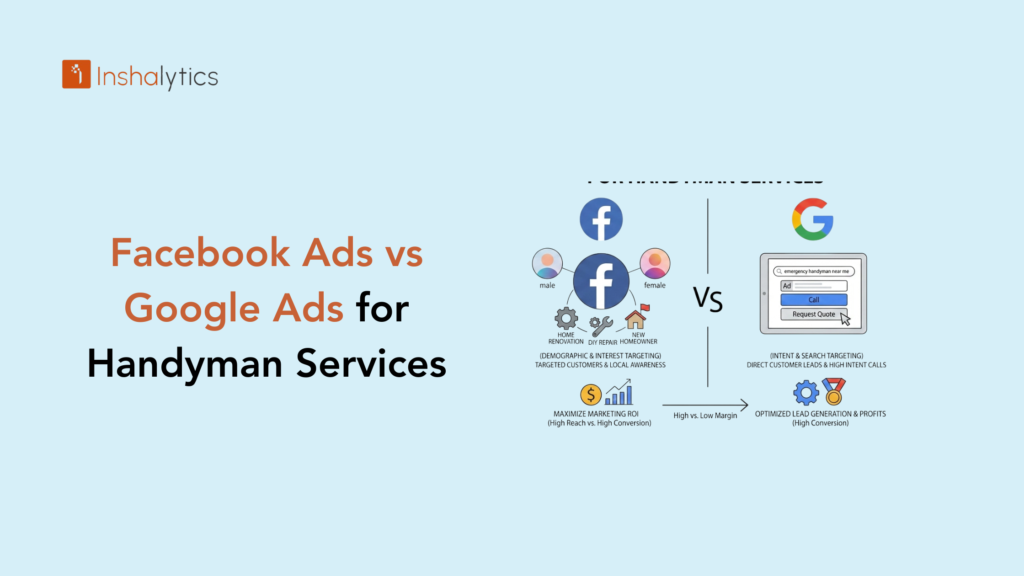
Google Ads: Capturing Demand When a Homeowner Is Ready to Hire Right Now
Google Ads, specifically search ads, appear when a homeowner actively searches for a service. When someone types “handyman near me” or “drywall repair in [City],” they see your ad because their search query signals demand. They have a problem. They want a solution. They are ready to contact someone.
This is demand capture: intercepting a buyer at the moment their intent is highest. The conversion path from Google search ad to phone call is typically short: one click, a 30-second scan of your landing page, and a decision. Google Ads excels in this environment.
Facebook Ads: Creating Awareness Before Homeowners Know They Need You
Facebook Ads do not appear because someone searched for your services. They appear in the middle of a scroll between a photo of a friend’s dinner and a news article. The person seeing your ad did not signal any intent to hire a handyman. They were interrupted by your ad.
This is demand creation: putting your brand in front of homeowners who may eventually need your services. The path from Facebook ad to phone call is longer: awareness, consideration, eventual search, then contact. Facebook Ads excels at brand building and staying top-of-mind rather than immediate conversion.
Why Understanding This Difference Determines Whether You Waste or Win
The most common mistake handyman businesses make with paid advertising is using Facebook Ads to try to capture demand (expecting immediate calls from people who were not looking for a handyman) or using Google Ads without the targeting precision needed to make search intent work economically.
Understanding that Google captures existing demand and Facebook creates future demand changes how you budget, how you measure results, and when each makes sense for your business. Our pay-per-click management services include both platforms with a clear strategic framework for which to prioritize and why.
Google Ads for Handyman Services: When and Why They Work
Google search advertising is the most direct paid path between a homeowner’s problem and your phone ringing.
Search Intent Targeting: Reaching Homeowners at the Exact Moment of Need
The power of Google search ads is timing. A homeowner who searches “emergency handyman near me” is in the highest possible state of buying intent at the exact moment they see your ad. No other advertising channel can produce that timing precision.
For handyman businesses, this means that well-configured Google Ads can generate calls within hours of campaign launch, something that social media ads and SEO cannot replicate. The tradeoff is cost: high-intent keywords in competitive markets carry real cost-per-click. Getting the targeting and bidding right requires expertise to avoid wasteful spend.
Google Local Service Ads (LSAs): Pay-Per-Lead With a Google Guarantee Badge
Google Local Service Ads are a separate product from standard Google Ads. They appear above standard search results with a “Google Guaranteed” badge, your star rating, and your phone number. Critically, you pay per lead rather than per click, meaning you pay only when a homeowner actually contacts you through the ad.
LSAs typically produce lower cost-per-lead than standard PPC for handyman businesses, and the Google Guaranteed badge adds a trust signal that can increase conversion rates meaningfully. For handyman businesses just entering paid advertising, LSAs are often the right starting point.
Geographic Precision and Service Area Targeting in Google Campaigns
Google Ads allows you to target searchers within a specific radius of your business address, within specific zip codes, or within a defined service area polygon. This precision ensures your ad budget is spent on homeowners who are actually within your service territory, not on people 40 miles away who would never hire you, regardless of the offer.
Setting tight geographic boundaries is one of the most important optimization steps for a handyman’s Google Ads campaign. Broad geography wastes budget. Precise geography concentrates it on the right audience.
Facebook Ads for Handyman Services: When and Why They Work
Facebook advertising is not the primary lead generation channel for most handyman businesses. It is a brand-building and awareness channel, and in that role, it can be genuinely valuable.
Brand Awareness at Scale: Staying Top-of-Mind Before the Problem Happens
The homeowner who sees your handyman business regularly in their Facebook feed, photos of completed projects, before-and-after repairs, and brief team videos is more likely to remember your name when they eventually need someone. That awareness does not produce an immediate call, but it shortens the decision process when the need arises.
This is the Facebook Ads value proposition for handyman businesses: not immediate leads, but a warm audience that already has some familiarity with your brand when they eventually search. Nielsen research consistently shows that repeated brand exposure significantly shortens the decision window when consumers eventually need a service.
Hyperlocal Targeting to Homeowners in Your Exact Service Area for $5/Day
Facebook’s targeting allows you to define your audience by geography, homeownership status, household income, age, and behavioral signals. A handyman business can run awareness ads specifically to homeowners aged 35 to 65 within a 15-mile radius for as little as $5 to $10 per day.
At that spend level, the objective is not immediate conversion; it is consistent brand visibility to the right audience at minimal cost. When combined with Google Ads and SEO, this awareness layer means that homeowners who search for you later have already encountered your brand.
Lead Forms, Retargeting, and Visual Proof as Facebook’s Strongest Assets
Facebook’s lead ad format allows homeowners to submit their contact information without leaving the platform, reducing friction in the inquiry process. Retargeting showing ads specifically to people who have visited your website is particularly effective, as these are homeowners who have already expressed some interest in your services.
Visual proof is Facebook’s most underrated advantage for handyman businesses. Before-and-after photos, project completion videos, and team introductions perform strongly in a social feed environment because they are inherently engaging and build trust visually in a way that text-only ads cannot. Our social media marketing team uses these formats specifically to build the brand visibility that amplifies Google Ads performance.
Should Handyman Businesses Use Facebook Ads or Google Ads?
Direct answer: For immediate lead generation, start with Google Ads or LSAs. For long-term brand dominance and amplified overall marketing performance, add Facebook when the budget allows. The two platforms work best together, but if you can only invest in one, Google produces faster, more measurable results for most handyman businesses.
For Immediate Leads: Google Ads and LSAs Win Hands Down
If you need leads this week, Google search ads and LSAs are the right tools. They reach homeowners who are actively searching for what you offer. At the moment, they are ready to contact someone. The conversion path is short, and the intent is high.
Facebook ads in the same situation would require weeks to months of awareness building before producing meaningful lead volume, a timeline that does not solve an immediate revenue need.
For Long-Term Brand Dominance: Facebook and Google Together Create the One-Two Punch
The most effective paid advertising strategy for a mature handyman business combines both platforms. Google captures demand when homeowners search. Facebook builds awareness so that when homeowners search, they already recognize your name.
A homeowner who has seen your Facebook ads for three months and then searches “handyman near me” on Google is more likely to click your paid or organic result than one who has never encountered your brand. The platforms reinforce each other in a way that produces better results from both than either achieves alone.
For Handyman Businesses at Different Budget Levels
- $0 to $500/month: Focus entirely on Google LSAs and local SEO. Paid budget is better concentrated on high-intent capture than spread across both platforms.
- $500 to $1,500/month: Google search ads or LSAs as the primary channel, with a small Facebook brand awareness budget ($5 to $10/day) as a secondary layer.
- $1,500+/month: A full combined strategy with Google capturing demand, Facebook building awareness, and retargeting, closing the gap between initial interest and eventual booking.
How Inshalytics Manages Paid Ads Strategy for Handyman Businesses
Paid advertising produces its best results when it is integrated with the broader marketing system, not run as an isolated tactic.
Our Approach to Google Ads and LSAs for Local Home Service Businesses
At Inshalytics, we configure Google campaigns with precise service area targeting, negative keyword lists that filter out irrelevant searches (DIY queries, competitor name searches, job-seeking searches), and bid strategies calibrated to your average job value and target cost per acquisition.
LSA setup includes securing the Google Guaranteed badge, configuring service categories and service area, and optimizing the profile to maximize impression share for high-intent searches.
When We Recommend Adding Facebook to the Mix and Why
We recommend adding Facebook ads when:
- The client has an established Google Ads or LSA campaign producing consistent results
- The budget can sustain meaningful daily spend on brand awareness without compromising the primary channel
- The client has quality visual content, photos of real work, and team videos that perform well in a social format
In those conditions, Facebook adds a layer of brand recognition that makes the entire marketing system more efficient.
How Paid Ads Fit Into a Broader SEO-First Handyman Marketing Strategy
Paid ads are a component of a complete handyman marketing strategy, not a substitute for organic foundations. A handyman business running Google Ads without a local SEO infrastructure is paying for traffic that a well-optimized GBP and website would deliver for free. Our search engine optimization and paid advertising work are designed to complement each other, organic and paid together, covering the full visibility landscape of local search. The right ad platform depends on your goals, your budget, and where you are in your marketing journey. Contact our team, and we will show you exactly which channels make sense for your market right now.