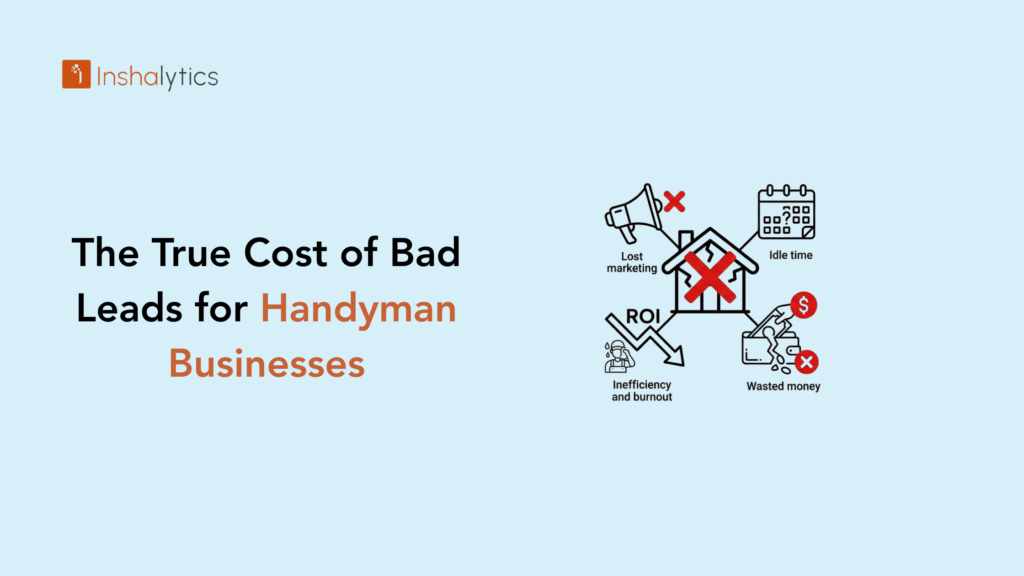
Every handyman business owner knows the feeling. You call within two minutes. The homeowner sounds interested. You drive across town, spend 20 minutes looking at the job, write up an estimate, follow up twice, and then nothing. No response. The lead disappears, and you are out an hour of your day and $8 in fuel with nothing to show for it.
That is a bad lead. And most handyman businesses are absorbing far more of them than they realize, at a cost that is far higher than the sticker price of any platform fee. This article breaks down what bad leads actually cost, what they reveal about your marketing strategy, and how to build a pipeline that produces the opposite.
What Makes a Lead “Bad” for a Handyman Business?
Not every lead that does not convert is bad. Sometimes the timing is wrong, the scope changed, or the client went with a family friend. A bad lead is one that was never a realistic match for your business, wrong service, wrong location, wrong budget, or wrong intent, but consumed your time and resources anyway.
Price Shoppers, Ghost Inquiries, and Out-of-Area Requests
Three categories of bad leads appear consistently in marketplace-heavy lead pipelines:
Price shoppers contact multiple contractors simultaneously with no intention of choosing based on anything other than the lowest quote. They will always find someone cheaper. Pursuing them at your actual rates is an exercise in futility.
Ghost inquiries lead who submit a contact form or request a quote and then never respond to calls, texts, or follow-ups are a particular plague on shared lead platforms, where the homeowner may have filled out a form without a strong intent to proceed.
Out-of-area requests come from homeowners who either misunderstand your service territory or are hoping you will make an exception. Each one requires the same qualification conversation as a real lead, without the prospect of a job.
How Shared Lead Platforms Systematically Deliver Low-Quality Prospects
The shared lead model structurally produces a higher proportion of bad leads than owned inbound channels. When a homeowner fills out a form on Angi, they are not necessarily signaling strong purchase intent; they are signaling awareness of a need. The platform distributes that signal to multiple contractors immediately, regardless of how serious the homeowner is about proceeding.
An organic search leads someone who found your website by searching specifically for your service in your area and chose to contact you has demonstrated significantly stronger intent through that decision sequence. The channel itself filters.
The Difference Between a Bad Lead and a Lead You Simply Didn’t Close
This distinction matters for accurate self-assessment. A lead that did not convert because your close rate on the call was low, your estimate was unclear, or your follow-up was delayed is not a bad lead it is a conversion problem. A lead that did not convert because the homeowner was outside your service area, had a $50 budget for a $300 job, or submitted the inquiry while already planning to hire a neighbor is a bad lead.
Diagnosing which type of non-conversion you are experiencing determines whether the fix is in lead quality (marketing strategy) or conversion rate (sales process).
The Direct Cost of a Bad Lead: Breaking Down the Real Numbers
The sticker price of a marketplace lead is the easiest cost to quantify. The full cost requires a more complete accounting.
Lead Cost Plus Time Spent Plus Fuel Plus Missed Opportunity
Consider a handyman business on a shared lead platform paying $45 per lead at a 12 percent close rate:
- Lead cost per closed job: $45 × ~8 leads = $360
- Time cost per lead pursued: average 45 minutes of calling, coordinating, estimating, and following up on each lead that does not convert
- Fuel and vehicle wear: $6 to $10 per estimate drive, multiplied by the proportion that involves site visits
- Missed opportunity: the inbound call or referral that came in while you were chasing a dead lead
When all inputs are included, the true cost per closed job from shared leads frequently exceeds $500 to $600 for handyman businesses with typical job values before labor, materials, and overhead on the actual job.
How a 10–15% Close Rate on Shared Leads Translates to Per-Job Acquisition Cost
The close rate is where the math becomes most revealing. Industry close rates on shared leads sit between 10 and 15 percent. At 12 percent, you need approximately eight to nine leads to produce one booking. At $45 per lead, that is $360 to $405 in lead cost alone before time, fuel, or missed alternatives.
For a handyman business averaging $500 per job with a 25 percent gross margin, that gross profit is $125. Subtract $360 to $405 in acquisition cost, and you are on paper operating at a loss on every lead-marketplace-sourced job. The economics only work at higher job values or if the platform costs are significantly lower.
The Job Value Math: What Bad Leads Cost at $300, $600, and $1,200 Average Jobs
The math changes meaningfully with average job value:
- $300 average job (25% margin = $75 gross profit): A $360 lead cost per closed job is 4.8x the gross profit. Every marketplace-sourced job at this value is a net loss.
- $600 average job (25% margin = $150 gross profit): A $360 lead cost is 2.4x the gross profit. Still deeply unprofitable without accounting for overhead.
- $1,200 average job (25% margin = $300 gross profit): A $360 lead cost equals the gross profit. Break-even before overhead, which means a net loss on every acquired customer.
These numbers make the case for higher job values and better lead quality more powerfully than any general argument could.
The Hidden Costs of Bad Leads That Never Show Up in Your Spreadsheet
The financial cost of bad leads is significant. The non-financial cost is arguably greater.
The Morale and Burnout Cost of Constant Rejection and Ghosting
Spending a significant portion of every workday chasing leads that go nowhere, calling numbers that do not answer, and waiting for callbacks that never come is demoralizing. This is not a soft complaint; it produces measurable business consequences. Burned-out handyman owners reduce their follow-up effort, become less responsive to new inquiries, and eventually pull back from the marketing activities that could generate better leads.
The burnout cycle often accelerates precisely when the lead quality problem is at its worst, when platform-dependent businesses are experiencing high lead volume but low close rates.
The Opportunity Cost: What You Could Have Done With That Time Instead
Time spent on bad leads is time not spent on activities with higher return:
- Calling back a referral who left a voicemail
- Following up with a past client who mentioned a future project
- Posting photos to Google Business Profile after completing a job
- Asking a satisfied client for a review immediately after their job is finished
These activities, all of them free, all of them effective, get crowded out when a handyman’s available time is consumed by the bad lead chase. The opportunity cost is real and significant.
How Chasing Bad Leads Prevents You From Building a Referral-Driven Business
The most valuable handyman businesses are those where a significant portion of new clients come from referrals, warm, pre-qualified, high-trust leads that cost nothing and close at rates above 50 percent. Building that referral base requires time invested in client relationships, follow-up, and exceptional job quality.
When your available time is consumed by marketplace lead pursuit, that relationship-building does not happen. The referral base never develops. The business remains dependent on the platform. The cycle continues.
What Bad Leads Are Actually Telling You About Your Marketing Strategy
A consistent pattern of bad leads is a diagnostic signal, not just a frustration. It points to specific problems in where your leads are coming from and how they are being generated.
High Volume, Low Close Rate = Wrong Channel or Wrong Positioning
If you are receiving a high volume of leads and closing a low percentage of them, the problem is rarely your conversion skills; it is the quality of the leads entering the pipeline. And lead quality is a function of the marketing channel that generates them.
SEO-generated leads homeowners who found your business through specific, intent-driven searches close at two to three times the rate of marketplace leads. The channel determines the quality. Changing the channel changes the economics.
How Your Lead Source Determines Your Lead Quality Every Single Time
This is not a correlation; it is causation. The way a lead was generated tells you exactly what kind of intent the prospect has. A homeowner who searched “licensed handyman for bathroom grab bar installation in [City]” and clicked your organic result is a different prospect from one who submitted a generic home repair form on a lead aggregator platform.
The search tells you exactly what they need. The click tells you they chose your business from the available options. The organic source tells you they were not simultaneously sent to four competitors. Every one of those factors improves the lead quality relative to a marketplace lead.
The Connection Between Bad Leads and an Under-Optimized Online Presence
Bad leads are often a symptom of an online presence that does not pre-qualify visitors. A vague website that does not clearly define your service area, your minimum job size, or your specialty allows misaligned leads to progress to contact. A well-designed website with clear positioning, a defined service area, and specific service descriptions filters most of them out before they pick up the phone.
Our web development services include this lead-filtering architecture as a core design principle because the best qualification system is one that works before you answer the call.
How Inshalytics Eliminates Bad Leads From the Equation
Bad leads are not inevitable. They are a consequence of the wrong marketing strategy, and they disappear when the right one is in place.
Building Inbound Lead Systems That Attract Ready-to-Hire Homeowners
At Inshalytics, we build the local SEO, content, and conversion infrastructure that generates inbound leads from homeowners who have actively sought your business, evaluated your credentials, and decided to contact you specifically. These are not distributed to competitors. They are not submitted without intent. They are ready-to-hire prospects who have pre-qualified themselves through the search process.
The SEO and Positioning Strategy That Pre-Qualifies Leads Before They Contact You
Search engine optimization combined with clear website positioning does pre-qualification work that most handyman businesses leave entirely undone. A homeowner who finds your business by searching “senior home modification handyman in [City]” and reads your dedicated service page on aging-in-place modifications is pre-qualified in every meaningful way before they dial your number.
Measuring What Matters: Booked Jobs, Not Just Lead Volume
Our reporting focuses on the metrics that actually reflect business health: inbound call volume, lead source, conversion rate, and booked job count. Not impressions. Not traffic. Not social engagement. Booked jobs.
That focus keeps every marketing decision anchored to the outcome that matters, and it makes bad leads visible immediately rather than hidden in volume numbers that look like success.
Bad leads are costing you more than the platform fee. They are costing you time, energy, margin, and the growth that could have been built while you were chasing dead ends. Contact our team to learn how we build the systems that eliminate bad leads from your pipeline.