Homeowners decide on your roofing company in under five seconds on your website. They’re not reading your ‘About Us’ story; they’re scanning for two things: proof that you can do the job, and a clear path to contact you. If either of those is missing or buried, they leave.
The Psychology of the Homeowner Visiting a Roofing Website
Homeowners visiting a roofing site have five primary fears: getting scammed, receiving poor workmanship, encountering hidden costs, dealing with project disruption, and worrying about warranty follow-through. Your website’s job is to address every one of these fears before the visitor has to ask.
Why First Impressions Are Made in Milliseconds
Research shows that visitors form opinions about a website in 0.05 seconds before they’ve read a single word. The visual quality of your site, the clarity of your headline, and the visibility of your phone number in the first screen determine whether a homeowner keeps scrolling or hits the back button. For the technical side of what makes sites fast and responsive, see our web development service.
What Homeowners Are Actually Looking For
In order of priority: proof that you’re local and real (reviews, real job photos, phone number), confidence that you’re licensed and insured (credentials, certifications), an easy way to contact you or request an estimate, evidence of the quality of your work (before-and-after photos, project gallery), and clarity on what you do and where you serve.
Trust Signals: The Elements That Convert Skeptical Homeowners
The Trust Signals That Matter Most for Roofers
Manufacturer certifications carry substantial weight. GAF Master Elite, Owens Corning Preferred Contractor, and similar designations tell homeowners that a third party has independently verified your quality standards. Display these prominently, with logos, near your main calls to action.
Google review count and average star rating should appear above the fold. A live review widget linking to your actual Google profile is more credible than a static image. Licensing and insurance information clearly stated, not buried, eliminates a significant fear for homeowners who worry about liability.
Placing Trust Signals Where They Influence Decisions
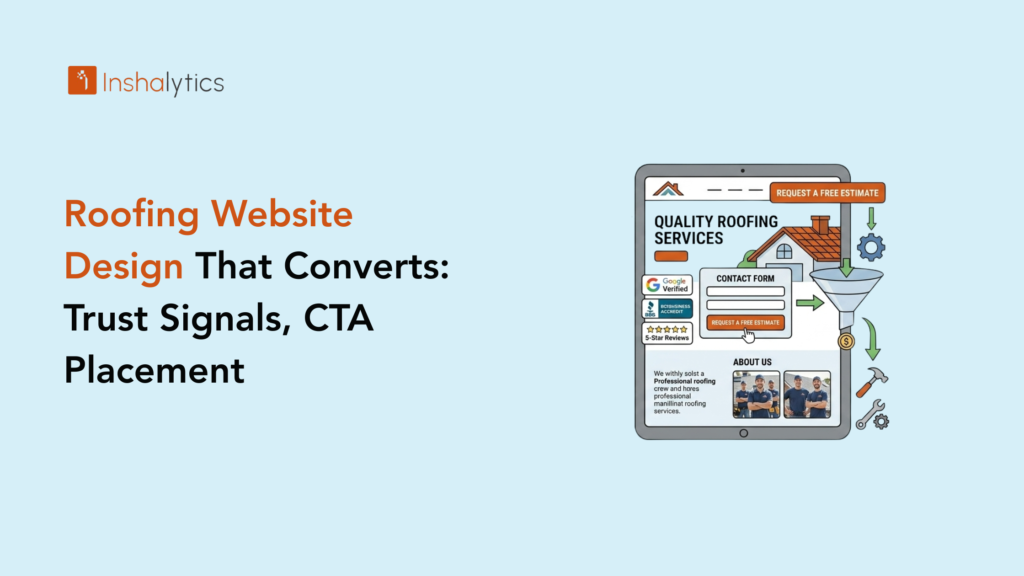
The most critical rule: trust signals must appear beside your calls to action, not on a separate page. Place your star rating and review count immediately below your primary CTA button. Place your license and insurance information below your estimate form. The moment a homeowner is about to commit is the moment they need reassurance.
CTA Placement: Turning Visitors Into Calls and Form Submissions
The CTA Hierarchy That Works for Roofers
Primary CTA: a phone number displayed in the header that’s fixed/sticky on scroll, so it’s always visible. On mobile, this should be a click-to-call button. Secondary CTA: an ‘Estimate Request’ or ‘Schedule Inspection’ button appearing in the hero section, after your services section, after your testimonials, and at the footer. Tertiary CTA: a chat widget or callback request form for after-hours visitors.
The language of your CTAs matters. ‘Get a Free Roof Inspection’ consistently outperforms ‘Contact Us.’ Verb-forward, benefit-specific language drives action.
Mobile-First: Where Most Roofing Searches Happen
Over 65% of roofing searches happen on smartphones, particularly during emergency situations. If your click-to-call button requires zooming in to tap, you’re losing those leads. Your site should load in under two seconds on a 4G connection. Our web development service builds roofing websites to these standards from the ground up.
The Content Structure That Converts Roofing Traffic
Hero Section: Trust First, Clarity Second
Your hero section (the first screen) should include: a clear, location-specific headline; a subheadline addressing the homeowner’s primary concern; a primary CTA button; a trust badge row (star rating, certifications, years in business); and a real photo of completed roofing work. No decorative slider, no autoplay video, no vague brand statement.
Social Proof: Testimonials and Project Galleries
A testimonials section with real homeowner names, project types, and authentic review text, ideally pulled live from Google, is significantly more convincing than curated quotes without attribution. For how reviews feed into both website performance and Google Maps rankings, see our Google Maps ranking guide for roofers.
How Inshalytics Builds Roofing Websites That Generate Leads
Most roofing websites are built by web designers who know design, not lead generation. The result looks professional, but doesn’t convert. Inshalytics builds roofing websites with conversion as the primary objective. See our web development service or contact us to discuss your current site.
Make Your Website Work Before You Pay for More Traffic
The fastest way to increase your leads without increasing your marketing spend is to improve your website conversion rate. If your site currently converts 2% of visitors and you improve it to 4%, you’ve doubled your leads from the same traffic. For the traffic side of this equation, see our lead generation for roofers guide.