You just signed with a marketing agency. The contract is done, the kickoff meeting is on the calendar, and you’re ready for results. Here’s what most agencies won’t tell you upfront: the first 90 days of a marketing partnership are mostly about building foundations, not celebrating wins. That’s not a red flag; it’s how effective marketing actually works. Understanding what to expect in the first 90 days of working with a marketing agency protects you from making reactive decisions that derail a strategy before it has time to compound.
Why the First 90 Days Feel Slower Than You Expect, and Why That’s Correct
The most common source of frustration in new agency relationships isn’t poor performance, it’s misaligned expectations. Clients expect immediate lead flow. Agencies know that the first month is almost entirely administrative. Neither party addresses this clearly enough before the work begins. The result is a client who’s second-guessing the decision at day 30 and an agency that’s trying to show progress before the foundation is even finished.
The Foundation Phase Is Not Wasted Time
Every hour spent in the first month on audit work, account setup, keyword research, and strategy development directly determines the quality of everything that follows. An agency that skips this phase and jumps straight to running ads is building campaigns on guesswork. The onboarding work, understanding your service area, your most profitable job types, your existing lead sources, and your competitive landscape, is what separates a campaign that generates quality leads from one that burns budget on the wrong audience.
The Most Common Mistake: Expecting Leads in Week Two
Paid campaigns can show early signals within the first two weeks, but ‘early signal’ means a handful of calls that help calibrate targeting, not a filled calendar. SEO produces no visible results in the first month at all, which is completely normal. If you go into the partnership expecting a return on investment by week three, you’ll make decisions based on noise instead of data. The businesses that get the most out of agency partnerships are the ones that judge month one on process quality, not lead volume.
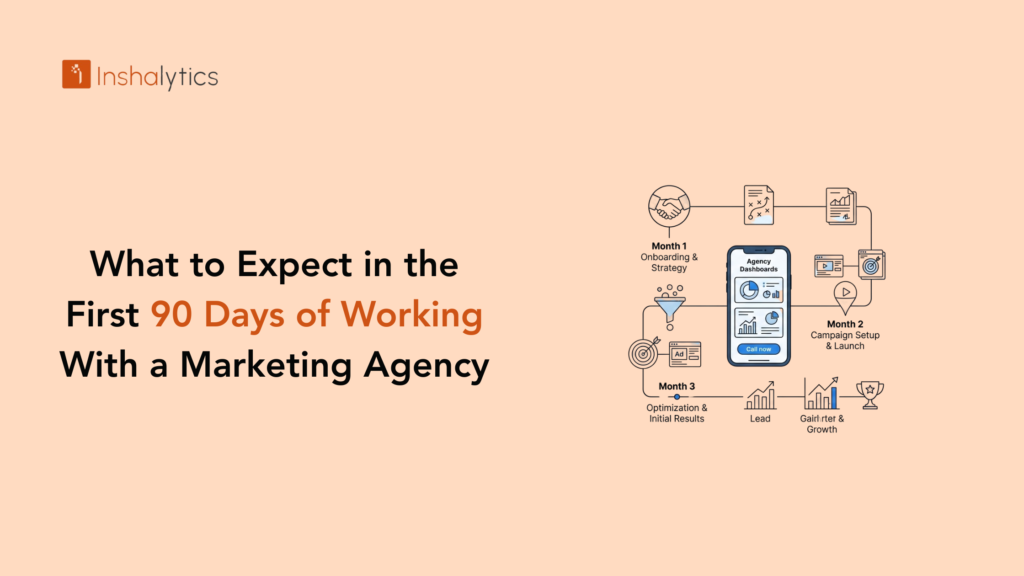
What Actually Happens in Days 1–30
The first month of a marketing partnership should feel like a deep discovery conversation combined with a lot of technical setup. If your agency’s first month looks like a flurry of ads launched without much conversation, that’s worth flagging.
Onboarding, Access, and Account Audits
Your agency needs access to your Google Ads account, Google Analytics, Google Business Profile, and website backend. This process takes longer than anyone expects because of two-step verifications, admin permissions, and ownership transfers. Plan for at least a week of back-and-forth just on access. Simultaneously, a good agency is auditing everything you already have, including existing campaign history, website conversion rates, GBP completeness, and current keyword rankings to understand where you’re starting from before deciding where to go.
Strategy Development and Baseline Benchmarking
Before any campaign goes live, your agency should deliver a clear written strategy: which channels they’re starting with and why, what keywords they’re targeting, what the campaign structure looks like, and what success metrics they’ll track. This document becomes your shared reference point for every future conversation about performance. If you don’t receive something like this in the first 30 days, ask for it. You should know exactly what the plan is before any budget starts being spent.
What You Should Be Doing as the Business Owner
The first month requires active participation from you. Your agency needs business context that they can’t get from a discovery call alone: your top-performing services by profit margin, your ideal customer profile, your service area boundaries, your seasonal demand patterns, and any past marketing efforts that did or didn’t work. The more clearly you communicate this upfront, the better the strategy they’ll build. Budget about two to four hours per week in the first month for calls, document reviews, and feedback.
What Happens in Days 31–60: Campaigns Go Live
Month two is when the work becomes visible. Campaigns launch, content gets published, and you start receiving data. This is also when the temptation to make reactive decisions is highest; resist it. Marketing campaigns need learning time before you can read the data meaningfully.
Paid Ads: When to Expect the First Signals
Google Ads and Local Services Ads typically generate their first calls within the first week of going live. Don’t read too much into early numbers, the campaign is still learning your audience. Google’s algorithm needs approximately two to four weeks of conversion data before Smart Bidding strategies start optimizing effectively. In this period, you might see a higher cost-per-lead than you will at month three or four. That’s expected. Our guide on pay-per-click advertising explains the learning phase in more detail.
SEO: What Early Traction Actually Looks Like
In month two, you should start seeing your Google Business Profile getting more views and engagement if your agency is actively optimizing it. Website changes are being made to service pages, location pages, and technical fixes. These changes will get crawled and indexed by Google, but ranking movement takes more time. Don’t expect to see keyword ranking shifts in month two. Our guide to local SEO optimization strategies shows what the foundation work covers.
How to Interpret Early Data Without Panicking
The most useful thing you can do in month two is establish a baseline. What is your current cost per lead? How many calls are you getting? What percentage of calls book appointments? With a clean baseline from weeks three and four of the campaign, you have a real comparison point for month three and beyond. If you don’t have call tracking set up by now, that’s the first thing to fix; without it, you’re flying blind on whether the campaigns are actually generating revenue.
What Happens in Days 61–90: Optimization and Early ROI
Month three is where the campaign starts showing its real character. The learning phase is complete, the data is meaningful, and your agency should be making evidence-based optimizations rather than structural changes. This is also when the first tangible ROI conversations become possible for paid channels.
Where Campaigns Get Refined Based on Real Data
By day 60, your paid campaigns have generated enough conversion data to identify patterns: which keywords drive booked jobs, which ad variations get clicked but don’t convert, and which geographic zones are producing the best leads. Your agency should be actively adjusting bids, pausing underperforming keywords, and testing new ad copy based on what they’re seeing. If you reach day 90 and your campaign looks exactly like it did on day 30, someone isn’t paying attention.
Leading Indicators vs. Lagging Indicators: What to Track
At 90 days, judge your paid channels on leading indicators: cost per lead, call volume, booked job rate, and early keyword ranking trends for SEO. Don’t expect to judge SEO performance on revenue, yet that’s a lagging indicator that takes longer to materialize. A useful question to ask your agency at the 90-day mark: ‘What’s changed since we launched, what’s the data showing, and what are the next 90 days focused on?’ If they have clear answers to all three, the partnership is on track.
The 90-Day Review: What a Good Agency Delivers
A strong agency delivers a formal 90-day review that covers channel performance, what worked and what didn’t, and a clear plan for months four through six. This isn’t a sales meeting to upsell you on more services; it’s a strategic accountability checkpoint. You should walk away knowing exactly what your cost per booked job is by channel, what your organic ranking trajectory looks like, and what the priority work is in the next phase.
How Results Differ by Channel for Home Service Businesses
Marketing timelines are not one-size-fits-all. Different channels produce results at fundamentally different speeds, and understanding that difference prevents you from cutting a channel before it has time to work.
Google Ads: Leads Can Start Week 1, But Profitability Takes 30–60 Days
Paid search delivers the fastest results of any digital channel. You can be generating calls within days of launch. But ‘calls’ and ‘profitable calls’ are different things. Campaign optimization, negative keywords, bid adjustments, ad copy testing, and landing page refinements take four to eight weeks to meaningfully improve cost-per-lead. The first month of paid ads is expensive learning. Months two and three are where the efficiency starts to show. Read more about how landing pages affect conversion rates for home service campaigns.
Local SEO: Map Pack Movement Starts Around Month 2–3
Google Business Profile optimization starts showing engagement improvements, such as more profile views, more website clicks, and more direct calls, within four to six weeks of consistent optimization. Map pack ranking movement for competitive terms typically takes two to four months. Organic website rankings for well-optimized service pages often begin appearing between months three and five. Our guide on the local pack and SEO explains the ranking mechanics behind map pack placement.
Social Ads: Brand Awareness First, Lead Volume Follows
For home service businesses, Facebook and Instagram ads require a longer run-up than Google campaigns because they’re interruption-based rather than intent-based. The first 30–60 days are primarily about building local brand familiarity and generating a retargeting pool. Actual lead volume from social typically picks up in month two or three, once the algorithm has found your best audience and the brand has enough impressions to be recognized.
What Inshalytics Does Differently in the First 90 Days
We’ve structured our entire onboarding around one goal: reaching your first owned-lead milestone as fast as possible. That means the work we do in the first 90 days isn’t just campaign setup, it’s building the organic infrastructure that makes every future marketing dollar more efficient. Before your engagement begins, review our guide on questions to ask before hiring an HVAC marketing agency to see the standards we hold ourselves to.
How We Set Expectations from Day One
Before any campaign launches, we deliver a written 90-day roadmap that covers which channels we’re prioritizing, what the realistic timeline looks like for each, and exactly how we’ll measure success. You’ll know what a win looks like at 30 days, at 60 days, and at 90 days before we run a single dollar of ad spend.
The Owned-Lead Milestone We Aim to Hit by Day 90
For most home service clients, our 90-day goal is your first consistent organic lead, a call that came from your Google Business Profile or an organic ranking, with no paid media attached. After that first organic lead, the trajectory becomes clear: every month, the owned portion of your lead flow grows. Read how our lead generation services are structured around this long-term owned-lead outcome. Not sure what your first 90 days should look like? Book a free strategy call with Inshalytics, and we’ll walk you through an honest timeline based on your market, your starting point, and your goals.