Most handyman business owners who’ve had a bad agency experience say the same thing: “I had no idea what was happening, and by the time I figured it out, I’d already wasted three months of budget.”
The frustration rarely comes from a lack of effort on either side. It comes from misaligned expectations: the business owner expected leads by week two, the agency was still building the foundation in week six, and nobody defined what success was supposed to look like before the engagement started.
The first 90 days with a handyman marketing agency are the most consequential period of the entire relationship. What gets built here or doesn’t determines whether month six looks like a filled calendar or another round of “let’s give it a little more time.”
This guide tells you exactly what should happen, when, and what to watch for if things are going wrong.
Why the First 90 Days Are Different for Handyman Businesses
A generic agency onboarding process is not a handyman onboarding process. The channels that matter, the timelines that apply, and the milestones that signal genuine progress are specific to your niche, and any agency worth hiring knows the difference.
Handyman Lead Cycles Are Faster Than Most Trades And That Changes the Timeline
Handyman customers make faster decisions than almost any other home service buyer. A homeowner who needs a door rehung or a ceiling fan installed is not researching for three weeks. They’re searching, calling whoever shows up first with good reviews, and booking within 24–48 hours.
This faster decision cycle means certain channels produce signals earlier for handyman businesses than they do for, say, a roofing company selling $12,000 replacements. LSA leads can start flowing within days of activation. GBP improvements can produce visible ranking movement in 30–45 days. You don’t need to wait six months before asking whether your paid channels are producing signal.
The flip side: because handyman jobs have smaller average tickets, volume matters more. An agency that generates two leads per week for an HVAC company might be ahead of pace. Two leads per week for a solo handyman is not a functioning business. Make sure your agency understands your volume requirements before they build your program.
What a Handyman-Specific Audit Covers That Generic Onboarding Misses
The first thing any competent handyman marketing agency does is audit your current state. Not a surface-level review, a genuine competitive and technical audit that tells you why your current rankings and lead flow look the way they do.
A handyman-specific audit covers:
- GBP completeness and category accuracy: whether your primary and secondary categories match how homeowners actually search for your services
- Review velocity and rating trend: whether you’re generating reviews fast enough to stay competitive in your market
- Citation consistency: whether your name, address, and phone number match across all directories, and how that inconsistency is suppressing your Map Pack ranking
- Competitor visibility: which businesses are ranking above you in your service area and what they’re doing differently
- Existing lead source tracking: whether you can currently tell which channel generated which booked job
If an agency skips this audit or completes it in under a week, they are building your strategy on guesswork. Demand to see the audit findings before any campaign goes live. For context on what good GBP optimization looks like, see how handyman businesses should approach their Google Business Profile.
Setting Realistic Expectations Before You Sign
The single most common cause of early agency relationship failure is not incompetence it’s unspoken expectations. Before you sign anything, get explicit answers to these questions:
- What does success look like at 30 days, at 60 days, and at 90 days in specific, measurable terms?
- Which channels will be live in month one vs. month two?
- What is the realistic timeline to see organic results vs. paid results?
- What do you need from me to keep the engagement on schedule?
Any agency that struggles to answer these clearly before the contract is signed is an agency that will struggle to deliver against them. The generic post on what to expect in the first 90 days with a marketing agency covers the universal principles; this guide focuses on the handyman-specific milestones that differentiate a performing program from a stalling one.
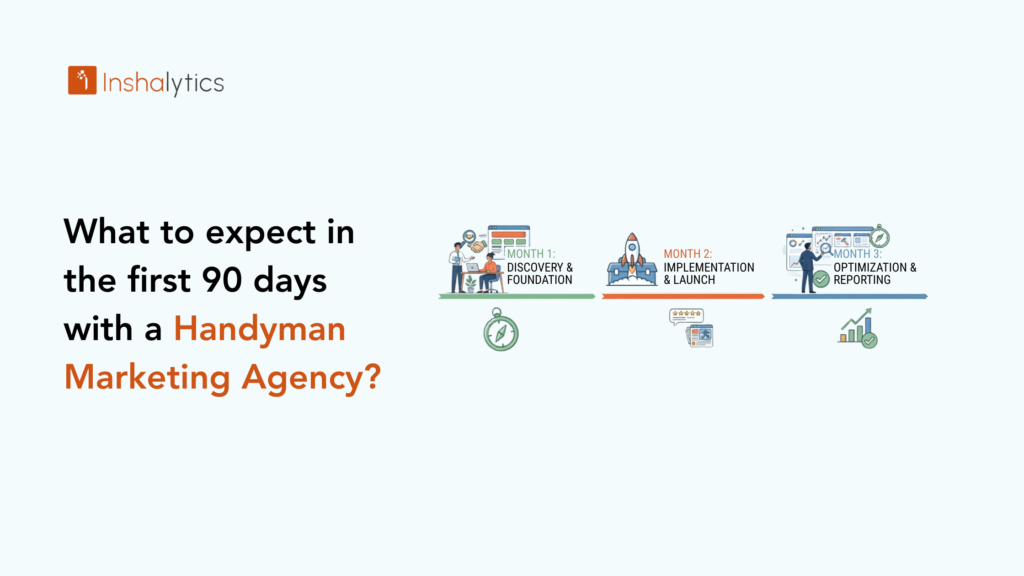
Days 1–30: Foundation Work That Determines Everything Else
Month one is diagnostic and structural. It is not campaign month. If an agency launches Google Ads in the first week without completing the audit, building the tracking infrastructure, and confirming the keyword and targeting strategy, they are burning your budget on guesswork.
GBP Audit and Optimization: Why This Comes Before Any Ads
Your Google Business Profile is the highest-return, lowest-cost marketing asset a handyman business has. A fully optimized, actively managed GBP generates inbound calls from Map Pack rankings at zero cost per click. It also directly supports your LSA ranking because LSA scores your profile as part of its ranking algorithm.
By the end of week two, your agency should have audited your GBP and identified every completeness gap. By the end of month one, the following should be in place:
- Primary category set to the correct handyman service type
- All services listed with keyword-relevant descriptions
- Business description updated with location, service types, and differentiators
- 20+ real job photos uploaded (your agency may need these from you)
- Q&A section seeded with common homeowner questions and answers
- Review response template in use for any unanswered existing reviews
This is not glamorous work. It is the foundation that paid channels run on top of. An agency that skips it and goes straight to running ads is building on an unstable base.
Competitor Mapping: Who’s Ranking in Your Service Area and Why
A handyman marketing audit is not just about what you’re doing it’s about what the people ranking above you are doing. By day 30, your agency should be able to show you the specific GBP profiles, review counts, category selections, and content strategies of your top three to five Map Pack competitors in your primary service city.
This competitor map tells you the gap you need to close to compete. If the top-ranking handyman in your market has 180 Google reviews and you have 22, you know one of the most important benchmarks you’re working toward. If a competitor is ranking for “handyman services ” because they have a well-optimized service page and you don’t, you know a content priority.
Understanding your market positioning against larger handyman companies is part of what this mapping should produce not just data, but a strategic picture of where you can win fastest.
What You Should See (and Not See) by the End of Month One
You should see:
- A completed audit with documented findings
- A 90-day strategy document that specifies which channels launch when, with KPI targets for each
- GBP fully optimized with all sections complete
- Call tracking in place for each channel before any paid campaign launches
- Either LSA verification initiated or your first Google Ads campaign structure reviewed and approved
You should not see:
- Active paid campaigns running without call tracking or conversion goals set up
- An agency that can’t explain what changed in your GBP and why
- Vague reporting that shows “we’re working on it” without specific deliverables tied to specific dates
If by day 30 you don’t have a documented strategy with specific 60- and 90-day milestones, ask for one explicitly. The pattern of why handyman marketing agencies fail almost always begins here a month one that drifts without accountability sets the tone for everything that follows.
Days 31–60: First Campaigns Live and Early Signal Data
Month two is execution month. Strategy moves into action. Paid campaigns go live. The first data starts coming in and interpreting that data correctly is critical, because early data is signal, not verdict.
When to Expect Your First Paid Leads From Google Ads or LSA
Google Local Services Ads can produce leads within 48–72 hours of going live, assuming the account was verified in month one. The first few calls you receive from LSA are signal they tell you whether your targeting is capturing the right service types, whether homeowners in your area are responding to your profile, and how your response time compares to what the platform expects.
Google Search Ads take longer to optimize. The algorithm needs conversion data to improve bid efficiency, and that data takes 2–4 weeks to accumulate. The first two weeks of a Google Ads campaign are not representative of its ultimate performance. An agency that evaluates campaigns in week two and starts making significant structural changes is reacting to noise rather than data.
Your job in this phase: answer every LSA call within two minutes and log every lead by source in your CRM. The call tracking your agency set up in month one is only useful if you’re feeding it data about which calls converted to booked jobs. Tracking your handyman lead sources at this stage is what makes month three decisions data-driven rather than guesswork.
What Early Data Tells You And What It Doesn’t
Early paid data tells you whether your targeting is finding the right homeowners. Are you getting calls about services you offer in locations you serve? Are those callers converting at a reasonable rate when you pick up? Are the clicks going to a page that makes it obvious what you do and how to reach you?
Early data does not tell you whether the channel will produce long-term ROI at the right cost per booked job. That requires the algorithm to optimize, which takes weeks, not days. An agency that calls a campaign a failure in week three or declares success based on two good weeks is not reading the data correctly.
What early data should produce is a list of refinements: negative keywords to add, ad copy variations to test, landing page changes to improve the conversion rate on incoming traffic. Ask your agency what the early data is telling them and what specific adjustments they’re making based on it.
The Feedback Loop Your Agency Needs From You in Month Two
Your agency cannot optimize what they don’t know. In month two, they need from you:
- Which leads became booked jobs (so they can close the attribution loop)
- Any service types generating leads you can’t realistically fulfill (so targeting can be refined)
- Any calls that felt like wrong-fit inquiries too far out of your service area, for services you don’t offer, from customers who seemed price-sensitive in ways that don’t fit your positioning
This feedback loop is a two-way obligation. Agencies that underperform in month three often do so because the client stopped engaging with the optimization process in month two. Your responsiveness to feedback requests directly affects what the algorithm learns about your ideal customer. For a broader view of how handyman marketing should be systematized beyond just the agency relationship, that context is worth understanding.
Days 61–90: Optimization, Organic Movement, and Your First Owned Lead
Month three is where a well-run program starts to differentiate itself from a mediocre one. Paid channels should be showing consistent lead flow with improving cost efficiency. Organic channels should be showing early movement. And the milestone that matters most your first owned lead from a channel that costs nothing per click should be on the horizon.
What GBP Ranking Improvement Looks Like at 90 Days
Google Business Profile rankings don’t move overnight, but 60–90 days of consistent optimization and review generation should produce measurable change. At the 90-day mark, you should be able to compare your Map Pack position in your primary service city against where you started.
Realistic movement: if you started outside the top five for your primary keyword, a well-managed program should show you moving into the top five for at least some service-specific searches by day 90. Crossing into the top three for high-competition terms in a major metro typically takes 4–6 months. Ranking in the top three in a smaller city or suburban market can happen faster.
The key metric here is not absolute position; it’s trajectory. A GBP moving from position 7 to position 4 is on a path that produces Map Pack appearance. A GBP that hasn’t moved from position 9 in 90 days signals either an audit that missed something or an optimization plan that isn’t being executed. The complete picture of ranking your handyman business on Google Maps helps frame realistic expectations for your specific market.
Why Your First Organic Lead Is the Real Milestone That Matters
At Inshalytics, we track one milestone above all others in the first 90 days for handyman clients: the first owned organic lead. This is the first call or form submission that came from your Google Business Profile or an organic search ranking, a lead that cost nothing per click, and that will keep producing calls even if paid campaigns pause.
That first organic lead is proof that the foundation is working. It’s not a coincidence; it’s the result of GBP optimization, review generation, and citation work all compounding together. The moment it happens, the math on your long-term marketing investment starts changing in your favor.
Paid leads validate that the targeting is right. The first organic lead validates that the asset you’re building is taking hold.
The Metrics That Predict Whether Month Four Will Be Profitable
At 90 days, a performing handyman program should show:
- Cost per booked job from paid channels that is within your acceptable range (typically under $150 for a solo handyman, under $200 for a multi-crew operation)
- GBP ranking trajectory moving toward the top three in at least one primary service keyword
- Review count increased by at least 8–12 new reviews from active generation
- At least one organic or GBP lead in the trailing 30 days
- Call tracking data that shows which channels are producing booked jobs, not just calls
If you have all five of these, month four is likely to be better than month three. If you have none of them, something in the program needs a serious reassessment before further investment.
Red Flags in the First 90 Days: What Should Concern You
Slow early results are normal. These specific patterns are not; they signal structural problems that will not self-correct.
No Baseline Audit or Documented Strategy by Day 30
If you reach day 30 without a completed audit and a documented 90-day strategy that specifies channels, targets, and timelines, the engagement is already behind. Discovery work should take two to three weeks, not the entire first month. An agency that is still “gathering information” at day 30 is either understaffed, disorganized, or treating your account as a lower priority.
Ask for the audit findings and strategy document explicitly. If they don’t exist, that conversation is a necessary reset of expectations before month two.
Reporting That Shows Traffic and Impressions But Not Booked Jobs
Impressions are not leads. Clicks are not leads. Sessions are not jobs. If your agency’s monthly report focuses on traffic metrics without connecting them to actual inquiries and booked appointments, you are receiving a report designed to make the agency look active rather than to inform your decisions.
Ask specifically: “How many leads did we generate last month, what did each lead cost, and how many of those leads became booked jobs?” If the agency cannot answer that question with data because the tracking infrastructure was never built, that is a month-one failure you are now seeing the consequence of.
Good handyman marketing performance tracking always closes the loop at the booked-job level, not the click level.
Agencies That Can’t Explain What Handyman Seasonality Means for Your Campaign
Handyman businesses have seasonal patterns that a generalist agency will either ignore or misinterpret. Exterior work peaks in spring and fall. Indoor work sustains through winter. Certain service types pressure washing, gutter cleaning, deck repair have very specific seasonal windows.
An agency managing your campaigns should be proactively adjusting targeting, ad copy, and service emphasis based on the calendar. If you’re running the same ads in October that you ran in July without any seasonal adjustment, the agency is running a set-and-forget program rather than an active management program.
Ask your agency in month two: “What seasonal adjustments are you making to our campaigns in the next 30 days, and why?” The quality of the answer tells you whether they understand your business or just your account structure.
How Inshalytics Structures the First 90 Days for Handyman Clients
At Inshalytics, the first 90 days are not a ramp-up period; they are a defined sequence of deliverables with specific milestones at 30, 60, and 90 days. We know what a performing handyman program looks like at each stage because we have built them across multiple markets and service types.
Our Day-One Audit Process and What It Reveals
Before any campaign goes live, we complete a full audit of your current online presence: GBP completeness and category accuracy, review velocity and rating trend, citation consistency across directories, competitor positioning in your primary service city, existing lead source tracking, and website conversion readiness.
The audit takes 7–10 business days. The findings drive the strategy; we don’t apply a template to your market; we build from what the audit reveals. If your GBP is 40% complete and your top competitor has 150 reviews, our 30-day priority list looks completely different than if you’re starting from a well-optimized profile with strong review velocity.
We deliver the audit findings as a documented report before we ask you to approve any spend. You know exactly where you stand before any money moves.
How We Define Success at 30, 60, and 90 Days for Handyman Businesses
Day 30: GBP fully optimized, call tracking live on all channels, LSA verification complete or campaign structure reviewed and approved, 90-day strategy document delivered with specific channel targets and KPIs.
Day 60: LSA or Google Ads producing consistent lead flow, early data reviewed with documented optimizations made, review generation system active with at least 4–6 new reviews generated, first GBP ranking movement visible.
Day 90: Cost per booked job from paid channels within target range, first organic or GBP lead confirmed, review count materially improved from baseline, 90-day performance report delivered against original KPI targets.
If we don’t hit these milestones, you should know why, and we should be able to tell you specifically what is being done to address it.
Ready to see what a structured, milestone-driven handyman marketing program looks like for your market? Talk to the Inshalytics team; we’ll walk you through exactly what your first 90 days would look like before you commit to anything.
The first 90 days with a handyman marketing agency are not about patience; they’re about accountability. Know what should be happening in each phase. Know what milestones signal that the program is on track. And know the red flags that indicate structural problems before you’ve invested six months into a program that wasn’t built correctly from the start.
A well-structured first 90 days is not a guarantee of long-term success. But a poorly structured first 90 days is almost always a predictor of a frustrating, underperforming relationship. The handyman businesses that get the best results from agency partnerships are the ones that engage with the onboarding process, ask the right questions, and hold their agency accountable for specific outcomes from day one.