Most handyman businesses have advertising but no funnel. They spend money on a Google ad or a listing on Angi and hope the phone rings. Sometimes it does. Often enough, it does not, and the reason is structural, not circumstantial.
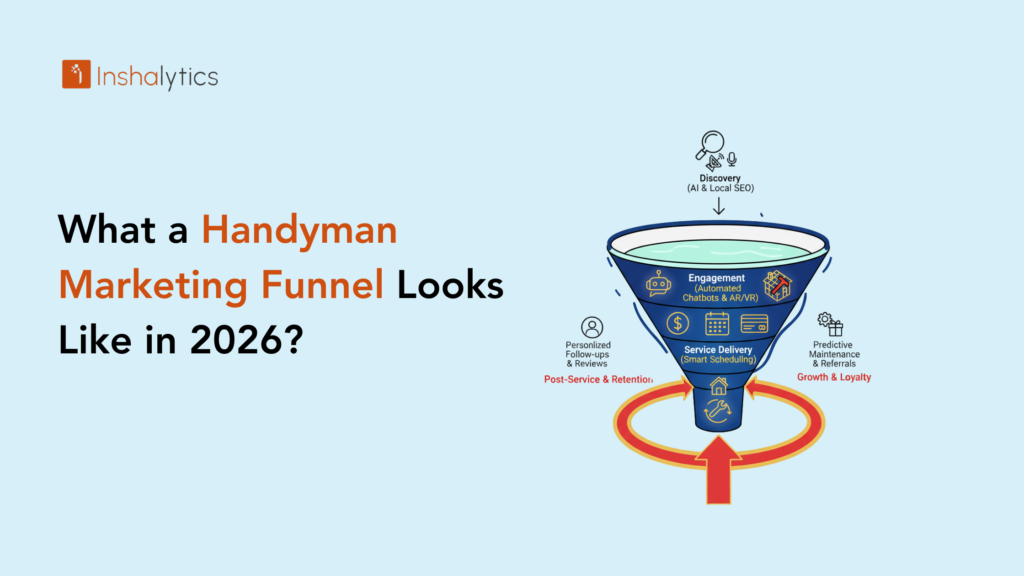
A marketing funnel is the deliberate path that takes a homeowner from never having heard of you to becoming a loyal, referring client. For handyman businesses in 2026, the funnel looks different from five years ago. AI search, updated Google Business Profile features, and changing homeowner behavior have all shifted how each stage works. This article maps the full funnel, stage by stage, and shows exactly what your business needs at each point to convert strangers into steady revenue.
Why Handyman Businesses Need a Funnel, Not Just Advertising
Advertising without a funnel is a transaction without a relationship. It produces calls sometimes, but it does not build the compounding, self-reinforcing lead flow that comes from owning the full homeowner journey.
The Difference Between Random Ads and a Structured Marketing System
Random advertising produces random results. A Google ad might generate three calls one week and none the next, with no clear understanding of why. A structured marketing funnel produces predictable results because every stage is intentionally designed to move a prospect toward booking, and every stage feeds the next.
The difference in business outcomes between these two approaches is significant. Businesses running a structured funnel know where their leads come from, what converts, and where prospects drop off. That knowledge allows continuous improvement. Random advertising does not.
How the Handyman Buyer Journey Differs From Most Other Service Businesses
The handyman buyer journey is typically fast and need-driven. A homeowner does not spend weeks researching handyman companies the way someone might research a kitchen renovation contractor. Something breaks, they search, they scan results, they call. The time from problem to decision is often measured in hours, not days.
This urgency shapes what your funnel needs to do at each stage. The top of the funnel is about being findable when the problem occurs. The middle of the funnel is about being the most credible option in that brief evaluation window. The bottom of the funnel is about making it easy to book and hard to say no.
What “Owning” Your Lead Flow Actually Means in Practice
Owning your lead flow means that your business generates inbound contacts through channels you control, your website, your Google Business Profile, and your reputation, rather than channels that belong to a third party. Platforms like Angi or Thumbtack can be part of a strategy, but when they are the primary source, your business depends on their algorithm, their pricing, and their decisions.
A business with owned lead flow generates calls from organic search, direct traffic, and referral sources that are not subject to external price increases or algorithm changes. Building toward that ownership is the strategic goal of a well-designed funnel.
The Top of the Funnel: Getting Found When Homeowners Have a Problem
The top of the funnel for a handyman business is simple: be visible when a homeowner has a problem and turns to Google for help.
Google Search and the Map Pack: Where Most Handyman Journeys Start
When a homeowner searches “handyman near me” or “drywall repair in [City],” they encounter two types of results: the Google Map Pack (the block of three local businesses at the top of the page) and organic search results below it. Being present in both significantly increases your visibility. Being present in only one reduces it. Being absent from both means you do not exist in the moment that matters.
The Map Pack is driven by your Google Business Profile, your reviews, your photos, your categories, and your activity. The organic results are driven by your website’s SEO, your content, your local signals, and your backlink profile. Both require deliberate work. Both produce results that compound over time.
AI Search and GBP in 2026: How Homeowners Are Now Finding Services
AI-powered search tools, including Google’s AI overviews, Siri, and third-party AI assistants, are increasingly being used to find local service providers. When a homeowner asks an AI tool for a handyman recommendation, the result is typically a single business, not a list. That recommendation is usually informed by Google Business Profile data, reviews, and local authority signals.
The businesses that appear in these AI-generated responses have almost always done the foundational local SEO work well, with a complete GBP, consistent reviews, and relevant content on their website. There is no separate AI optimization strategy. The same work that makes you rank in the Map Pack makes you recommendable by AI tools.
Social Media Awareness: When Facebook and Instagram Play a Role
Social media sits at the top of the funnel for a different segment of homeowners, those who are not yet searching but who might become aware of your business through their social feed. Facebook and Instagram ads can generate awareness and keep your brand visible to homeowners in your service area before they have a need.
This is a long-game strategy rather than an immediate lead source. Our social media marketing approach for handyman businesses is built around brand awareness at a low daily cost, designed to make your business the first name homeowners think of when a need arises.
The Middle of the Funnel: Converting Interest Into a Phone Call or Booking
The middle of the funnel is where most handyman businesses lose. A homeowner finds your business, visits your profile or website, and then goes to call a competitor. The middle of the funnel is about making sure that does not happen.
Your Website as the Conversion Engine: What Makes Homeowners Call?
A handyman website that converts has several non-negotiable elements: a phone number visible above the fold, a clear description of services and service area, before-and-after photos of real work, customer reviews or testimonials, and a fast load time on mobile.
What kills conversion: a slow-loading site, a buried contact form, stock photos that look generic, no service area information, and no clear indication of what the business specializes in. Our web development services build handyman websites designed specifically to convert local traffic into phone calls.
Reviews, Photos, and Social Proof at the Decision Stage
At the moment, a homeowner is deciding whether to call you or a competitor, and social proof does the heavy lifting. Your star rating, your number of reviews, and the content of those reviews are often the deciding factor. A business with 65 reviews at 4.9 stars beats a business with 8 reviews at 4.2 stars in that moment almost universally.
Photos of real work reinforce the credibility signal. A Google Business Profile with 40 high-quality photos of completed projects tells a story of experience and quality that a profile with three stock images simply cannot.
Response Time as a Funnel Variable: Why Speed Determines Win Rate
Research from MIT and Harvard Business Review consistently shows that businesses that respond to a service inquiry within five minutes are 100 times more likely to make contact than those who wait 30 minutes, and that 78% of customers buy from the first business to respond. A homeowner who has submitted a request and waits an hour will often have already booked someone else by the time you call back.
Speed is a funnel variable that most handyman businesses underestimate. Responding to leads within five minutes, even with a brief text message confirming you received their inquiry, dramatically improves conversion rates compared to callbacks that happen hours later.
The Bottom of the Funnel: Turning One Job Into Repeat Business and Referrals
The bottom of the funnel is where most handyman businesses leave the most money on the table. One job, one transaction, done, when that same client represents the potential for years of repeat business and multiple referrals.
The Post-Job Follow-Up That Most Handymen Skip (And Why It Matters)
A simple follow-up message 24 to 48 hours after a job is complete, “Just wanted to check in and make sure everything looks good. Let me know if you have any questions,” costs nothing and produces outsized results. It signals professionalism, it gives the client an opening to raise any concerns before they become a negative review, and it keeps your name fresh in their mind at the moment their satisfaction is highest.
Most handymen skip this step entirely. The ones who do it consistently report both higher review rates and higher repeat booking rates.
How Review Requests and Referral Programs Become Top-of-Funnel Fuel?
Reviews generated at the bottom of the funnel feed directly back to the top. A client who leaves a Google review improves your local ranking, which puts your business in front of more homeowners searching for “handyman near me.” The bottom of the funnel, executed well, continuously re-energizes the top.
Similarly, a simple referral, such as “If you have friends or neighbors who need handyman work, I’d really appreciate the recommendation,” turns satisfied clients into active top-of-funnel contributors. Clients referred by someone they trust convert at dramatically higher rates than cold leads from any other source.
The Retention Loop: Building a Client Base That Books You Again and Again
The most profitable handyman businesses build their revenue on retention and referral, not constant new client acquisition. A client who books once and never hears from you again is a one-time transaction. A client who receives a seasonal maintenance reminder, books annually, and refers two neighbors per year is worth many multiples of that.
Email marketing and SMS campaigns to past clients: “Time to check your smoke detectors before winter,” “Seasonal maintenance special this month,” keep your business top of mind without requiring a full marketing budget.
How Inshalytics Designs and Manages Full Handyman Marketing Funnels
Building a full funnel from top to bottom is not something most handyman owners have the time or expertise to do themselves. That is what we do at Inshalytics.
Our Awareness-to-Retention Framework for Home Service Businesses
Our framework covers every stage: local SEO and GBP optimization at the top, conversion-focused website and social proof management in the middle, and reputation building and client retention strategies at the bottom. Every component is designed to work together and feed the next stage of the funnel.
What a Well-Built Funnel Produces at 6 Months vs. 12 Months?
At six months: improved local search ranking, a growing review profile, consistent inbound calls from organic search, and a small but growing base of repeat clients. At twelve months: Map Pack presence for primary local keywords, a referral loop that generates a measurable percentage of new work, and a cost-per-lead that has decreased as the organic system matures.
The timeline is predictable for businesses that do the foundational work correctly. The compounding effect of a well-run funnel is one of the most reliable growth patterns in local service marketing.
How to Get Started Building Your Funnel With Our Team?
Every engagement starts with an audit of your current position across all funnel stages where you are visible, where you are losing prospects, and what the fastest path to improved lead flow looks like for your specific market. Most handyman businesses have advertising but no funnel. Let us show you what a system that converts strangers into loyal clients actually looks like. Contact our team to start with a free funnel assessment.