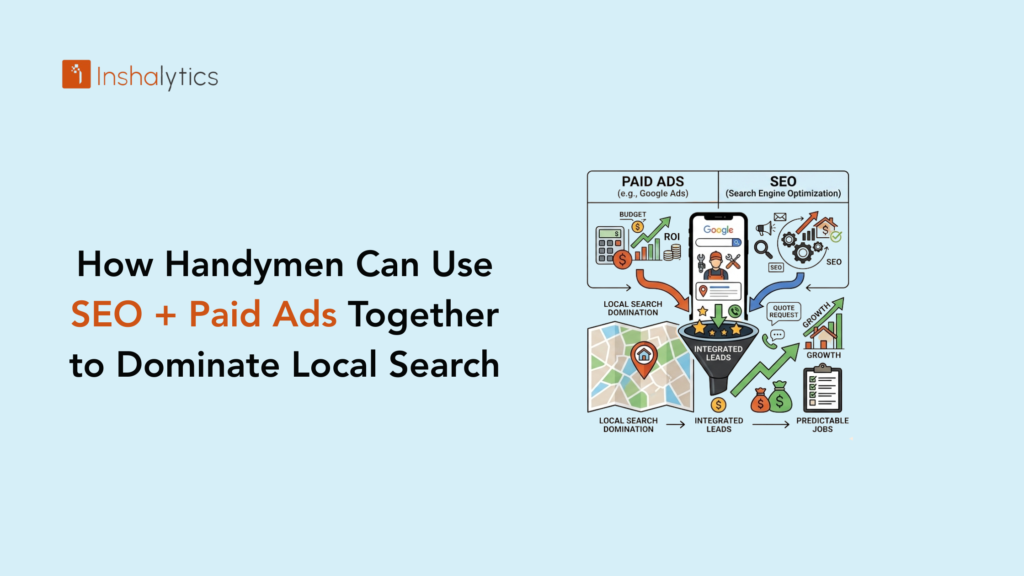
Most handymen pick a lane; either they run Google Ads and stop there, or they dabble in SEO and wonder why the phone isn’t ringing yet. The businesses that consistently dominate local search aren’t choosing between the two. They’re using handyman SEO and paid ads together as a single, compounding system. This guide breaks down exactly how that works, why each channel is stronger when paired with the other, and what the timeline looks like when you build it the right way.
Why Choosing Between SEO and Paid Ads Is the Wrong Question
The debate about SEO versus paid advertising is everywhere online. It’s also mostly a waste of your time. The real question isn’t which one is better; it’s how they each solve a different problem, and what happens when you run them together.
Paid ads capture demand right now. Someone searches ‘handyman near me’ at 7 PM on a Thursday, your ad appears, and they call. No waiting. But the moment you stop paying, you disappear. SEO, on the other hand, builds an asset. A well-ranked Google Business Profile or website page keeps generating leads without a cost-per-click attached to every call. The catch: it takes time to build.
Running both gives you full-stack coverage. You’re capturing today’s demand through ads while building tomorrow’s organic lead flow through SEO. That’s not redundancy, that’s a lead system.
The Real Cost of Running Only Ads (And Why It Keeps Compounding)
If paid advertising is your only source of leads, you’re renting visibility indefinitely. Your cost per lead doesn’t decrease over time because you’re not building any underlying authority. Every job you book costs essentially the same as the first one, and your business is entirely dependent on a budget you can never reduce. For a solo handyman or small crew, that’s an increasingly expensive treadmill with no exit ramp.
There’s also a trust gap. A homeowner who’s never seen your name before might click your ad, but they’ll almost always check your reviews, your Google Business Profile, and your website before calling. If those assets are thin or nonexistent, you’re paying for clicks that never convert. See why most handyman websites don’t convert to understand what they check before calling.
Why SEO Alone Leaves Money on the Table During Slow Seasons
Local SEO for handymen is genuinely powerful, but it doesn’t switch on immediately. Building organic rankings takes three to six months of consistent effort. In that window, you have no paid backstop. If you launch SEO-only and need jobs next month, you’re stuck waiting.
SEO also has blind spots. It performs best for planned, research-driven searches. For urgent, emergency-style searches, paid ads have an inherent timing advantage. A homeowner with a broken door doesn’t have time to scroll past three organic results. Read our full breakdown of SEO vs Google Ads for handyman businesses to see exactly where each channel wins.
What Dominating Local Search Actually Looks Like
Dominating your local search area means your business shows up in multiple places on the same results page: the paid ad at the top, the Local Pack map listing, and ideally an organic result below. When a homeowner sees your name three times before clicking anything, you’ve already won the trust game before they pick up the phone.
That triple presence takes time to build, but it’s achievable for most handyman businesses in mid-size markets. It’s also exactly what large platforms like HomeAdvisor and Angi can never give you because their listings replace your brand, not build it. Learn more about why lead marketplaces hurt handyman profit margins.
How SEO and Google Ads Create a Feedback Loop for Handyman Businesses
The real power of running SEO and paid ads together isn’t just additive, it’s synergistic. The data from each channel actively makes the other one better.
Using Ad Data to Find Your Best-Converting SEO Keywords
When you run Google Ads, you generate real data about which keywords and search terms are driving actual calls and bookings, not just clicks. That’s information SEO alone can’t give you without months of waiting. If your ads reveal that ‘handyman tile repair ‘ drives three times the booked jobs compared to ‘handyman near me,’ that’s exactly where you should be building organic content and optimizing your service pages. Paid ads become your keyword research engine for SEO. Our guide to Google Ads for handyman services covers the exact campaign structure to start with.
How Organic Rankings Lower Your Cost Per Click Over Time
As your website gains authority and your Google Business Profile accumulates reviews and engagement, something interesting happens to your paid campaigns: they get more efficient. Google’s Quality Score system rewards advertisers whose landing pages and business profiles signal trust and relevance. A handyman business with 50 reviews, a fast-loading website, and service-specific pages will often pay less per click than a competitor with a thin online presence bidding on the same terms.
Your SEO investment directly subsidizes your ad costs over time. The two channels aren’t competing for the same budget; they’re reinforcing each other.
Owning the Map Pack, the Ad Slot, and the Organic Result Simultaneously
The handyman businesses that build both channels eventually achieve SERP dominance; their name appears in the paid position, in the map pack, and in organic results for the same search. Getting there requires sustained effort, but it creates a competitive moat. See how Google Maps ranking works for handyman businesses in competitive cities, specifically.
What Does an SEO + Paid Ads Strategy Actually Look Like for a Handyman?
The sequence in which you build these channels matters as much as running them together. The right approach starts with paid ads to generate immediate revenue, then uses that revenue and data to fund a disciplined SEO build.
Month 1–3: Lead With Ads While SEO Builds
In the first quarter, your paid campaigns should be doing the heavy lifting. Set up a tightly targeted Google Ads campaign focused on your highest-value service terms in your specific service area. At the same time, start building your SEO foundation: claim and fully optimize your Google Business Profile, get your first batch of reviews, and ensure your website has dedicated service pages for your core offerings. Our guide on local SEO for handyman businesses walks through exactly what that foundation looks like.
Don’t expect SEO to produce calls in this phase. It won’t. Your job is to plant the seeds while ads keep the calendar full. Expect to spend $800–$1,500/month on ads during this phase, depending on your market competitiveness.
Month 4–6: Your Organic Traffic Cuts Your Ad Dependency
By month four, if your GBP optimization and review strategy has been consistent, you should start seeing your business appear in the map pack for at least some of your target keywords. As organic traffic grows, you can begin reducing bids on the keywords where you’re already ranking organically. See how reviews impact handyman lead generation to understand why building your rating concurrently is essential.
Month 7+: The Compounding Effect of Owned Leads
After six to twelve months of consistent SEO work, a well-executed strategy produces leads that cost you nothing per acquisition beyond the initial investment in rankings. Many handyman businesses at this stage run a smaller paid campaign specifically for high-urgency searches and rely on organic for their baseline call volume. That’s the owned-lead model: leads you’ve earned, not rented. Read how to get handyman leads without Angi or Thumbtack for the full picture.
Which Keywords Deserve Ads vs. SEO and How to Decide
Not every keyword benefits equally from paid ads or SEO. The right allocation depends on urgency, competition, and search volume in your specific market.
High-Intent Emergency Terms: Where Ads Win
Terms like ‘handyman near me,’ ’emergency handyman,’ and ‘same-day handyman ‘ have immediate urgency attached to them. The searcher needs help now, not after comparing three organic results. These are your paid ad keywords. Bid on them, maintain a fast-loading landing page or click-to-call setup, and make sure your response time is under five minutes. The first handyman who answers wins the job.
Informational and Seasonal Terms: Where SEO Wins
Terms like ‘how to hang shelves,’ ‘deck repair cost ,’ or ‘best handyman services for landlords in ‘ represent searches that happen before the urgent need kicks in. These are research queries perfect for blog content and service pages that rank organically and introduce your brand to homeowners before they have a problem. Our guide on how to build city-specific pages that generate handyman leads shows how to turn those pages into calls.
Budget Split Benchmarks for Solo Operators vs. Multi-Crew Companies
For a solo operator just starting, allocate roughly 70–80% of your marketing budget to paid ads and 20–30% to SEO and GBP work. As your organic rankings strengthen over six to twelve months, shift that ratio toward 50/50 or even 40% paid and 60% organic. Multi-crew companies with more revenue to invest can afford to build both channels simultaneously from the start and often see faster results because they can sustain higher ad spend while SEO compounds.
How Inshalytics Builds This System for Handyman Businesses
At Inshalytics, the handyman lead systems we build are specifically designed to move clients off platform dependency away from Angi, Thumbtack, and HomeAdvisor and onto owned channels where every lead belongs to their business.
The Owned-Lead Model: Why We Don’t Rely on Angi or Thumbtack
Lead platforms make money by selling the same homeowner’s contact information to four or five contractors simultaneously. You’re not building a brand, you’re competing in a race to the phone. Our approach builds your Google presence, your review profile, and your website authority as durable assets. When you stop paying an ad platform, you retain everything you’ve built. Read our full guide on digital marketing strategies for handyman businesses to see how the full system works.
What a Full-Stack Local Search System Looks Like in Practice
For handyman clients, we build a Google Ads campaign targeting the highest-urgency local terms, a fully optimized GBP designed for map pack visibility, and a conversion-focused website with service and location pages built for organic rankings. We run call tracking across every channel so you know exactly which campaigns are generating booked jobs, not just clicks. Learn more about how we systemize handyman marketing into a predictable lead engine.
Ready to stop renting leads and start owning your local search? Book a free strategy call with Inshalytics, and we’ll map out exactly what a full-stack handyman marketing system looks like for your market.