The electrical contracting market in 2026 is as competitive as it’s ever been. EV adoption is driving panel upgrade demand. Aging housing stock needs rewiring. And every electrician in your service area is competing for the same homeowners searching ‘electrician near me’ at the moment a breaker fails. Lead generation for electricians works best when it’s built as a system where each channel does the job it’s suited for, and all of them compound over time. This guide walks you through every channel that generates real electrical contractor leads, how they fit together, and how to sequence them for the fastest path to a full schedule.
Why Single-Channel Electricians Lose Jobs Every Day
Electrical contractors who rely on one lead source are structurally vulnerable. Not because their source isn’t working, but because any single channel has blind spots that competitors who run multiple channels are actively exploiting.
The Hidden Cost of HomeAdvisor and Shared Lead Platforms
Shared lead platforms like HomeAdvisor and Angi send the same homeowner’s contact information to four or five contractors simultaneously. You’re not winning a job, you’re entering a race. The homeowner calls whoever calls back first, which means your close rate on these leads is a fraction of what it would be on a lead that came directly to you. And every dollar you spend on shared platforms is a dollar you’re not investing in your Google Business Profile, your website, or your review profile assets that build a durable lead flow you own. Read exactly how this damages your business economics in our guide on why lead marketplaces hurt profit margins.
What a Predictable, Multi-Channel Lead System Looks Like
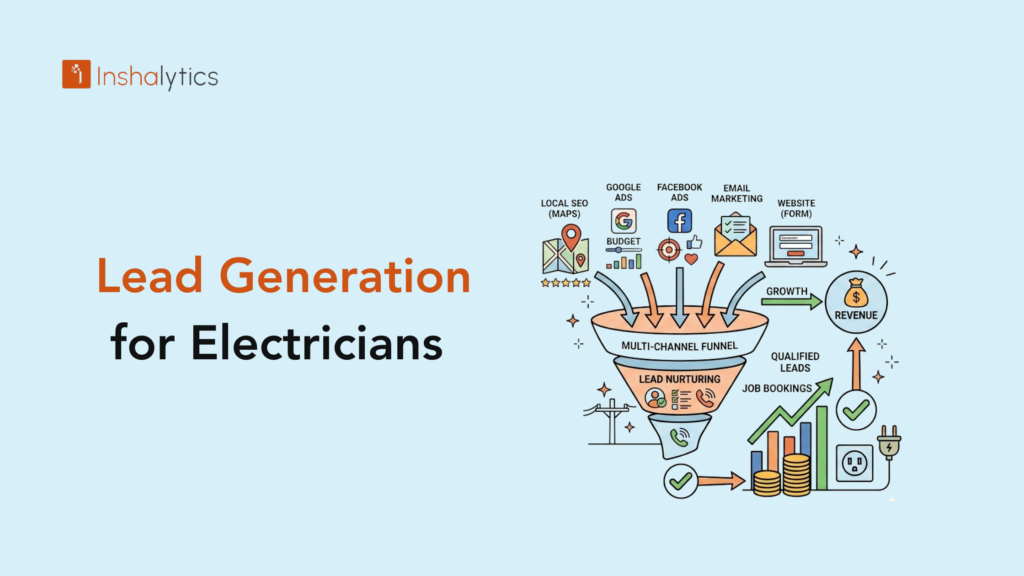
A multi-channel lead system for electricians runs three to four channels simultaneously, each targeting a different stage of homeowner intent. Google Local Services Ads and Search Ads capture explicit search demand. Local SEO builds the organic authority that generates calls at no marginal cost over time. Facebook Ads create awareness and demand for high-value planned services like EV charger installations and panel upgrades. Our lead generation services page covers how this system is structured for home service businesses.
Google Local Services Ads for Electricians: Your First Priority
For electricians starting a paid advertising strategy from scratch, Google Local Services Ads are the best first channel. They capture the highest-intent homeowner searches, require no keyword research or landing page strategy, and produce results faster than most other options.
Why the Google Guaranteed Badge Converts Electrical Leads Faster
Electrical work carries a safety dimension that most home services don’t. A homeowner isn’t just evaluating price and responsiveness; they’re evaluating whether they trust you to do work that could burn their house down. The Google Guaranteed badge signals that Google has vetted your business through a screening process that includes background checks, license verification, and insurance confirmation. For a category as trust-sensitive as electrical contracting, that badge is a powerful conversion accelerant. It removes a significant layer of hesitation from homeowners who would otherwise click your listing and close the tab without calling. Read our guide on pay-per-click advertising for the full mechanics of how LSA verification and bidding work.
How to Get Approved and Rank Higher in LSA Results
LSA approval for electricians requires completing Google’s verification process: submitting your electrical contractor license documentation, proof of general liability insurance, and passing a background check. The process typically takes two to four weeks. Once approved, your ranking within the LSA results is influenced by your review count and rating, your responsiveness to leads (missed calls hurt your ranking), and your bid setting relative to competitors. Aim for a response time under five minutes for LSA calls. Google tracks this, and it directly affects your placement.
Cost Per Lead Benchmarks for Electricians in 2026
Based on current market data, LSA cost per lead for electrical contractors ranges from $20–$60 in most markets, with competitive metro areas trending toward the higher end. That cost reflects the pay-per-lead model: you’re not paying for impressions or clicks, only for actual customer contacts. When compared to the average job value for an electrician $200–$400 for service calls, $3,000–$8,000 for panel upgrades, $800–$2,500 for EV charger installations, even the high end of that range typically produces positive ROI within the first few calls. Our full breakdown of electrician marketing costs is covered on our digital marketing services page.
Local SEO for Electricians: Building Long-Term Organic Lead Flow
Paid ads generate leads while you’re paying. Local SEO generates leads while you’re sleeping. The economics are fundamentally different: a well-ranked Google Business Profile and a set of optimized service pages require an upfront investment but produce calls at no marginal cost for years afterward.
Google Business Profile Optimization for Electrical Contractors
Your GBP is the central signal Google uses to place you in the map pack, the three-listing block at the top of local search results that earns the majority of clicks for electrical service queries. Complete every field with precision: your primary category should be ‘Electrician,’ with secondary categories for relevant specialties (‘Electrical Installation Service,’ ‘EV Charging Station Contractor,’ ‘Lighting Contractor’). Your service list should include every specific service type: panel upgrades, outlet installation, EV charger installation, circuit breaker repair, home rewiring, each with its own description. Our guide to NAP consistency in local SEO explains how to ensure your GBP business information is consistent across every platform Google checks.
Service Pages That Target High-Value Jobs (Panel Upgrades, EV Chargers)
The most profitable electrical jobs are also the most searchable: panel upgrades, EV charger installations, whole-home rewiring, and generator installation all generate specific searches from homeowners who need them. Each of these deserves a dedicated service page on your website, not a bullet point on a generic ‘Electrical Services’ page, but a full page with service-specific content, local relevance signals, cost information, FAQs, and a clear call-to-action. Our guide on on-page SEO optimization covers the full structure for building these service pages correctly.
Review Systems That Keep You Visible in the Local Pack
Google’s local ranking algorithm favors recent review activity. An electrician with 20 new reviews in the last 90 days will often outrank a competitor with 100 older reviews. After every completed job, send a follow-up text or email with a direct Google review link. Keep the request simple: ‘Thanks for choosing us. A quick Google review makes a big difference for our business.’ With three to five jobs per day, a disciplined review request process generates 15–25 new reviews per month, enough to build and maintain strong map pack rankings in most markets. Our guide on the local pack and SEO explains exactly how review signals influence map pack placement.
Google Ads for Electricians: Capturing Demand That LSAs Miss
LSAs handle urgent, high-intent emergency searches effectively. But there’s a category of electrical demand that LSAs don’t serve well: searches where the homeowner has a specific problem in mind, needs targeted information before calling, or is comparing service options. That’s where Google Search Ads pick up.
Problem-Aware Keywords That Convert Better Than Generic Terms
The most efficient Google Ads keywords for electricians aren’t broad terms like ‘electrician near me’; they’re problem-aware phrases that signal specific intent: ‘breaker keeps tripping,’ ‘lights flickering in house,’ ‘burning smell from outlet,’ ‘upgrade electrical panel for EV charger.’ A homeowner searching for those terms has a specific problem, not a vague need. Your ad can directly address that problem in the headline, and a landing page built around that specific issue converts at significantly higher rates than sending all traffic to a homepage. Our keyword research guide shows how to identify and prioritize these problem-aware terms for your local market.
Negative Keywords: Cutting Waste Before Your First Dollar Spends
Before your first Google Ads campaign goes live, build a comprehensive negative keyword list. Exclude all occupational terms (‘electrician salary,’ ‘electrician apprenticeship,’ ‘electrician certification’), DIY terms (‘how to wire a switch,’ ‘DIY electrical,’ ‘electrical code for homeowners’), supply terms (‘electrical supplies near me,’ ‘wire at Home Depot’), and geographic terms outside your service area. Without these exclusions, your ads will burn significant budget on searches from people who will never call you.
Landing Pages That Turn Clicks Into Calls
Sending Google Ads traffic to your homepage is one of the most common and expensive mistakes in electrical contractor marketing. Your homepage is designed to introduce your business broadly. A paid ad for ‘panel upgrade near me’ should land on a page about panel upgrades specifically with service details, cost range, your credentials for this service, testimonials from panel upgrade customers, and a prominent click-to-call button above the fold. Read our guide to landing pages to understand how to structure each service page for maximum paid traffic conversion.
Facebook and Social Ads for Electricians: Where They Fit
Social advertising for electricians is not about capturing emergency calls; it’s about generating demand for high-value planned services before the homeowner starts searching. Used in the right context, Facebook and Instagram ads produce profitable leads for the services that drive your highest-margin jobs.
EV Charger Awareness Campaigns: A Facebook Use Case That Works
EV adoption is growing rapidly, and every new EV buyer needs a Level 2 home charger installation. This is a predictable, addressable market that Facebook is uniquely positioned to capture. Target new EV buyers, homeowners in income brackets that skew toward EV ownership, and residents within your service area. An ad offering a ‘free EV charger installation quote for new EV owners’ reaches a motivated, underserved audience before they’ve started searching Google. The same approach to awareness-based social campaigns is covered in our guide on social media marketing.
Retargeting Homeowners Who Visited Your Service Pages
Retargeting is the highest-ROI use of Facebook advertising for most electrical contractors. A homeowner who visited your panel upgrade page three days ago showed clear intent; they just didn’t call. Showing that person a retargeting ad featuring a testimonial from a recent panel upgrade customer, a limited-time quote offer, or a reassurance about your credentials keeps your brand visible while they continue their decision process. Retargeting audiences convert at three to five times the rate of cold audiences. Our guide to landing pages covers how to structure your service pages to build these audiences effectively.
What Budget to Allocate to Social vs. Search
For electricians in their first year of multi-channel marketing, allocate 70–75% of paid budget to Google (LSAs and Search Ads combined) and 25–30% to Facebook. The Google allocation captures existing demand from homeowners who are already searching for an electrician. The Facebook allocation builds awareness and a retargeting pool for planned high-value services. As your Google campaigns mature and organic SEO generates an increasing share of call volume, you can gradually shift budget toward Facebook to extend your reach into audiences that haven’t yet searched for you.
How the Channels Work Together to Create Owned Lead Flow
The compound value of running multiple channels isn’t just that they generate more leads; it’s that they make each other more effective over time.
The 12-Month Sequencing Plan for Electricians
Months one through three: LSA setup and approval, Google Search Ads launch, GBP optimization, initial service page build-out, and review collection system activated. Months four through six: First map pack rankings appear for target keywords, Google Ads campaign optimization produces improved cost-per-lead, and first organic calls begin arriving. Facebook retargeting campaign launches as website traffic builds. Months seven through twelve: SEO generates meaningful organic call volume, paid ads shift to higher-competition terms, and Facebook campaigns refine high-value service audiences. Our local SEO optimization strategies guide covers the detailed month-by-month organic build.
When to Add Channels and When to Optimize the Ones You Have
The most common mistake in multi-channel marketing is adding new channels before existing ones are optimized. Adding Facebook ads while your Google campaigns are still losing money to poor keyword targeting doesn’t add revenue; it adds complexity and cost. The right sequence: optimize each channel to a positive ROI before adding the next. Start with LSAs. When they’re producing consistent, measurable returns, add Search Ads. When Search Ads are optimized, add SEO and Facebook together. See how the full sequencing works in the context of a home service business on our lead generation services page.
How Inshalytics Builds Full-Stack Lead Systems for Electricians
Our electrician marketing systems are built around the same principle we apply to every home service vertical: owned leads compound, rented leads don’t. Our goal is to transition every client from a pay-per-lead platform dependency to a system where Google rankings, reviews, and direct brand recognition generate calls at decreasing cost per acquisition. Explore our digital marketing services to see the full scope of what a full-stack electrician engagement covers.
Our Owned-Lead Model for Electrical Contractors
We build every campaign inside the accounts the client owns. We configure full-funnel call tracking so every lead is attributed to a specific channel and campaign. We build service pages targeting high-value job types, panel upgrades, EV charger installations, and home rewiring rather than generic ‘electrician’ traffic. And we establish a review system that generates 15–25 new Google reviews per month as a standard operational output. Our search engine optimization services cover the full organic infrastructure we build alongside paid campaigns.
What Our Electrician Marketing Campaigns Include
A full-stack electrician marketing engagement with Inshalytics covers LSA setup and management, Google Search Ads with call tracking, local SEO with GBP optimization and review systems, service and city page development, and Facebook ads for high-value demand generation when the timing is right. Every component is reported against a single metric that matters: cost per booked job. Learn more about how we structure attribution in our lead generation services overview. Stop buying leads you don’t own. Book a free strategy session with Inshalytics, and let’s build the electrician marketing system that fills your schedule with high-value jobs, panel upgrades, EV chargers, and emergency calls that come directly to you.